CHAPTER LXXV.
IN BRUTON STREET.
Mr. Squercum all this time was in a perfect fever of hard work and
anxiety. It may be said of him that he had been quite sharp enough
to perceive the whole truth. He did really know it all,--if he could
prove that which he knew. He had extended his enquiries in the city
till he had convinced himself that, whatever wealth Melmotte might
have had twelve months ago, there was not enough of it left at
present to cover the liabilities. Squercum was quite sure that
Melmotte was not a falling, but a fallen star,--perhaps not giving
sufficient credence to the recuperative powers of modern commerce.
Squercum told a certain stockbroker in the City, who was his
specially confidential friend, that Melmotte was a "gone coon." The
stockbroker made also some few enquiries, and on that evening agreed
with Squercum that Melmotte was a "gone coon." If such were the
case it would positively be the making of Squercum if it could be
so managed that he should appear as the destroying angel of this
offensive dragon. So Squercum raged among the Bideawhiles, who were
unable altogether to shut their doors against him. They could not
dare to bid defiance to Squercum,--feeling that they had themselves
blundered, and feeling also that they must be careful not to seem to
screen a fault by a falsehood. "I suppose you give it up about the
letter having been signed by my client," said Squercum to the elder
of the two younger Bideawhiles.
"I give up nothing and I assert nothing," said the superior attorney.
"Whether the letter be genuine or not we had no reason to believe it
to be otherwise. The young gentleman's signature is never very plain,
and this one is about as like any other as that other would be like
the last."
"Would you let me look at it again, Mr. Bideawhile?" Then the letter
which had been very often inspected during the last ten days was
handed to Mr. Squercum. "It's a stiff resemblance;--such as he never
could have written had he tried it ever so."
"Perhaps not, Mr. Squercum. We are not generally on the lookout for
forgeries in letters from our clients or our clients' sons."
"Just so, Mr. Bideawhile. But then Mr. Longestaffe had already told
you that his son would not sign the letter."
"How is one to know when and how and why a young man like that will
change his purpose?"
"Just so, Mr. Bideawhile. But you see after such a declaration as
that on the part of my client's father, the letter,--which is in
itself a little irregular perhaps--"
"I don't know that it's irregular at all."
"Well;--it didn't reach you in a very confirmatory manner. We'll just
say that. What Mr. Longestaffe can have been at to wish to give up
his title-deeds without getting anything for them--"
"Excuse me, Mr. Squercum, but that's between Mr. Longestaffe and us."
"Just so;--but as Mr. Longestaffe and you have jeopardised my
client's property it is natural that I should make a few remarks. I
think you'd have made a few remarks yourself, Mr. Bideawhile, if the
case had been reversed. I shall bring the matter before the Lord
Mayor, you know." To this Mr. Bideawhile said not a word. "And I
think I understand you now that you do not intend to insist on the
signature as being genuine."
"I say nothing about it, Mr. Squercum. I think you'll find it very
hard to prove that it's not genuine."
"My client's oath, Mr. Bideawhile."
"I'm afraid your client is not always very clear as to what he does."
"I don't know what you mean by that, Mr. Bideawhile. I fancy that if
I were to speak in that way of your client you would be very angry
with me. Besides, what does it all amount to? Will the old gentleman
say that he gave the letter into his son's hands, so that, even if
such a freak should have come into my client's head, he could have
signed it and sent it off? If I understand, Mr. Longestaffe says that
he locked the letter up in a drawer in the very room which Melmotte
occupied, and that he afterwards found the drawer open. It won't, I
suppose, be alleged that my client knew so little what he was about
that he broke open the drawer in order that he might get at the
letter. Look at it whichever way you will, he did not sign it, Mr.
Bideawhile."
"I have never said he did. All I say is that we had fair ground for
supposing that it was his letter. I really don't know that I can say
anything more."
"Only that we are to a certain degree in the same boat together in
this matter."
"I won't admit even that, Mr. Squercum."
"The difference being that your client by his fault has jeopardised
his own interests and those of my client, while my client has not
been in fault at all. I shall bring the matter forward before the
Lord Mayor to-morrow, and as at present advised shall ask for an
investigation with reference to a charge of fraud. I presume you will
be served with a subpoena to bring the letter into court."
"If so you may be sure that we shall produce it." Then Mr. Squercum
took his leave and went straight away to Mr. Bumby, a barrister well
known in the City. The game was too powerful to be hunted down by Mr.
Squercum's unassisted hands. He had already seen Mr. Bumby on the
matter more than once. Mr. Bumby was inclined to doubt whether it
might not be better to get the money, or some guarantee for the
money. Mr. Bumby thought that if a bill at three months could be had
for Dolly's share of the property it might be expedient to take it.
Mr. Squercum suggested that the property itself might be recovered,
no genuine sale having been made. Mr. Bumby shook his head.
"Title-deeds give possession, Mr. Squercum. You don't suppose that
the company which has lent money to Melmotte on the title-deeds
would have to lose it. Take the bill; and if it is dishonoured run your
chance of what you'll get out of the property. There must be assets."
"Every rap will have been made over," said Mr. Squercum.
This took place on the Monday, the day on which Melmotte had offered
his full confidence to his proposed son-in-law. On the following
Wednesday three gentlemen met together in the study in the house
in Bruton Street from which it was supposed that the letter had
been abstracted. There were Mr. Longestaffe, the father, Dolly
Longestaffe, and Mr. Bideawhile. The house was still in Melmotte's
possession, and Melmotte and Mr. Longestaffe were no longer on
friendly terms. Direct application for permission to have this
meeting in this place had been formally made to Mr. Melmotte, and he
had complied. The meeting took place at eleven o'clock--a terribly
early hour. Dolly had at first hesitated as to placing himself as he
thought between the fire of two enemies, and Mr. Squercum had told
him that as the matter would probably soon be made public, he could
not judiciously refuse to meet his father and the old family lawyer.
Therefore Dolly had attended, at great personal inconvenience to
himself. "By George, it's hardly worth having if one is to take all
this trouble about it," Dolly had said to Lord Grasslough, with whom
he had fraternised since the quarrel with Nidderdale. Dolly entered
the room last, and at that time neither Mr. Longestaffe nor Mr.
Bideawhile had touched the drawer, or even the table, in which the
letter had been deposited.
"Now, Mr. Longestaffe," said Mr. Bideawhile, "perhaps you will show
us where you think you put the letter."
"I don't think at all," said he. "Since the matter has been discussed
the whole thing has come back upon my memory."
"I never signed it," said Dolly, standing with his hands in his
pockets and interrupting his father.
"Nobody says you did, sir," rejoined the father with an angry voice.
"If you will condescend to listen we may perhaps arrive at the
truth."
"But somebody has said that I did. I've been told that Mr. Bideawhile
says so."
"No, Mr. Longestaffe; no. We have never said so. We have only said
that we had no reason for supposing the letter to be other than
genuine. We have never gone beyond that."
"Nothing on earth would have made me sign it," said Dolly. "Why
should I have given my property up before I got my money? I never
heard such a thing in my life."
The father looked up at the lawyer and shook his head, testifying as
to the hopelessness of his son's obstinacy. "Now, Mr. Longestaffe,"
continued the lawyer, "let us see where you put the letter."
Then the father very slowly, and with much dignity of deportment,
opened the drawer,--the second drawer from the top, and took from it
a bundle of papers very carefully folded and docketed. "There," said
he, "the letter was not placed in the envelope but on the top of it,
and the two were the two first documents in the bundle." He went on
to say that as far as he knew no other paper had been taken away. He
was quite certain that he had left the drawer locked. He was very
particular in regard to that particular drawer, and he remembered
that about this time Mr. Melmotte had been in the room with him when
he had opened it, and,--as he was certain,--had locked it again. At
that special time there had been, he said, considerable intimacy
between him and Melmotte. It was then that Mr. Melmotte had offered
him a seat at the Board of the Mexican railway.
"Of course he picked the lock, and stole the letter," said Dolly.
"It's as plain as a pike-staff. It's clear enough to hang any man."
"I am afraid that it falls short of evidence, however strong and just
may be the suspicion induced," said the lawyer. "Your father for a
time was not quite certain about the letter."
"He thought that I had signed it," said Dolly.
"I am quite certain now," rejoined the father angrily. "A man has to
collect his memory before he can be sure of anything."
"I am thinking you know how it would go to a jury."
"What I want to know is how we are to get the money," said Dolly.
"I should like to see him hung,--of course; but I'd sooner have the
money. Squercum says--"
"Adolphus, we don't want to know here what Mr. Squercum says."
"I don't know why what Mr. Squercum says shouldn't be as good as what
Mr. Bideawhile says. Of course Squercum doesn't sound very
aristocratic."
"Quite as much so as Bideawhile, no doubt," said the lawyer laughing.
"No; Squercum isn't aristocratic, and Fetter Lane is a good deal
lower than Lincoln's Inn. Nevertheless Squercum may know what he's
about. It was Squercum who was first down upon Melmotte in this
matter, and if it wasn't for Squercum we shouldn't know as much about
it as we do at present." Squercum's name was odious to the elder
Longestaffe. He believed, probably without much reason, that all his
family troubles came to him from Squercum, thinking that if his son
would have left his affairs in the hands of the old Slows and the
old Bideawhiles, money would never have been scarce with him, and
that he would not have made this terrible blunder about the Pickering
property. And the sound of Squercum, as his son knew, was horrid to
his ears. He hummed and hawed, and fumed and fretted about the room,
shaking his head and frowning. His son looked at him as though quite
astonished at his displeasure. "There's nothing more to be done here,
sir, I suppose," said Dolly putting on his hat.
"Nothing more," said Mr. Bideawhile. "It may be that I shall have
to instruct counsel, and I thought it well that I should see in the
presence of both of you exactly how the thing stood. You speak so
positively, Mr. Longestaffe, that there can be no doubt?"
"There is no doubt."
"And now perhaps you had better lock the drawer in our presence. Stop
a moment--I might as well see whether there is any sign of violence
having been used." So saying Mr. Bideawhile knelt down in front of
the table and began to examine the lock. This he did very carefully
and satisfied himself that there was "no sign of violence." "Whoever
has done it, did it very well," said Bideawhile.
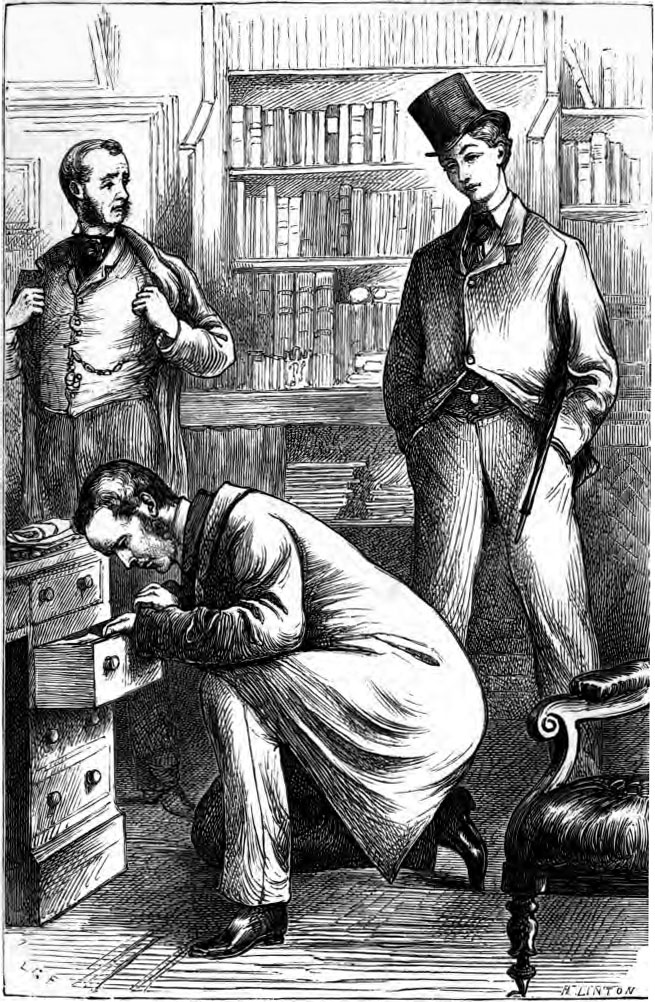
"Of course Melmotte did it," said Dolly Longestaffe standing
immediately over Bideawhile's shoulder.
At that moment there was a knock at the door,--a very distinct, and,
we may say, a formal knock. There are those who knock and immediately
enter without waiting for the sanction asked. Had he who knocked done
so on this occasion Mr. Bideawhile would have been found still on
his knees, with his nose down to the level of the keyhole. But the
intruder did not intrude rapidly, and the lawyer jumped on to his
feet, almost upsetting Dolly with the effort. There was a pause,
during which Mr. Bideawhile moved away from the table,--as he might
have done had he been picking a lock;--and then Mr. Longestaffe bade
the stranger come in with a sepulchral voice. The door was opened,
and Mr. Melmotte appeared.
Now Mr. Melmotte's presence certainly had not been expected. It was
known that it was his habit to be in the City at this hour. It was
known also that he was well aware that this meeting was to be held
in this room at this special hour,--and he might well have surmised
with what view. There was now declared hostility between both the
Longestaffes and Mr. Melmotte, and it certainly was supposed by all
the gentlemen concerned that he would not have put himself out of the
way to meet them on this occasion. "Gentlemen," he said, "perhaps you
think that I am intruding at the present moment." No one said that he
did not think so. The elder Longestaffe simply bowed very coldly. Mr.
Bideawhile stood upright and thrust his thumbs into his waistcoat
pockets. Dolly, who at first forgot to take his hat off, whistled a
bar, and then turned a pirouette on his heel. That was his mode of
expressing his thorough surprise at the appearance of his debtor. "I
fear that you do think I am intruding," said Melmotte, "but I trust
that what I have to say will be held to excuse me. I see, sir," he
said, turning to Mr. Longestaffe, and glancing at the still open
drawer, "that you have been examining your desk. I hope that you will
be more careful in locking it than you were when you left it before."
"The drawer was locked when I left it," said Mr. Longestaffe.
"I make
no deductions and draw no conclusions, but the drawer was locked."
"Then I should say it must have been locked when you returned to it."
"No, sir, I found it open. I make no deductions and draw no
conclusions,--but I left it locked and I found it open."
"I should make a deduction and draw a conclusion," said Dolly; "and
that would be that somebody else had opened it."
"This can answer no purpose at all," said Bideawhile.
"It was but a chance remark," said Melmotte. "I did not come here
out of the City at very great personal inconvenience to myself to
squabble about the lock of the drawer. As I was informed that you
three gentlemen would be here together, I thought the opportunity
a suitable one for meeting you and making you an offer about this
unfortunate business." He paused a moment; but neither of the three
spoke. It did occur to Dolly to ask them to wait while he should
fetch Squercum; but on second thoughts he reflected that a great deal
of trouble would have to be taken, and probably for no good. "Mr.
Bideawhile, I believe," suggested Melmotte; and the lawyer bowed his
head. "If I remember rightly I wrote to you offering to pay the money
due to your clients--"
"Squercum is my lawyer," said Dolly.
"That will make no difference."
"It makes a deal of difference," said Dolly.
"I wrote," continued Melmotte, "offering my bills at three and six
months' date."
"They couldn't be accepted, Mr. Melmotte."
"I would have allowed interest. I never have had my bills refused
before."
"You must be aware, Mr. Melmotte," said the lawyer, "that
the sale of
a property is not like an ordinary mercantile transaction in which
bills are customarily given and taken. The understanding was that
money should be paid in the usual way. And when we learned, as we did
learn, that the property had been at once mortgaged by you, of course
we became,--well, I think I may be justified in saying more than
suspicious. It was a most,--most--unusual proceeding. You say you
have another offer to make, Mr. Melmotte."
"Of course I have been short of money. I have had enemies whose
business it has been for some time past to run down my credit, and,
with my credit, has fallen the value of stocks in which it has been
known that I have been largely interested. I tell you the truth
openly. When I purchased Pickering I had no idea that the payment of
such a sum of money could inconvenience me in the least. When the
time came at which I should pay it, stocks were so depreciated that
it was impossible to sell. Very hostile proceedings are threatened
against me now. Accusations are made, false as hell,"--Mr. Melmotte
as he spoke raised his voice and looked round the room,--"but which
at the present crisis may do me most cruel damage. I have come to
say that, if you will undertake to stop proceedings which have been
commenced in the City, I will have fifty thousand pounds,--which is
the amount due to these two gentlemen,--ready for payment on Friday
at noon."
"I have taken no proceedings as yet," said Bideawhile.
"It's Squercum," says Dolly.
"Well, sir," continued Melmotte addressing Dolly, "let me assure
you that if these proceedings are stayed the money will be
forthcoming;--but if not, I cannot produce the money. I little
thought two months ago that I should ever have to make such a
statement in reference to such a sum as fifty thousand pounds. But
so it is. To raise that money by Friday, I shall have to cripple
my resources frightfully. It will be done at a terrible cost. But
what Mr. Bideawhile says is true. I have no right to suppose that
the purchase of this property should be looked upon as an ordinary
commercial transaction. The money should have been paid,--and, if
you will now take my word, the money shall be paid. But this cannot
be done if I am made to appear before the Lord Mayor to-morrow. The
accusations brought against me are damnably false. I do not know
with whom they have originated. Whoever did originate them, they are
damnably false. But unfortunately, false as they are, in the present
crisis, they may be ruinous to me. Now gentlemen, perhaps you will
give me an answer."
Both the father and the lawyer looked at Dolly. Dolly was in truth
the accuser through the mouthpiece of his attorney Squercum. It was
at Dolly's instance that these proceedings were being taken. "I, on
behalf of my client," said Mr. Bideawhile, "will consent to wait till
Friday at noon."
"I presume, Adolphus, that you will say as much," said the elder
Longestaffe.
Dolly Longestaffe was certainly not an impressionable person, but
Melmotte's eloquence had moved even him. It was not that he was sorry
for the man, but that at the present moment he believed him. Though
he had been absolutely sure that Melmotte had forged his name or
caused it to be forged,--and did not now go so far into the matter
as to abandon that conviction,--he had been talked into crediting
the reasons given for Melmotte's temporary distress, and also into
a belief that the money would be paid on Friday. Something of
the effect which Melmotte's false confessions had had upon Lord
Nidderdale, they now also had on Dolly Longestaffe. "I'll ask
Squercum, you know," he said.
"Of course Mr. Squercum will act as you instruct him," said
Bideawhile.
"I'll ask Squercum. I'll go to him at once. I can't do any more than
that. And upon my word, Mr. Melmotte, you've given me a great deal of
trouble."
Melmotte with a smile apologized. Then it was settled that they three
should meet in that very room on Friday at noon, and that the payment
should then be made,--Dolly stipulating that as his father would be
attended by Bideawhile, so would he be attended by Squercum. To this
Mr. Longestaffe senior yielded with a very bad grace.
CHAPTER LXXVI.
HETTA AND HER LOVER.
Lady Carbury was at this time so miserable in regard to her son that
she found herself unable to be active as she would otherwise have
been in her endeavours to separate Paul Montague and her daughter.
Roger had come up to town and given his opinion, very freely at any
rate with regard to Sir Felix. But Roger had immediately returned to
Suffolk, and the poor mother in want of assistance and consolation
turned naturally to Mr. Broune, who came to see her for a few minutes
almost every evening. It had now become almost a part of Mr. Broune's
life to see Lady Carbury once in the day. She told him of the two
propositions which Roger had made: first, that she should fix her
residence in some second-rate French or German town, and that Sir
Felix should be made to go with her; and, secondly, that she should
take possession of Carbury manor for six months. "And where would Mr.
Carbury go?" asked Mr. Broune.
"He's so good that he doesn't care what he does with himself.
There's a cottage on the place, he says, that he would move to." Mr.
Broune shook his head. Mr. Broune did not think that an offer so
quixotically generous as this should be accepted. As to the German or
French town, Mr. Broune said that the plan was no doubt feasible, but
he doubted whether the thing to be achieved was worth the terrible
sacrifice demanded. He was inclined to think that Sir Felix should go
to the colonies. "That he might drink himself to death," said Lady
Carbury, who now had no secrets from Mr. Broune. Sir Felix in the
mean time was still in the doctor's hands up-stairs. He had no doubt
been very severely thrashed, but there was not in truth very much
ailing him beyond the cuts on his face. He was, however, at the
present moment better satisfied to be an invalid than to have to come
out of his room and to meet the world. "As to Melmotte," said Mr.
Broune, "they say now that he is in some terrible mess which will
ruin him and all who have trusted him."
"And the girl?"
"It is impossible to understand it all. Melmotte was to have been
summoned before the Lord Mayor to-day on some charge of fraud;--
but it was postponed. And I was told this morning that Nidderdale
still means to marry the girl. I don't think anybody knows the truth
about it. We shall hold our tongue about him till we really do know
something." The "we" of whom Mr. Broune spoke was, of course,
the "Morning Breakfast Table."
But in all this there was nothing about Hetta. Hetta, however,
thought very much of her own condition, and found herself driven to
take some special step by the receipt of two letters from her lover,
written to her from Liverpool. They had never met since she had
confessed her love to him. The first letter she did not at once
answer, as she was at that moment waiting to hear what Roger
Carbury would say about Mrs. Hurtle. Roger Carbury had spoken,
leaving a conviction on her mind that Mrs. Hurtle was by no means
a fiction,--but indeed a fact very injurious to her happiness. Then
Paul's second love-letter had come, full of joy, and love, and
contentment,--with not a word in it which seemed to have been in the
slightest degree influenced by the existence of a Mrs. Hurtle. Had
there been no Mrs. Hurtle, the letter would have been all that Hetta
could have desired; and she could have answered it, unless forbidden
by her mother, with all a girl's usual enthusiastic affection for her
chosen lord. But it was impossible that she should now answer it in
that strain;--and it was equally impossible that she should leave
such letters unanswered. Roger had told her to "ask himself;" and
she now found herself constrained to bid him either come to her and
answer the question, or, if he thought it better, to give her some
written account of Mrs. Hurtle,--so that she might know who the lady
was, and whether the lady's condition did in any way interfere with
her own happiness. So she wrote to Paul, as follows:--
Welbeck Street,
16th July, 18--.
MY DEAR PAUL.
She found that after that which had passed between them she could not
call him "My dear Sir," or "My dear Mr. Montague,"
and that it must
either be "Sir" or "My dear Paul." He was dear to her,--very dear;
and she thought that he had not been as yet convicted of any conduct
bad enough to force her to treat him as an outcast. Had there been no
Mrs. Hurtle he would have been her "Dearest Paul,"--but she made her
choice, and so commenced.
MY DEAR PAUL,
A strange report has come round to me about a lady called
Mrs. Hurtle. I have been told that she is an American lady
living in London, and that she is engaged to be your wife.
I cannot believe this. It is too horrid to be true. But
I fear,--I fear there is something true that will be very
very sad for me to hear. It was from my brother I first
heard it,--who was of course bound to tell me anything he
knew. I have talked to mamma about it, and to my cousin
Roger. I am sure Roger knows it all;--but he will not tell
me. He said,--"Ask himself." And so I ask you. Of course I
can write about nothing else till I have heard about this.
I am sure I need not tell you that it has made me very
unhappy. If you cannot come and see me at once, you had
better write. I have told mamma about this letter.
Then came the difficulty of the signature, with the declaration
which must naturally be attached to it. After some hesitation she
subscribed herself,
Your affectionate friend,
HENRIETTA CARBURY.
"Most affectionately your own Hetta" would have been the form in
which she would have wished to finish the first letter she had ever
written to him.
Paul received it at Liverpool on the Wednesday morning, and on the
Wednesday evening he was in Welbeck Street. He had been quite aware
that it had been incumbent on him to tell her the whole history of
Mrs. Hurtle. He had meant to keep back--almost nothing. But it had
been impossible for him to do so on that one occasion on which he
had pleaded his love to her successfully. Let any reader who is
intelligent in such matters say whether it would have been possible
for him then to have commenced the story of Mrs. Hurtle and to have
told it to the bitter end. Such a story must be postponed for a
second or a third interview. Or it may, indeed, be communicated
by letter. When Paul was called away to Liverpool he did consider
whether he should write the story. But there are many reasons strong
against such written communications. A man may desire that the woman
he loves should hear the record of his folly,--so that, in after
days, there may be nothing to be detected; so that, should the Mrs.
Hurtle of his life at any time intrude upon his happiness, he may
with a clear brow and undaunted heart say to his beloved one,--"Ah,
this is the trouble of which I spoke to you." And then he and his
beloved one will be in one cause together. But he hardly wishes to
supply his beloved one with a written record of his folly. And then
who does not know how much tenderness a man may show to his own
faults by the tone of his voice, by half-spoken sentences, and by
an admixture of words of love for the lady who has filled up the
vacant space once occupied by the Mrs. Hurtle of his romance? But the
written record must go through from beginning to end, self-accusing,
thoroughly perspicuous, with no sweet, soft falsehoods hidden under
the half-expressed truth. The soft falsehoods which would be sweet as
the scent of violets in a personal interview, would stand in danger
of being denounced as deceit added to deceit, if sent in a letter. I
think therefore that Paul Montague did quite right in hurrying up to
London.
He asked for Miss Carbury, and when told that Miss Henrietta was with
her mother, he sent his name up and said that he would wait in the
dining-room. He had thoroughly made up his mind to this course. They
should know that he had come at once; but he would not, if it could
be helped, make his statement in the presence of Lady Carbury. Then,
up-stairs, there was a little discussion. Hetta pleaded her right to
see him alone. She had done what Roger had advised, and had done it
with her mother's consent. Her mother might be sure that she would
not again accept her lover till this story of Mrs. Hurtle had been
sifted to the very bottom. But she must herself hear what her lover
had to say for himself. Felix was at the time in the drawing-room
and suggested that he should go down and see Paul Montague on his
sister's behalf;--but his mother looked at him with scorn, and his
sister quietly said that she would rather see Mr. Montague herself.
Felix had been so cowed by circumstances that he did not say another
word, and Hetta left the room alone.
When she entered the parlour Paul stept forward to take her in his
arms. That was a matter of course. She knew it would be so, and she
had prepared herself for it. "Paul," she said, "let me hear about all
this--first." She sat down at some distance from him,--and he found
himself compelled to seat himself at some little distance from her.
"And so you have heard of Mrs. Hurtle," he said, with a faint attempt
at a smile.
"Yes;--Felix told me, and Roger evidently had heard about her."
"Oh yes; Roger Carbury has heard about her from the beginning;--knows
the whole history almost as well as I know it myself. I don't think
your brother is as well informed."
"Perhaps not. But--isn't it a story that--concerns me?"
"Certainly it so far concerns you, Hetta, that you ought to know it.
And I trust you will believe that it was my intention to tell it
you."
"I will believe anything that you will tell me."
"If so, I don't think that you will quarrel with me when you know
all. I was engaged to marry Mrs. Hurtle."
"Is she a widow?"--He did not answer this at once. "I suppose she
must be a widow if you were going to marry her."
"Yes;--she is a widow. She was divorced."
"Oh, Paul! And she is an American?"
"Yes."
"And you loved her?"
Montague was desirous of telling his own story, and did not wish to
be interrogated. "If you will allow me I will tell it you all from
beginning to end."
"Oh, certainly. But I suppose you loved her. If you meant to marry
her you must have loved her." There was a frown upon Hetta's brow and
a tone of anger in her voice which made Paul uneasy.
"Yes;--I loved her once; but I will tell you all." Then he did
tell his story, with a repetition of which the reader need not be
detained. Hetta listened with fair attention,--not interrupting very
often, though when she did interrupt, the little words which she
spoke were bitter enough. But she heard the story of the long journey
across the American continent, of the ocean journey before the end of
which Paul had promised to make this woman his wife. "Had she been
divorced then?" asked Hetta,--"because I believe they get themselves
divorced just when they like." Simple as the question was he could
not answer it. "I could only know what she told me," he said, as he
went on with his story. Then Mrs. Hurtle had gone on to Paris, and
he, as soon as he reached Carbury, had revealed everything to Roger.
"Did you give her up then?" demanded Hetta with stern severity.
No,--not then. He had gone back to San Francisco, and,--he had not
intended to say that the engagement had been renewed, but he was
forced to acknowledge that it had not been broken off. Then he had
written to her on his second return to England,--and then she had
appeared in London at Mrs. Pipkin's lodgings in Islington. "I can
hardly tell you how terrible that was to me," he said, "for I had by
that time become quite aware that my happiness must depend upon you."
He tried the gentle, soft falsehoods that should have been as sweet
as violets. Perhaps they were sweet. It is odd how stern a girl can
be, while her heart is almost breaking with love. Hetta was very
stern.
"But Felix says you took her to Lowestoft,--quite the other day."
Montague had intended to tell all,--almost all. There was a something
about the journey to Lowestoft which it would be impossible to make
Hetta understand, and he thought that that might be omitted. "It was
on account of her health."
"Oh;--on account of her health. And did you go to the play with her?"
"I did."
"Was that for her--health?"
"Oh, Hetta, do not speak to me like that! Cannot you understand that
when she came here, following me, I could not desert her?"
"I cannot understand why you deserted her at all," said Hetta. "You
say you loved her, and you promised to marry her. It seems horrid to
me to marry a divorced woman,--a woman who just says that she was
divorced. But that is because I don't understand American ways. And I
am sure you must have loved her when you took her to the theatre, and
down to Lowestoft,--for her health. That was only a week ago."
"It was nearly three weeks," said Paul in despair.
"Oh;--nearly three weeks! That is not such a very long time for a
gentleman to change his mind on such a matter. You were engaged to
her, not three weeks ago."
"No, Hetta, I was not engaged to her then."
"I suppose she thought you were when she went to Lowestoft with you."
"She wanted then to force me to--to--to--. Oh, Hetta, it is so hard
to explain, but I am sure that you understand. I do know that you do
not, cannot think that I have, even for one moment, been false to
you."
"But why should you be false to her? Why should I step in and crush
all her hopes? I can understand that Roger should think badly of her
because she was--divorced. Of course he would. But an engagement is
an engagement. You had better go back to Mrs. Hurtle and tell her
that you are quite ready to keep your promise."
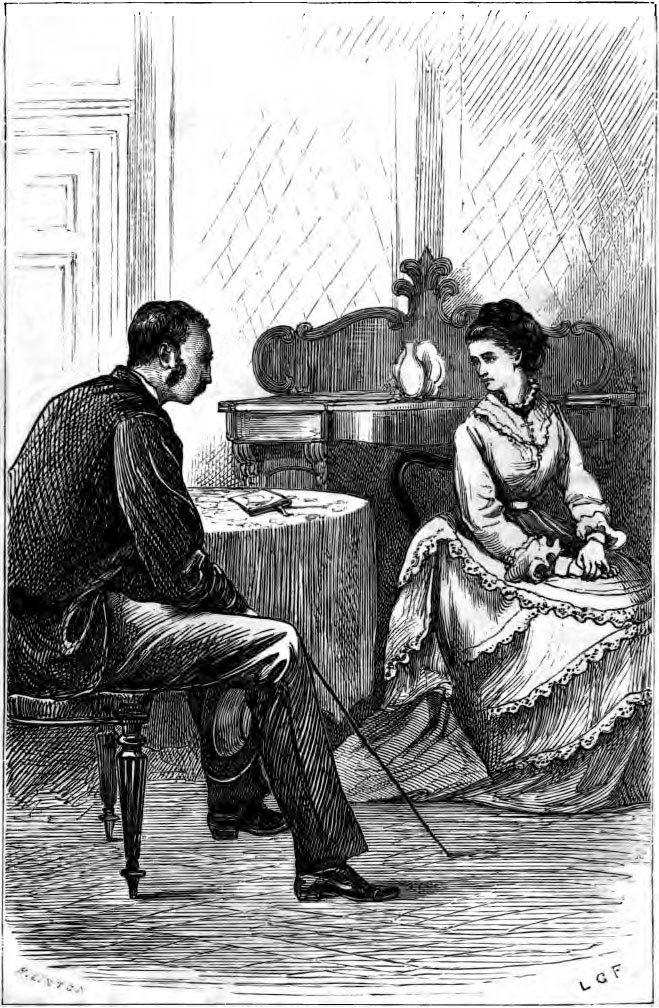
"She knows now that it is all over."
"I dare say you will be able to persuade her to reconsider it. When
she came all the way here from San Francisco after you, and when she
asked you to take her to the theatre, and to Lowestoft--because of
her health, she must be very much attached to you. And she is waiting
here,--no doubt on purpose for you. She is a very old friend,--very
old,--and you ought not to treat her unkindly. Good bye, Mr.
Montague. I think you had better lose no time in going--back to Mrs.
Hurtle." All this she said with sundry little impedimentary gurgles
in her throat, but without a tear and without any sign of tenderness.
"You don't mean to tell me, Hetta, that you are going to quarrel with
me!"
"I don't know about quarrelling. I don't wish to quarrel with any
one. But of course we can't be friends when you have married--Mrs.
Hurtle."
"Nothing on earth would induce me to marry her."
"Of course I cannot say anything about that. When they told me this
story I did not believe them. No; I hardly believed Roger when,--he
would not tell it for he was too kind,--but when he would not
contradict it. It seemed to be almost impossible that you should
have come to me just at the very same moment. For, after all, Mr.
Montague, nearly three weeks is a very short time. That trip to
Lowestoft couldn't have been much above a week before you came to
me."
"What does it matter?"
"Oh no; of course not;--nothing to you. I think I will go away now,
Mr. Montague. It was very good of you to come and tell me all. It
makes it so much easier."
"Do you mean to say that--you are going to--throw me over?"
"I don't want you to throw Mrs. Hurtle over. Good bye."
"Hetta!"
"No; I will not have you lay your hand upon me. Good night, Mr.
Montague." And so she left him.
Paul Montague was beside himself with dismay as he left the house.
He had never allowed himself for a moment to believe that this affair
of Mrs. Hurtle would really separate him from Hetta Carbury. If she
could only really know it all, there could be no such result. He
had been true to her from the first moment in which he had seen her,
never swerving from his love. It was to be supposed that he had loved
some woman before; but, as the world goes, that would not, could
not, affect her. But her anger was founded on the presence of Mrs.
Hurtle in London,--which he would have given half his possessions to
have prevented. But when she did come, was he to have refused to see
her? Would Hetta have wished him to be cold and cruel like that? No
doubt he had behaved badly to Mrs. Hurtle;--but that trouble he had
overcome. And now Hetta was quarrelling with him, though he certainly
had never behaved badly to her.
He was almost angry with Hetta as he walked home. Everything that
he could do he had done for her. For her sake he had quarrelled with
Roger Carbury. For her sake,--in order that he might be effectually
free from Mrs. Hurtle,--he had determined to endure the spring of the
wild cat. For her sake,--so he told himself,--he had been content
to abide by that odious railway company, in order that he might if
possible preserve an income on which to support her. And now she
told him that they must part,--and that only because he had not been
cruelly indifferent to the unfortunate woman who had followed him
from America. There was no logic in it, no reason,--and, as he
thought, very little heart. "I don't want you to throw Mrs. Hurtle
over," she had said. Why should Mrs. Hurtle be anything to her?
Surely she might have left Mrs. Hurtle to fight her own battles.
But they were all against him. Roger Carbury, Lady Carbury, and Sir
Felix; and the end of it would be that she would be forced into
marriage with a man almost old enough to be her father! She could not
ever really have loved him. That was the truth. She must be incapable
of such love as was his own for her. True love always forgives.
And here there was really so very little to forgive! Such were his
thoughts as he went to bed that night. But he probably omitted to
ask himself whether he would have forgiven her very readily had he
found that she had been living "nearly three weeks ago" in close
intercourse with another lover of whom he had hitherto never even
heard the name. But then,--as all the world knows,--there is a wide
difference between young men and young women!
Hetta, as soon as she had dismissed her lover, went up at once to
her own room. Thither she was soon followed by her mother, whose
anxious ear had heard the closing of the front door. "Well; what
has he said?" asked Lady Carbury. Hetta was in tears,--or very
nigh to tears,--struggling to repress them, and struggling almost
successfully. "You have found that what we told you about that
woman was all true."
"Enough of it was true," said Hetta, who, angry as she was with
her lover, was not on that account less angry with her mother for
disturbing her bliss.
"What do you mean by that, Hetta? Had you not better speak to me
openly?"
"I say, mamma, that enough was true. I do not know how to speak more
openly. I need not go into all the miserable story of the woman. He
is like other men, I suppose. He has entangled himself with some
abominable creature and then when he is tired of her thinks that he
has nothing to do but to say so,--and to begin with somebody else."
"Roger Carbury is very different."
"Oh, mamma, you will make me ill if you go on like that. It seems to
me that you do not understand in the least."
"I say he is not like that."
"Not in the least. Of course I know that he is not in the least like
that."
"I say that he can be trusted."
"Of course he can be trusted. Who doubts it?"
"And that if you would give yourself to him, there would be no cause
for any alarm."
"Mamma," said Hetta jumping up, "how can you talk to me in that way?
As soon as one man doesn't suit, I am to give myself to another! Oh,
mamma, how can you propose it? Nothing on earth will ever induce me
to be more to Roger Carbury than I am now."
"You have told Mr. Montague that he is not to come here again?"
"I don't know what I told him, but he knows very well what I mean."
"That it is all over?" Hetta made no reply. "Hetta, I have a right to
ask that, and I have a right to expect a reply. I do not say that you
have hitherto behaved badly about Mr. Montague."
"I have not behaved badly. I have told you everything. I have done
nothing that I am ashamed of."
"But we have now found out that he has behaved very badly. He has
come here to you,--with unexampled treachery to your cousin Roger--"
"I deny that," exclaimed Hetta.
"And at the very time was almost living with this woman who says that
she is divorced from her husband in America! Have you told him that
you will see him no more?"
"He understood that."
"If you have not told him so plainly, I must tell him."
"Mamma, you need not trouble yourself. I have told him very plainly."
Then Lady Carbury expressed herself satisfied for the moment, and
left her daughter to her solitude.
CHAPTER LXXVII.
ANOTHER SCENE IN BRUTON STREET.
When Mr. Melmotte made his promise to Mr. Longestaffe and to Dolly,
in the presence of Mr. Bideawhile, that he would, on the next day but
one, pay to them a sum of fifty thousand pounds, thereby completing,
satisfactorily as far as they were concerned, the purchase of the
Pickering property, he intended to be as good as his word. The reader
knows that he had resolved to face the Longestaffe difficulty,--that
he had resolved that at any rate he would not get out of it by
sacrificing the property to which he had looked forward as a safe
haven when storms should come. But, day by day, every resolution
that he made was forced to undergo some change. Latterly he had
been intent on purchasing a noble son-in-law with this money,--still
trusting to the chapter of chances for his future escape from the
Longestaffe and other difficulties. But Squercum had been very hard
upon him; and in connexion with this accusation as to the Pickering
property, there was another, which he would be forced to face also,
respecting certain property in the East of London, with which the
reader need not much trouble himself specially, but in reference to
which it was stated that he had induced a foolish old gentleman to
consent to accept railway shares in lieu of money. The old gentleman
had died during the transaction, and it was asserted that the old
gentleman's letter was hardly genuine. Melmotte had certainly raised
between twenty and thirty thousand pounds on the property, and had
made payments for it in stock which was now worth--almost nothing at
all. Melmotte thought that he might face this matter successfully
if the matter came upon him single-handed;--but in regard to the
Longestaffes he considered that now, at this last moment, he had
better pay for Pickering.
The property from which he intended to raise the necessary funds was
really his own. There could be no doubt about that. It had never been
his intention to make it over to his daughter. When he had placed it
in her name, he had done so simply for security,--feeling that his
control over his only daughter would be perfect and free from danger.
No girl apparently less likely to take it into her head to defraud
her father could have crept quietly about a father's house. Nor did
he now think that she would disobey him when the matter was explained
to her. Heavens and earth! That he should be robbed by his own
child,--robbed openly, shamefully, with brazen audacity! It was
impossible. But still he had felt the necessity of going about this
business with some little care. It might be that she would disobey
him if he simply sent for her and bade her to affix her signature
here and there. He thought much about it and considered that it would
be wise that his wife should be present on the occasion, and that
a full explanation should be given to Marie, by which she might be
made to understand that the money had in no sense become her own.
So he gave instructions to his wife when he started into the city that
morning; and when he returned, for the sake of making his offer to
the Longestaffes, he brought with him the deeds which it would be
necessary that Marie should sign, and he brought also Mr. Croll, his
clerk, that Mr. Croll might witness the signature.
When he left the Longestaffes and Mr. Bideawhile he went at once to
his wife's room. "Is she here?" he asked.
"I will send for her. I have told her."
"You haven't frightened her?"
"Why should I frighten her? It is not very easy to frighten her,
Melmotte. She is changed since these young men have been so much
about her."
"I shall frighten her if she does not do as I bid her. Bid her come
now." This was said in French. Then Madame Melmotte left the room,
and Melmotte arranged a lot of papers in order upon a table. Having
done so, he called to Croll, who was standing on the landing-place,
and told him to seat himself in the back drawing-room till he should
be called. Melmotte then stood with his back to the fire-place in his
wife's sitting-room, with his hands in his pockets, contemplating
what might be the incidents of the coming interview. He would be very
gracious,--affectionate if it were possible,--and, above all things,
explanatory. But, by heavens, if there were continued opposition
to his demand,--to his just demand,--if this girl should dare to
insist upon exercising her power to rob him, he would not then be
affectionate,--nor gracious! There was some little delay in the
coming of the two women, and he was already beginning to lose his
temper when Marie followed Madame Melmotte into the room. He at once
swallowed his rising anger--with an effort. He would put a constraint
upon himself. The affection and the graciousness should be all
there,--as long as they might secure the purpose in hand.
"Marie," he began, "I spoke to you the other day about some property
which for certain purposes was placed in your name just as we were
leaving Paris."
"Yes, papa."
"You were such a child then,--I mean when we left Paris,--that I
could hardly explain to you the purpose of what I did." "I understood
it, papa."
"You had better listen to me, my dear. I don't think you did quite
understand it. It would have been very odd if you had, as I never
explained it to you."
"You wanted to keep it from going away if you got into trouble."
This was so true that Melmotte did not know how at the moment to
contradict the assertion. And yet he had not intended to talk of the
possibility of trouble. "I wanted to lay aside a large sum of money
which should not be liable to the ordinary fluctuations of commercial
enterprise."
"So that nobody could get at it."
"You are a little too quick, my dear."
"Marie, why can't you let your papa speak?" said Madame Melmotte.
"But of course, my dear," continued Melmotte, "I had no idea of
putting the money beyond my own reach. Such a transaction is very
common; and in such cases a man naturally uses the name of some one
who is very near and dear to him, and in whom he is sure that he can
put full confidence. And it is customary to choose a young person, as
there will then be less danger of the accident of death. It was for
these reasons, which I am sure that you will understand, that I chose
you. Of course the property remained exclusively my own."
"But it is really mine," said Marie.
"No, miss; it was never yours," said Melmotte, almost bursting out
into anger, but restraining himself. "How could it become yours,
Marie? Did I ever make you a gift of it?"
"But I know that it did become mine,--legally."
"By a quibble of law,--yes; but not so as to give you any right to
it. I always draw the income."
"But I could stop that, papa,--and if I were married, of course it
would be stopped."
Then, quick as a flash of lightning, another idea occurred to
Melmotte, who feared that he already began to see that this child of
his might be stiff-necked. "As we are thinking of your marriage," he
said, "it is necessary that a change should be made. Settlements must
be drawn for the satisfaction of Lord Nidderdale and his father. The
old Marquis is rather hard upon me, but the marriage is so splendid
that I have consented. You must now sign these papers in four or
five places. Mr. Croll is here, in the next room, to witness your
signature, and I will call him."
"Wait a moment, papa."
"Why should we wait?"
"I don't think I will sign them."
"Why not sign them? You can't really suppose that the property is
your own. You could not even get it if you did think so."
"I don't know how that may be; but I had rather not sign them. If I
am to be married, I ought not to sign anything except what he tells
me."
"He has no authority over you yet. I have authority over you. Marie,
do not give more trouble. I am very much pressed for time. Let me
call in Mr. Croll."
"No, papa," she said.
Then came across his brow that look which had probably first induced
Marie to declare that she would endure to be "cut to pieces," rather
than to yield in this or that direction. The lower jaw squared
itself, and the teeth became set, and the nostrils of his nose became
extended,--and Marie began to prepare herself to be "cut to pieces."
But he reminded himself that there was another game which he had
proposed to play before he resorted to anger and violence. He would
tell her how much depended on her compliance. Therefore he relaxed
the frown,--as well as he knew how, and softened his face towards
her, and turned again to his work. "I am sure, Marie, that you will
not refuse to do this when I explain to you its importance to me. I
must have that property for use in the city to-morrow, or--I shall
be ruined." The statement was very short, but the manner in which he
made it was not without effect.
"Oh!" shrieked his wife.
"It is true. These harpies have so beset me about the election that
they have lowered the price of every stock in which I am concerned,
and have brought the Mexican Railway so low that they cannot be sold
at all. I don't like bringing my troubles home from the city; but on
this occasion I cannot help it. The sum locked up here is very large,
and I am compelled to use it. In point of fact it is necessary to
save us from destruction." This he said, very slowly, and with the
utmost solemnity.
"But you told me just now you wanted it because I was going to be
married," rejoined Marie.
A liar has many points in his favour,--but he has this against him,
that unless he devote more time to the management of his lies than
life will generally allow, he cannot make them tally. Melmotte was
thrown back for a moment, and almost felt that the time for violence
had come. He longed to be at her that he might shake the wickedness
and the folly, and the ingratitude out of her. But he once more
condescended to argue and to explain. "I think you misunderstood me,
Marie. I meant you to understand that settlements must be made, and
that of course I must get my own property back into my own hands
before anything of that kind can be done. I tell you once more, my
dear, that if you do not do as I bid you, so that I may use that
property the first thing to-morrow, we are all ruined. Everything
will be gone."
"This can't be gone," said Marie, nodding her head at the papers.
"Marie,--do you wish to see me disgraced and ruined? I have done a
great deal for you."
"You turned away the only person I ever cared for," said Marie.
"Marie, how can you be so wicked? Do as your papa bids you,"
said
Madame Melmotte.
"No!" said Melmotte. "She does not care who is ruined, because we
saved her from that reprobate."
"She will sign them now," said Madame Melmotte.
"No;--I will not sign them," said Marie. "If I am to be married to
Lord Nidderdale as you all say, I am sure I ought to sign nothing
without telling him. And if the property was once made to be mine,
I don't think I ought to give it up again because papa says that he
is going to be ruined. I think that's a reason for not giving it up
again."
"It isn't yours to give. It's mine," said Melmotte gnashing his
teeth.
"Then you can do what you like with it without my signing," said
Marie.
He paused a moment, and then laying his hand gently upon her
shoulder, he asked her yet once again. His voice was changed, and was
very hoarse. But he still tried to be gentle with her. "Marie,"
he
said, "will you do this to save your father from destruction?"
But she did not believe a word that he said to her. How could she
believe him? He had taught her to regard him as her natural enemy,
making her aware that it was his purpose to use her as a chattel for
his own advantage, and never allowing her for a moment to suppose
that aught that he did was to be done for her happiness. And now,
almost in a breath, he had told her that this money was wanted that
it might be settled on her and the man to whom she was to be married,
and then that it might be used to save him from instant ruin. She
believed neither one story nor the other. That she should have done
as she was desired in this matter can hardly be disputed. The father
had used her name because he thought that he could trust her. She
was his daughter and should not have betrayed his trust. But she had
steeled herself to obstinacy against him in all things. Even yet,
after all that had passed, although she had consented to marry Lord
Nidderdale, though she had been forced by what she had learned to
despise Sir Felix Carbury, there was present to her an idea that she
might escape with the man she really loved. But any such hope could
depend only on the possession of the money which she now claimed as
her own. Melmotte had endeavoured to throw a certain supplicatory
pathos into the question he had asked her; but, though he was in some
degree successful with his voice, his eyes and his mouth and his
forehead still threatened her. He was always threatening her. All her
thoughts respecting him reverted to that inward assertion that he
might "cut her to pieces" if he liked. He repeated his question in
the pathetic strain. "Will you do this now,--to save us all from
ruin?" But his eyes still threatened her.
"No;" she said, looking up into his face as though watching for the
personal attack which would be made upon her; "no, I won't."
"Marie!" exclaimed Madame Melmotte.
She glanced round for a moment at her pseudo-mother with contempt.
"No;" she said. "I don't think I ought,--and I won't."
"You won't!" shouted Melmotte. She merely shook her head. "Do you
mean that you, my own child, will attempt to rob your father just at
the moment you can destroy him by your wickedness?" She shook her
head but said no other word.
"Nec pueros coram populo Medea trucidet."
"Let not Medea with unnatural rage
Slaughter her mangled infants on the stage."
Nor will I attempt to harrow my readers by a close description of the
scene which followed. Poor Marie! That cutting her up into pieces was
commenced after a most savage fashion. Marie crouching down hardly
uttered a sound. But Madame Melmotte frightened beyond endurance
screamed at the top of her voice,--"Ah, Melmotte, tu la tueras!"
And then she tried to drag him from his prey. "Will you sign them
now?" said Melmotte, panting. At that moment Croll, frightened by the
screams, burst into the room. It was perhaps not the first time that
he had interfered to save Melmotte from the effects of his own wrath.
"Oh, Mr. Melmotte, vat is de matter?" asked the clerk.
Melmotte was out of breath and could hardly tell his story. Marie
gradually recovered herself, and crouched, cowering, in a corner of
a sofa, by no means vanquished in spirit, but with a feeling that
the very life had been crushed out of her body. Madame Melmotte
was standing weeping copiously, with her handkerchief up to her
eyes. "Will you sign the papers?" Melmotte demanded. Marie, lying
as she was, all in a heap, merely shook her head. "Pig!" said
Melmotte,--"wicked, ungrateful pig."
"Ah, Ma'am-moiselle," said Croll, "you should oblige your fader."
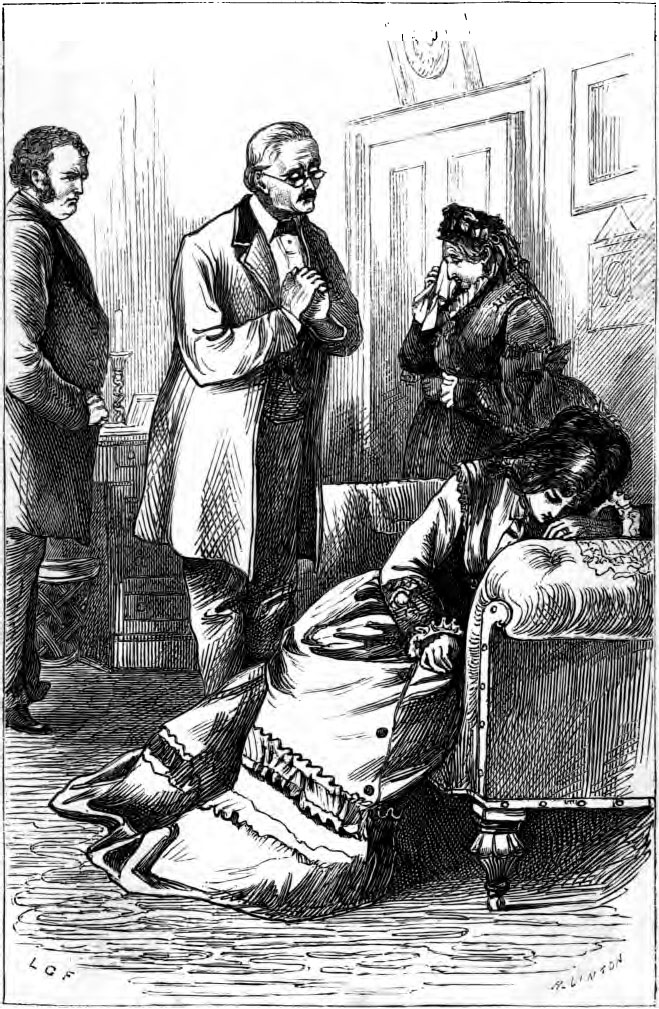
"Wretched, wicked girl!" said Melmotte, collecting the papers
together. Then he left the room, and followed by Croll descended to
the study, whence the Longestaffes and Mr. Bideawhile had long since
taken their departure.
Madame Melmotte came and stood over the girl, but for some minutes
spoke never a word. Marie lay on the sofa, all in a heap, with her
hair dishevelled and her dress disordered, breathing hard, but
uttering no sobs and shedding no tears. The stepmother,--if she might
so be called,--did not think of attempting to persuade where her
husband had failed. She feared Melmotte so thoroughly, and was so
timid in regard to her own person, that she could not understand
the girl's courage. Melmotte was to her an awful being, powerful as
Satan,--whom she never openly disobeyed, though she daily deceived
him, and was constantly detected in her deceptions. Marie seemed to
her to have all her father's stubborn, wicked courage, and very much
of his power. At the present moment she did not dare to tell the girl
that she had been wrong. But she had believed her husband when he had
said that destruction was coming, and had partly believed him when he
declared that the destruction might be averted by Marie's obedience.
Her life had been passed in almost daily fear of destruction. To
Marie the last two years of splendour had been so long that they had
produced a feeling of security. But to the elder woman the two years
had not sufficed to eradicate the remembrance of former reverses, and
never for a moment had she felt herself to be secure. At last she
asked the girl what she would like to have done for her. "I wish he
had killed me," Marie said, slowly dragging herself up from the sofa,
and retreating without another word to her own room.
In the meantime another scene was being acted in the room below.
Melmotte after he reached the room hardly made a reference to his
daughter,--merely saying that nothing would overcome her wicked
obstinacy. He made no allusion to his own violence, nor had Croll the
courage to expostulate with him now that the immediate danger was
over. The Great Financier again arranged the papers, just as they had
been laid out before,--as though he thought that the girl might be
brought down to sign them there. And then he went on to explain to
Croll what he had wanted to have done,--how necessary it was that
the thing should be done, and how terribly cruel it was to him that in
such a crisis of his life he should be hampered, impeded,--he did not
venture to his clerk to say ruined,--by the ill-conditioned obstinacy
of a girl! He explained very fully how absolutely the property was
his own, how totally the girl was without any right to withhold it
from him! How monstrous in its injustice was the present position
of things! In all this Croll fully agreed. Then Melmotte went on
to declare that he would not feel the slightest scruple in writing
Marie's signature to the papers himself. He was the girl's father and
was justified in acting for her. The property was his own property,
and he was justified in doing with it as he pleased. Of course he
would have no scruple in writing his daughter's name. Then he looked
up at the clerk. The clerk again assented,--after a fashion, not by
any means with the comfortable certainty with which he had signified
his accordance with his employer's first propositions. But he did
not, at any rate, hint any disapprobation of the step which Melmotte
proposed to take. Then Melmotte went a step farther, and explained
that the only difficulty in reference to such a transaction would
be that the signature of his daughter would be required to be
corroborated by that of a witness before he could use it. Then he
again looked up at Croll;--but on this occasion Croll did not move a
muscle of his face. There certainly was no assent. Melmotte continued
to look at him; but then came upon the old clerk's countenance a
stern look which amounted to very strong dissent. And yet Croll had
been conversant with some irregular doings in his time, and Melmotte
knew well the extent of Croll's experience. Then Melmotte made a
little remark to himself. "He knows that the game is pretty well
over." "You had better return to the city now," he said aloud. "I
shall follow you in half an hour. It is quite possible that I may
bring my daughter with me. If I can make her understand this thing I
shall do so. In that case I shall want you to be ready." Croll again
smiled, and again assented, and went his way.
But Melmotte made no further attempt upon his daughter. As soon as
Croll was gone he searched among various papers in his desk and
drawers, and having found two signatures, those of his daughter and
of this German clerk, set to work tracing them with some thin tissue
paper. He commenced his present operation by bolting his door and
pulling down the blinds. He practised the two signatures for the best
part of an hour. Then he forged them on the various documents;--and,
having completed the operation, refolded them, placed them in a
little locked bag of which he had always kept the key in his purse,
and then, with the bag in his hand, was taken in his brougham into
the city.
CHAPTER LXXVIII.
MISS LONGESTAFFE AGAIN AT CAVERSHAM.
All this time Mr. Longestaffe was necessarily detained in London
while the three ladies of his family were living forlornly at Cav-
ersham. He had taken his younger daughter home on the day after
his visit to Lady Monogram, and in all his intercourse with her had
spoken of her suggested marriage with Mr. Brehgert as a thing utterly
out of the question. Georgiana had made one little fight for her
independence at the Jermyn Street Hotel. "Indeed, papa, I think it's
very hard," she said.
"What's hard? I think a great many things are hard; but I have to
bear them."
"You can do nothing for me."
"Do nothing for you! Haven't you got a home to live in, and clothes
to wear, and a carriage to go about in,--and books to read if you
choose to read them? What do you expect?"
"You know, papa, that's nonsense."
"How do you dare to tell me that what I say is nonsense?"
"Of course there's a house to live in and clothes to wear; but what's
to be the end of it? Sophia, I suppose, is going to be married."
"I am happy to say she is,--to a most respectable young man and a
thorough gentleman."
"And Dolly has his own way of going on."
"You have nothing to do with Adolphus."
"Nor will he have anything to do with me. If I don't marry what's to
become of me? It isn't that Mr. Brehgert is the sort of man I should
choose."
"Do not mention his name to me."
"But what am I to do? You give up the house in town, and how am I to
see people? It was you sent me to Mr. Melmotte."
"I didn't send you to Mr. Melmotte."
"It was at your suggestion I went there, papa. And of course I could
only see the people he had there. I like nice people as well as
anybody."
"There's no use talking any more about it."
"I don't see that. I must talk about it, and think about it too. If
I can put up with Mr. Brehgert I don't see why you and mamma should
complain."
"A Jew!"
"People don't think about that as they used to, papa. He has a very
fine income, and I should always have a house in--"
Then Mr. Longestaffe became so furious and loud, that he stopped her
for that time. "Look here," he said, "if you mean to tell me that you
will marry that man without my consent, I can't prevent it. But you
shall not marry him as my daughter. You shall be turned out of my
house, and I will never have your name pronounced in my presence
again. It is disgusting,--degrading,--disgraceful!" And then he left
her.
On the next morning before he started for Caversham he did see Mr.
Brehgert; but he told Georgiana nothing of the interview, nor had
she the courage to ask him. The objectionable name was not mentioned
again in her father's hearing, but there was a sad scene between
herself, Lady Pomona, and her sister. When Mr. Longestaffe and his
younger daughter arrived, the poor mother did not go down into the
hall to meet her child,--from whom she had that morning received the
dreadful tidings about the Jew. As to these tidings she had as yet
heard no direct condemnation from her husband. The effect upon Lady
Pomona had been more grievous even than that made upon the father.
Mr. Longestaffe had been able to declare immediately that the
proposed marriage was out of the question, that nothing of the kind
should be allowed, and could take upon himself to see the Jew with
the object of breaking off the engagement. But poor Lady Pomona was
helpless in her sorrow. If Georgiana chose to marry a Jew tradesman
she could not help it. But such an occurrence in the family would,
she felt, be to her as though the end of all things had come. She
could never again hold up her head, never go into society, never
take pleasure in her powdered footmen. When her daughter should have
married a Jew, she didn't think that she could pluck up the courage
to look even her neighbours Mrs. Yeld and Mrs. Hepworth in the face.
Georgiana found no one in the hall to meet her, and dreaded to go to
her mother. She first went with her maid to her own room, and waited
there till Sophia came to her. As she sat pretending to watch the
process of unpacking, she strove to regain her courage. Why need she
be afraid of anybody? Why, at any rate, should she be afraid of other
females? Had she not always been dominant over her mother and sister?
"Oh, Georgey," said Sophia, "this is wonderful news!"
"I suppose it seems wonderful that anybody should be going to be
married except yourself."
"No;--but such a very odd match!"
"Look here, Sophia. If you don't like it, you need not talk about it.
We shall always have a house in town, and you will not. If you don't
like to come to us, you needn't. That's about all."
"George wouldn't let me go there at all," said Sophia.
"Then--George--had better keep you at home at Toodlam. Where's mamma?
I should have thought somebody might have come and met me to say a
word to me, instead of allowing me to creep into the house like
this."
"Mamma isn't at all well; but she's up and in her own room. You
mustn't be surprised, Georgey, if you find mamma very--very much cut
up about this." Then Georgiana understood that she must be content to
stand all alone in the world, unless she made up her mind to give up
Mr. Brehgert.
"So I've come back," said Georgiana, stooping down and kissing her
mother.
"Oh, Georgiana; oh, Georgiana!" said Lady Pomona, slowly raising
herself and covering her face with one of her hands. "This is
dreadful. It will kill me. It will indeed. I didn't expect it from
you."
"What is the good of all that, mamma?"
"It seems to me that it can't be possible. It's unnatural. It's worse
than your wife's sister. I'm sure there's something in the Bible
against it. You never would read your Bible, or you wouldn't be going
to do this."
"Lady Julia Start has done just the same thing,--and she goes
everywhere."
"What does your papa say? I'm sure your papa won't allow it. If he's
fixed about anything, it's about the Jews. An accursed race;--think
of that, Georgiana;--expelled from Paradise."
"Mamma, that's nonsense."
"Scattered about all over the world, so that nobody knows who anybody
is. And it's only since those nasty Radicals came up that they have
been able to sit in Parliament."
"One of the greatest judges in the land is a Jew," said Georgiana,
who had already learned to fortify her own case.
"Nothing that the Radicals can do can make them anything else but
what they are. I'm sure that Mr. Whitstable, who is to be your
brother-in-law, will never condescend to speak to him."
Now, if there was anybody whom Georgiana Longestaffe had despised
from her youth upwards it was George Whitstable. He had been a
laughing-stock to her when they were children, had been regarded
as a lout when he left school, and had been her common example of
rural dullness since he had become a man. He certainly was neither
beautiful nor bright;--but he was a Conservative squire born of Tory
parents. Nor was he rich,--having but a moderate income, sufficient
to maintain a moderate country house and no more. When first
there came indications that Sophia intended to put up with George
Whitstable, the more ambitious sister did not spare the shafts of her
scorn. And now she was told that George Whitstable would not speak to
her future husband! She was not to marry Mr. Brehgert lest she should
bring disgrace, among others, upon George Whitstable! This was not to
be endured.
"Then Mr. Whitstable may keep himself at home at Toodlam and not
trouble his head at all about me or my husband. I'm sure I shan't
trouble myself as to what a poor creature like that may think about
me. George Whitstable knows as much about London as I do about the
moon."
"He has always been in county society," said Sophia, "and was staying
only the other day at Lord Cantab's."
"Then there were two fools together," said Georgiana, who at this
moment was very unhappy.
"Mr. Whitstable is an excellent young man, and I am sure he will make
your sister happy; but as for Mr. Brehgert,--I can't bear to have his
name mentioned in my hearing."
"Then, mamma, it had better not be mentioned. At any rate it shan't
be mentioned again by me." Having so spoken, Georgiana bounced out of
the room and did not meet her mother and sister again till she came
down into the drawing-room before dinner.
Her position was one very trying both to her nerves and to her
feelings. She presumed that her father had seen Mr. Brehgert, but did
not in the least know what had passed between them. It might be that
her father had been so decided in his objection as to induce Mr.
Brehgert to abandon his intention,--and if this were so, there could
be no reason why she should endure the misery of having the Jew
thrown in her face. Among them all they had made her think that she
would never become Mrs. Brehgert. She certainly was not prepared to
nail her colours upon the mast and to live and die for Brehgert. She
was almost sick of the thing herself. But she could not back out of
it so as to obliterate all traces of the disgrace. Even if she should
not ultimately marry the Jew, it would be known that she had been
engaged to a Jew,--and then it would certainly be said afterwards
that the Jew had jilted her. She was thus vacillating in her mind,
not knowing whether to go on with Brehgert or to abandon him. That
evening Lady Pomona retired immediately after dinner, being "far from
well." It was of course known to them all that Mr. Brehgert was her
ailment. She was accompanied by her elder daughter, and Georgiana
was left with her father. Not a word was spoken between them. He sat
behind his newspaper till he went to sleep, and she found herself
alone and deserted in that big room. It seemed to her that even the
servants treated her with disdain. Her own maid had already given her
notice. It was manifestly the intention of her family to ostracise
her altogether. Of what service would it be to her that Lady Julia
Goldsheiner should be received everywhere, if she herself were to
be left without a single Christian friend? Would a life passed
exclusively among the Jews content even her lessened ambition? At
ten o'clock she kissed her father's head and went to bed. Her father
grunted less audibly than usual under the operation. She had always
given herself credit for high spirits, but she began to fear that her
courage would not suffice to carry her through sufferings such as
these.
On the next day her father returned to town, and the three ladies
were left alone. Great preparations were going on for the Whitstable
wedding. Dresses were being made and linen marked, and consultations
held,--from all which things Georgiana was kept quite apart. The
accepted lover came over to lunch, and was made as much of as though
the Whitstables had always kept a town house. Sophy loomed so large
in her triumph and happiness, that it was not to be borne. All
Caversham treated her with a new respect. And yet if Toodlam was a
couple of thousand a year, it was all it was;--and there were two
unmarried sisters! Lady Pomona went half into hysterics every time
she saw her younger daughter, and became in her way a most oppressive
parent. Oh, heavens;--was Mr. Brehgert with his two houses worth all
this? A feeling of intense regret for the things she was losing came
over her. Even Caversham, the Caversham of old days which she had
hated, but in which she had made herself respected and partly feared
by everybody about the place,--had charms for her which seemed to
her delightful now that they were lost for ever. Then she had always
considered herself to be the first personage in the house,--superior
even to her father;--but now she was decidedly the last.
Her second evening was worse even than the first. When Mr.
Longestaffe was not at home the family sat in a small dingy room
between the library and the dining-room, and on this occasion the
family consisted only of Georgiana. In the course of the evening she
went up-stairs and calling her sister out into the passage demanded
to be told why she was thus deserted. "Poor mamma is very ill," said
Sophy.
"I won't stand it if I'm to be treated like this," said Georgiana.
"I'll go away somewhere."
"How can I help it, Georgey? It's your own doing. Of course you must
have known that you were going to separate yourself from us."
On the next morning there came a dispatch from Mr. Longestaffe,--of
what nature Georgey did not know as it was addressed to Lady Pomona.
But one enclosure she was allowed to see. "Mamma," said Sophy,
"thinks you ought to know how Dolly feels about it." And then a
letter from Dolly to his father was put into Georgey's hands. The
letter was as follows:--
MY DEAR FATHER,--
Can it be true that Georgey is thinking of marrying that
horrid vulgar Jew, old Brehgert? The fellows say so; but I
can't believe it. I'm sure you wouldn't let her. You ought
to lock her up.
Yours affectionately,
A. LONGESTAFFE.
Dolly's letters made his father very angry, as, short as they were,
they always contained advice or instruction, such as should come from
a father to a son, rather than from a son to a father. This letter
had not been received with a welcome. Nevertheless the head of the
family had thought it worth his while to make use of it, and had sent
it to Caversham in order that it might be shown to his rebellious
daughter.
And so Dolly had said that she ought to be locked up! She'd like to
see somebody do it! As soon as she had read her brother's epistle she
tore it into fragments and threw it away in her sister's presence.
"How can mamma be such a hypocrite as to pretend to care what Dolly
says? Who doesn't know that he's an idiot? And papa has thought it
worth his while to send that down here for me to see! Well, after
that I must say that I don't much care what papa does."
"I don't see why Dolly shouldn't have an opinion as well as anybody
else," said Sophy.
"As well as George Whitstable? As far as stupidness goes they are
about the same. But Dolly has a little more knowledge of the world."
"Of course we all know, Georgiana," rejoined the elder sister,
"that for cuteness and that kind of thing one must look among the
commercial classes, and especially among a certain sort."
"I've done with you all," said Georgey rushing out of the room. "I'll
have nothing more to do with any one of you."
But it is very difficult for a young lady to have done with her
family! A young man may go anywhere, and may be lost at sea; or come
and claim his property after twenty years. A young man may demand an
allowance, and has almost a right to live alone. The young male bird
is supposed to fly away from the paternal nest. But the daughter of
a house is compelled to adhere to her father till she shall get a
husband. The only way in which Georgey could "have done" with them
all at Caversham would be by trusting herself to Mr. Brehgert, and at
the present moment she did not know whether Mr. Brehgert did or did
not consider himself as engaged to her.
That day also passed away with ineffable tedium. At one time she was
so beaten down by ennui that she almost offered her assistance to
her sister in reference to the wedding garments. In spite of the
very bitter words which had been spoken in the morning she would
have done so had Sophy afforded her the slightest opportunity. But
Sophy was heartlessly cruel in her indifference. In her younger days
she had had her bad things, and now,--with George Whitstable by her
side,--she meant to have good things, the goodness of which was
infinitely enhanced by the badness of her sister's things. She
had been so greatly despised that the charm of despising again
was irresistible. And she was able to reconcile her cruelty to
her conscience by telling herself that duty required her to show
implacable resistance to such a marriage as this which her sister
contemplated. Therefore Georgiana dragged out another day, not in the
least knowing what was to be her fate.
CHAPTER LXXIX.
THE BREHGERT CORRESPONDENCE.
Mr. Longestaffe had brought his daughter down to Caversham on a
Wednesday. During the Thursday and Friday she had passed a very sad
time, not knowing whether she was or was not engaged to marry Mr.
Brehgert. Her father had declared to her that he would break off
the match, and she believed that he had seen Mr. Brehgert with that
purpose. She had certainly given no consent, and had never hinted to
any one of the family an idea that she was disposed to yield. But
she felt that, at any rate with her father, she had not adhered to
her purpose with tenacity, and that she had allowed him to return
to London with a feeling that she might still be controlled. She
was beginning to be angry with Mr. Brehgert, thinking that he had
taken his dismissal from her father without consulting her. It was
necessary that something should be settled, something known. Life
such as that she was leading now would drive her mad. She had all the
disadvantages of the Brehgert connection and none of the advantages.
She could not comfort herself with thinking of the Brehgert wealth
and the Brehgert houses, and yet she was living under the general
ban of Caversham on account of her Brehgert associations. She was
beginning to think that she herself must write to Mr. Brehgert,--only
she did not know what to say to him.
But on the Saturday morning she got a letter from Mr. Brehgert.
It was handed to her as she was sitting at breakfast with her
sister,--who at that moment was triumphant with a present of
gooseberries which had been sent over from Toodlam. The Toodlam
gooseberries were noted throughout Suffolk, and when the letters
were being brought in Sophia was taking her lover's offering from the
basket with her own fair hands. "Well!" Georgey had exclaimed, "to
send a pottle of gooseberries to his lady love across the country!
Who but George Whitstable would do that?"
"I dare say you get nothing but gems and gold," Sophy retorted. "I
don't suppose that Mr. Brehgert knows what a gooseberry is." At that
moment the letter was brought in, and Georgiana knew the writing. "I
suppose that's from Mr. Brehgert," said Sophy.
"I don't think it matters much to you who it's from." She tried to be
composed and stately, but the letter was too important to allow of
composure, and she retired to read it in privacy.
The letter was as follows:--
MY DEAR GEORGIANA,
Your father came to me the day after I was to have met you
at Lady Monogram's party. I told him then that I would not
write to you till I had taken a day or two to consider
what he said to me;--and also that I thought it better
that you should have a day or two to consider what he
might say to you. He has now repeated what he said at our
first interview, almost with more violence; for I must say
that I think he has allowed himself to be violent when it
was surely unnecessary.
The long and short of it is this. He altogether
disapproves of your promise to marry me. He has given
three reasons;--first that I am in trade; secondly that
I am much older than you, and have a family; and thirdly
that I am a Jew. In regard to the first I can hardly
think that he is earnest. I have explained to him that my
business is that of a banker; and I can hardly conceive it
to be possible that any gentleman in England should object
to his daughter marrying a banker, simply because the man
is a banker. There would be a blindness of arrogance in
such a proposition of which I think your father to be
incapable. This has merely been added in to strengthen his
other objections.
As to my age, it is just fifty-one. I do not at all think
myself too old to be married again. Whether I am too old
for you is for you to judge,--as is also that question of
my children who, of course, should you become my wife will
be to some extent a care upon your shoulders. As this is
all very serious you will not, I hope, think me wanting in
gallantry if I say that I should hardly have ventured to
address you if you had been quite a young girl. No doubt
there are many years between us;--and so I think there
should be. A man of my age hardly looks to marry a woman
of the same standing as himself. But the question is one
for the lady to decide,--and you must decide it now.
As to my religion, I acknowledge the force of what your
father says,--though I think that a gentleman brought up
with fewer prejudices would have expressed himself in
language less likely to give offence. However I am a man
not easily offended; and on this occasion I am ready to
take what he has said in good part. I can easily conceive
that there should be those who think that the husband
and wife should agree in religion. I am indifferent to it
myself. I shall not interfere with you if you make me
happy by becoming my wife, nor, I suppose, will you with
me. Should you have a daughter or daughters I am quite
willing that they should be brought up subject to your
influence.
There was a plain-speaking in this which made Georgiana look round
the room as though to see whether any one was watching her as she
read it.
But no doubt your father objects to me specially because
I am a Jew. If I were an atheist he might, perhaps, say
nothing on the subject of religion. On this matter as well
as on others it seems to me that your father has hardly
kept pace with the movements of the age. Fifty years ago
whatever claim a Jew might have to be as well considered
as a Christian, he certainly was not so considered.
Society was closed against him, except under special
circumstances, and so were all the privileges of high
position. But that has been altered. Your father does not
admit the change; but I think he is blind to it, because
he does not wish to see.
I say all this more as defending myself than as combating
his views with you. It must be for you and for you alone
to decide how far his views shall govern you. He has told
me, after a rather peremptory fashion, that I have behaved
badly to him and to his family because I did not go to
him in the first instance when I thought of obtaining
the honour of an alliance with his daughter. I have been
obliged to tell him that in this matter I disagree with
him entirely, though in so telling him I endeavoured to
restrain myself from any appearance of warmth. I had not
the pleasure of meeting you in his house, nor had I any
acquaintance with him. And again, at the risk of being
thought uncourteous, I must say that you are to a certain
degree emancipated by age from that positive subordination
to which a few years ago you probably submitted without a
question. If a gentleman meets a lady in society, as I met
you in the home of our friend Mr. Melmotte, I do not think
that the gentleman is to be debarred from expressing his
feelings because the lady may possibly have a parent. Your
father, no doubt with propriety, had left you to be the
guardian of yourself, and I cannot submit to be accused of
improper conduct because, finding you in that condition, I
availed myself of it.
And now, having said so much, I must leave the question to
be decided entirely by yourself. I beg you to understand
that I do not at all wish to hold you to a promise merely
because the promise has been given. I readily acknowledge
that the opinion of your family should be considered by
you, though I will not admit that I was bound to consult
that opinion before I spoke to you. It may well be that
your regard for me or your appreciation of the comforts
with which I may be able to surround you, will not suffice
to reconcile you to such a breach from your own family as
your father, with much repetition, has assured me will be
inevitable. Take a day or two to think of this and turn it
well over in your mind. When I last had the happiness of
speaking to you, you seemed to think that your parents
might raise objections, but that those objections would
give way before an expression of your own wishes. I was
flattered by your so thinking; but, if I may form any
judgment from your father's manner, I must suppose that
you were mistaken. You will understand that I do not say
this as any reproach to you. Quite the contrary. I think
your father is irrational; and you may well have failed to
anticipate that he should be so.
As to my own feelings they remain exactly as they were
when I endeavoured to explain them to you. Though I do not
find myself to be too old to marry, I do think myself too
old to write love letters. I have no doubt you believe me
when I say that I entertain a most sincere affection for
you; and I beseech you to believe me in saying further
that should you become my wife it shall be the study of my
life to make you happy.
It is essentially necessary that I should allude to one
other matter, as to which I have already told your father
what I will now tell you. I think it probable that within
this week I shall find myself a loser of a very large sum
of money through the failure of a gentleman whose bad
treatment of me I will the more readily forgive because
he was the means of making me known to you. This you must
understand is private between you and me, though I have
thought it proper to inform your father. Such loss, if it
fall upon me, will not interfere in the least with the
income which I have proposed to settle upon you for your
use after my death; and, as your father declares that in
the event of your marrying me he will neither give to you
nor bequeath to you a shilling, he might have abstained
from telling me to my face that I was a bankrupt merchant
when I myself told him of my loss. I am not a bankrupt
merchant nor at all likely to become so. Nor will this
loss at all interfere with my present mode of living. But
I have thought it right to inform you of it, because, if
it occur,--as I think it will,--I shall not deem it right
to keep a second establishment probably for the next two
or three years. But my house at Fulham and my stables
there will be kept up just as they are at present.
I have now told you everything which I think it is
necessary you should know, in order that you may determine
either to adhere to or to recede from your engagement.
When you have resolved you will let me know,--but a day or
two may probably be necessary for your decision. I hope I
need not say that a decision in my favour will make me a
happy man.
I am, in the meantime, your affectionate friend,
EZEKIEL BREHGERT.
This very long letter puzzled Georgey a good deal, and left her, at
the time of reading it, very much in doubt as to what she would do.
She could understand that it was a plain-spoken and truth-telling
letter. Not that she, to herself, gave it praise for those virtues;
but that it imbued her unconsciously with a thorough belief. She
was apt to suspect deceit in other people;--but it did not occur to
her that Mr. Brehgert had written a single word with an attempt to
deceive her. But the single-minded genuine honesty of the letter was
altogether thrown away upon her. She never said to herself, as she
read it, that she might safely trust herself to this man, though he
were a Jew, though greasy and like a butcher, though over fifty and
with a family, because he was an honest man. She did not see that
the letter was particularly sensible;--but she did allow herself to be
pained by the total absence of romance. She was annoyed at the first
allusion to her age, and angry at the second; and yet she had never
supposed that Brehgert had taken her to be younger than she was.
She was well aware that the world in general attributes more years
to unmarried women than they have lived, as a sort of equalising
counter-weight against the pretences which young women make on
the other side, or the lies which are told on their behalf. Nor had
she wished to appear peculiarly young in his eyes. But, neverthe-
less, she regarded the reference to be uncivil,--perhaps almost
butcher-like,--and it had its effect upon her. And then the allusion
to the "daughter or daughters" troubled her. She told herself that it
was vulgar,--just what a butcher might have said. And although she
was quite prepared to call her father the most irrational, the most
prejudiced, and most ill-natured of men, yet she was displeased that
Mr. Brehgert should take such a liberty with him. But the passage
in Mr. Brehgert's letter which was most distasteful to her was that
which told her of the loss which he might probably incur through his
connection with Melmotte. What right had he to incur a loss which
would incapacitate him from keeping his engagements with her? The
town-house had been the great persuasion, and now he absolutely had
the face to tell her that there was to be no town-house for three
years. When she read this she felt that she ought to be indignant,
and for a few moments was minded to sit down without further
consideration and tell the man with considerable scorn that she
would have nothing more to say to him.
But on that side too there would be terrible bitterness. How would
she have fallen from her greatness when, barely forgiven by her
father and mother for the vile sin which she had contemplated, she
should consent to fill a common bridesmaid place at the nuptials of
George Whitstable! And what would then be left to her in life? This
episode of the Jew would make it quite impossible for her again
to contest the question of the London house with her father. Lady
Pomona and Mrs. George Whitstable would be united with him against
her. There would be no "season" for her, and she would be nobody
at Caversham. As for London, she would hardly wish to go there!
Everybody would know the story of the Jew. She thought that she could
have plucked up courage to face the world as the Jew's wife, but not
as the young woman who had wanted to marry the Jew and had failed.
How would her future life go with her, should she now make up her
mind to retire from the proposed alliance? If she could get her
father to take her abroad at once, she would do it; but she was not
now in a condition to make any terms with her father. As all this
gradually passed through her mind, she determined that she would so
far take Mr. Brehgert's advice as to postpone her answer till she had
well considered the matter.
She slept upon it, and the next day she asked her mother a few
questions. "Mamma, have you any idea what papa means to do?"
"In what way, my dear?" Lady Pomona's voice was not gracious, as
she was free from that fear of her daughter's ascendancy which had
formerly affected her.
"Well;--I suppose he must have some plan."
"You must explain yourself. I don't know why he should have any
particular plan."
"Will he go to London next year?"
"That will depend upon money, I suppose. What makes you ask?"
"Of course I have been very cruelly circumstanced. Everybody must
see that. I'm sure you do, mamma. The long and the short of it is
this;--if I give up my engagement, will he take us abroad for a
year?"
"Why should he?"
"You can't suppose that I should be very comfortable in England. If
we are to remain here at Caversham, how am I to hope ever to get
settled?"
"Sophy is doing very well."
"Oh, mamma, there are not two George Whitstables;--thank God." She
had meant to be humble and supplicating, but she could not restrain
herself from the use of that one shaft. "I don't mean but what Sophy
may be very happy, and I am sure that I hope she will. But that won't
do me any good. I should be very unhappy here."
"I don't see how you are to find any one to marry you by going
abroad," said Lady Pomona, "and I don't see why your papa is to be
taken away from his own home. He likes Caversham."
"Then I am to be sacrificed on every side," said Georgey, stalking
out of the room. But still she could not make up her mind what letter
she would write to Mr. Brehgert, and she slept upon it another night.
On the next day after breakfast she did write her letter, though when
she sat down to her task she had not clearly made up her mind what
she would say. But she did get it written, and here it is.
Caversham,
Monday.
MY DEAR MR. BREHGERT,
As you told me not to hurry, I have taken a little time
to think about your letter. Of course it would be very
disagreeable to quarrel with papa and mamma and everybody.
And if I do do so, I'm sure somebody ought to be very
grateful. But papa has been very unfair in what he has
said. As to not asking him, it could have been of no good,
for of course he would be against it. He thinks a great
deal of the Longestaffe family, and so, I suppose, ought
I. But the world does change so quick that one doesn't
think of anything now as one used to do. Anyway, I don't
feel that I'm bound to do what papa tells me just because
he says it. Though I'm not quite so old as you seem to
think, I'm old enough to judge for myself,--and I mean to
do so. You say very little about affection, but I suppose
I am to take all that for granted.
I don't wonder at papa being annoyed about the loss of the
money. It must be a very great sum when it will prevent
your having a house in London,--as you agreed. It does
make a great difference, because, of course, as you have
no regular place in the country, one could only see one's
friends in London. Fulham is all very well now and then,
but I don't think I should like to live at Fulham all the
year through. You talk of three years, which would be
dreadful. If as you say it will not have any lasting
effect, could you not manage to have a house in town? If
you can do it in three years, I should think you could do
it now. I should like to have an answer to this question.
I do think so much about being the season in town!
As for the other parts of your letter, I knew very well
beforehand that papa would be unhappy about it. But I
don't know why I'm to let that stand in my way when so
very little is done to make me happy. Of course you will
write to me again, and I hope you will say something
satisfactory about the house in London.
Yours always sincerely,
GEORGIANA LONGESTAFFE.
It probably never occurred to Georgey that Mr. Brehgert would under
any circumstances be anxious to go back from his engagement. She so
fully recognised her own value as a Christian lady of high birth and
position giving herself to a commercial Jew, that she thought that
under any circumstances Mr. Brehgert would be only too anxious to
stick to his bargain. Nor had she any idea that there was anything
in her letter which could probably offend him. She thought that she
might at any rate make good her claim to the house in London; and
that as there were other difficulties on his side, he would yield to
her on this point. But as yet she hardly knew Mr. Brehgert. He did
not lose a day in sending to her a second letter. He took her letter
with him to his office in the city, and there answered it without a
moment's delay.
No. 7, St. Cuthbert's Court, London,
Tuesday, July 16, 18--.
MY DEAR MISS LONGESTAFFE,
You say it would be very disagreeable to you to quarrel
with your papa and mamma; and as I agree with you, I will
take your letter as concluding our intimacy. I should not,
however, be dealing quite fairly with you or with myself
if I gave you to understand that I felt myself to be
coerced to this conclusion simply by your qualified assent
to your parents' views. It is evident to me from your
letter that you would not wish to be my wife unless I can
supply you with a house in town as well as with one in the
country. But this for the present is out of my power. I
would not have allowed my losses to interfere with your
settlement because I had stated a certain income; and
must therefore to a certain extent have compromised my
children. But I should not have been altogether happy till
I had replaced them in their former position, and must
therefore have abstained from increased expenditure till
I had done so. But of course I have no right to ask you
to share with me the discomfort of a single home. I may
perhaps add that I had hoped that you would have looked to
your happiness to another source, and that I will bear my
disappointment as best I may.
As you may perhaps under these circumstances be unwilling
that I should wear the ring you gave me, I return it by
post. I trust you will be good enough to keep the trifle
you were pleased to accept from me, in remembrance of one
who will always wish you well.
Yours sincerely,
EZEKIEL BREHGERT.
And so it was all over! Georgey, when she read this letter, was very
indignant at her lover's conduct. She did not believe that her own
letter had at all been of a nature to warrant it. She had regarded
herself as being quite sure of him, and only so far doubting herself,
as to be able to make her own terms because of such doubts. And now
the Jew had rejected her! She read this last letter over and over
again, and the more she read it the more she felt that in her heart
of hearts she had intended to marry him. There would have been
inconveniences no doubt, but they would have been less than the
sorrow on the other side. Now she saw nothing before her but a long
vista of Caversham dullness, in which she would be trampled upon by
her father and mother, and scorned by Mr. and Mrs. George Whitstable.
She got up and walked about the room thinking of vengeance. But what
vengeance was possible to her? Everybody belonging to her would take
the part of the Jew in that which he had now done. She could not ask
Dolly to beat him; nor could she ask her father to visit him with the
stern frown of paternal indignation. There could be no revenge. For
a time,--only for a few seconds,--she thought that she would write to
Mr. Brehgert and tell him that she had not intended to bring about
this termination of their engagement. This, no doubt, would have been
an appeal to the Jew for mercy;--and she could not quite descend to
that. But she would keep the watch and chain he had given her, and
which somebody had told her had not cost less than a hundred and
fifty guineas. She could not wear them, as people would know whence
they had come; but she might exchange them for jewels which she could
wear.
At lunch she said nothing to her sister, but in the course of the
afternoon she thought it best to inform her mother. "Mamma," she
said, "as you and papa take it so much to heart, I have broken off
everything with Mr. Brehgert."
"Of course it must be broken off," said Lady Pomona. This was very
ungracious,--so much so that Georgey almost flounced out of the room.
"Have you heard from the man?" asked her ladyship.
"I have written to him, and he has answered me; and it is all
settled. I thought that you would have said something kind to me."
And the unfortunate young woman burst out into tears.
"It was so dreadful," said Lady Pomona;--"so very dreadful. I never
heard of anything so bad. When young what's-his-name married the
tallow-chandler's daughter I thought it would have killed me if
it had been Dolly; but this was worse than that. Her father was a
methodist."
"They had neither of them a shilling of money," said Georgey through
her tears.
"And your papa says this man was next door to a bankrupt. But it's
all over?"
"Yes, mamma."
+
"And now we must all remain here at Caversham till people forget
it. It has been very hard upon George Whitstable, because of course
everybody has known it through the county. I once thought he would
have been off, and I really don't know that we could have said
anything." At that moment Sophy entered the room. "It's all over
between Georgiana and the--man," said Lady Pomona, who hardly saved
herself from stigmatising him by a further reference to his religion.
"I knew it would be," said Sophia.
"Of course it could never have really taken place," said their
mother.
"And now I beg that nothing more may be said about it," said
Georgiana. "I suppose, mamma, you will write to papa?"
"You must send him back his watch and chain, Georgey," said Sophia.
"What business is that of yours?"
"Of course she must. Her papa would not let her keep it."
To such a miserable depth of humility had the younger Miss
Longestaffe been brought by her ill-considered intimacy with the
Melmottes! Georgiana, when she looked back on this miserable episode
in her life, always attributed her grief to the scandalous breach of
compact of which her father had been guilty.
CHAPTER LXXX.
RUBY PREPARES FOR SERVICE.
Our poor old honest friend John Crumb was taken away to durance vile
after his performance in the street with Sir Felix, and was locked up
for the remainder of the night. This indignity did not sit so heavily
on his spirits as it might have done on those of a quicker nature.
He was aware that he had not killed the baronet, and that he had
therefore enjoyed his revenge without the necessity of "swinging
for it at Bury." That in itself was a comfort to him. Then it was a
great satisfaction to think that he had "served the young man out"
in the actual presence of his Ruby. He was not prone to give himself
undue credit for his capability and willingness to knock his enemies
about; but he did think that Ruby must have observed on this occasion
that he was the better man of the two. And, to John, a night in the
station-house was no great personal inconvenience. Though he was
very proud of his four-post bed at home, he did not care very much
for such luxuries as far as he himself was concerned. Nor did he
feel any disgrace from being locked up for the night. He was very
good-humoured with the policeman, who seemed perfectly to understand
his nature, and was as meek as a child when the lock was turned
upon him. As he lay down on the hard bench, he comforted himself
with thinking that Ruby would surely never care any more for the
"baronite" since she had seen him go down like a cur without striking
a blow. He thought a good deal about Ruby, but never attributed any
blame to her for her share in the evils that had befallen him.
The next morning he was taken before the magistrates, but was told
at an early hour of the day that he was again free. Sir Felix was not
much the worse for what had happened to him, and had refused to make
any complaint against the man who had beaten him. John Crumb shook
hands cordially with the policeman who had had him in charge, and
suggested beer. The constable, with regrets, was forced to decline,
and bade adieu to his late prisoner with the expression of a hope
that they might meet again before long. "You come down to Bungay,"
said John, "and I'll show you how we live there."
From the police-office he went direct to Mrs. Pipkin's house, and at
once asked for Ruby. He was told that Ruby was out with the children,
and was advised both by Mrs. Pipkin and Mrs. Hurtle not to present
himself before Ruby quite yet. "You see," said Mrs. Pipkin, "she's a
thinking how heavy you were upon that young gentleman."
"But I wasn't;--not particular. Lord love you, he ain't a hair the
wuss."
"You let her alone for a time," said Mrs. Hurtle. "A little neglect
will do her good."
"Maybe," said John,--"only I wouldn't like her to have it bad. You'll
let her have her wittles regular, Mrs. Pipkin."
It was then explained to him that the neglect proposed should not
extend to any deprivation of food, and he took his leave, receiving
an assurance from Mrs. Hurtle that he should be summoned to town
as soon as it was thought that his presence there would serve his
purposes; and with loud promises repeated to each of the friendly
women that as soon as ever a "line should be dropped" he would appear
again upon the scene, he took Mrs. Pipkin aside, and suggested that
if there were "any hextras," he was ready to pay for them. Then he
took his leave without seeing Ruby, and went back to Bungay.
When Ruby returned with the children she was told that John Crumb had
called. "I thought as he was in prison," said Ruby.
"What should they keep him in prison for?" said Mrs. Pipkin. "He
hasn't done nothing as he oughtn't to have done. That young man was
dragging you about as far as I can make out, and Mr. Crumb just did
as anybody ought to have done to prevent it. Of course they weren't
going to keep him in prison for that. Prison indeed! It isn't him as
ought to be in prison."
"And where is he now, aunt?"
"Gone down to Bungay to mind his business, and won't be coming here
any more of a fool's errand. He must have seen now pretty well what's
worth having, and what ain't. Beauty is but skin deep, Ruby."
"John Crumb 'd be after me again to-morrow, if I'd give him
encouragement," said Ruby. "If I'd hold up my finger he'd come."
"Then John Crumb's a fool for his pains, that's all; and now do you
go about your work." Ruby didn't like to be told to go about her
work, and tossed her head, and slammed the kitchen door, and scolded
the servant girl, and then sat down to cry. What was she to do with
herself now? She had an idea that Felix would not come back to her
after the treatment he had received;--and a further idea that if he
did come he was not, as she phrased it to herself, "of much account."
She certainly did not like him the better for having been beaten,
though, at the time, she had been disposed to take his part. She did
not believe that she would ever dance with him again. That had been
the charm of her life in London, and that was now all over. And as
for marrying her,--she began to feel certain that he did not intend
it. John Crumb was a big, awkward, dull, uncouth lump of a man, with
whom Ruby thought it impossible that a girl should be in love. Love
and John Crumb were poles asunder. But--! Ruby did not like wheeling
the perambulator about Islington, and being told by her aunt Pipkin
to go about her work. What Ruby did like was being in love and
dancing; but if all that must come to an end, then there would be a
question whether she could not do better for herself, than by staying
with her aunt and wheeling the perambulator about Islington.
Mrs. Hurtle was still living in solitude in the lodgings, and having
but little to do on her own behalf, had devoted herself to the
interest of John Crumb. A man more unlike one of her own countrymen
she had never seen. "I wonder whether he has any ideas at all in his
head," she had said to Mrs. Pipkin. Mrs. Pipkin had replied that Mr.
Crumb had certainly a very strong idea of marrying Ruby Ruggles. Mrs.
Hurtle had smiled, thinking that Mrs. Pipkin was also very unlike
her own countrywomen. But she was very kind to Mrs. Pipkin, ordering
rice-puddings on purpose that the children might eat them, and she
was quite determined to give John Crumb all the aid in her power.
In order that she might give effectual aid she took Mrs. Pipkin into
confidence, and prepared a plan of action in reference to Ruby. Mrs.
Pipkin was to appear as chief actor on the scene, but the plan was
altogether Mrs. Hurtle's plan. On the day following John's return
to Bungay Mrs. Pipkin summoned Ruby into the back parlour, and thus
addressed her. "Ruby, you know, this must come to an end now."
"What must come to an end?"
"You can't stay here always, you know."
"I'm sure I work hard, Aunt Pipkin, and I don't get no wages."
"I can't do with more than one girl,--and there's the keep if there
isn't wages. Besides, there's other reasons. Your grandfather won't
have you back there; that's certain."
"I wouldn't go back to grandfather, if it was ever so."
"But you must go somewheres. You didn't come to stay here
always,--nor I couldn't have you. You must go into service."
"I don't know anybody as 'd have me," said Ruby.
"You must put a 'vertisement into the paper. You'd better say as
nursemaid, as you seems to take kindly to children. And I must give
you a character;--only I shall say just the truth. You mustn't ask
much wages just at first." Ruby looked very sorrowful, and the tears
were near her eyes. The change from the glories of the music hall
was so startling and so oppressive! "It has got to be done sooner or
later, so you may as well put the 'vertisement in this afternoon."
"You're going to turn me out, Aunt Pipkin."
"Well;--if that's turning out, I am. You see you never would be
said by me as though I was mistress. You would go out with that
rapscallion when I bid you not. Now when you're in a regular place
like, you must mind when you're spoke to, and it will be best for
you. You've had your swing, and now you see you've got to pay for it.
You must earn your bread, Ruby, as you've quarrelled both with your
lover and with your grandfather."
There was no possible answer to this, and therefore the necessary
notice was put into the paper,--Mrs. Hurtle paying for its insertion.
"Because, you know," said Mrs. Hurtle, "she must stay here really,
till Mr. Crumb comes and takes her away." Mrs. Pipkin expressed
her opinion that Ruby was a "baggage" and John Crumb a "soft." Mrs.
Pipkin was perhaps a little jealous at the interest which her lodger
took in her niece, thinking perhaps that all Mrs. Hurtle's sympathies
were due to herself.
Ruby went hither and thither for a day or two, calling upon the
mothers of children who wanted nursemaids. The answers which she
had received had not come from the highest members of the aristo-
cracy, and the houses which she visited did not appal her by their
splendour. Many objections were made to her. A character from an aunt
was objectionable. Her ringlets were objectionable. She was a deal
too flighty-looking. She spoke up much too free. At last one happy
mother of five children offered to take her on approval for a month,
at £12 a year, Ruby to find her own tea and wash for herself. This
was slavery;--abject slavery. And she too, who had been the beloved
of a baronet, and who might even now be the mistress of a better
house than that into which she was to go as a servant,--if she
would only hold up her finger! But the place was accepted, and with
broken-hearted sobbings Ruby prepared herself for her departure from
aunt Pipkin's roof.
"I hope you like your place, Ruby," Mrs. Hurtle said on the afternoon
of her last day.
"Indeed then I don't like it at all. They're the ugliest children you
ever see, Mrs. Hurtle."
"Ugly children must be minded as well as pretty ones."
"And the mother of 'em is as cross as cross."
"It's your own fault, Ruby; isn't it?"
"I don't know as I've done anything out of the way."
"Don't you think it's anything out of the way to be engaged to a
young man and then to throw him over? All this has come because you
wouldn't keep your word to Mr. Crumb. Only for that your grandfather
wouldn't have turned you out of his house."
"He didn't turn me out. I ran away. And it wasn't along of John
Crumb, but because grandfather hauled me about by the hair of my
head."
"But he was angry with you about Mr. Crumb. When a young woman
becomes engaged to a young man, she ought not to go back from her
word." No doubt Mrs. Hurtle, when preaching this doctrine, thought
that the same law might be laid down with propriety for the conduct
of young men. "Of course you have brought trouble on yourself. I am
sorry that you don't like the place. I'm afraid you must go to it
now."
"I am agoing,--I suppose," said Ruby, probably feeling that if she
could but bring herself to condescend so far there might yet be open
for her a way of escape.
"I shall write and tell Mr. Crumb where you are placed."
"Oh, Mrs. Hurtle, don't. What should you write to him for? It ain't
nothing to him."
"I told him I'd let him know if any steps were taken."
"You can forget that, Mrs. Hurtle. Pray don't write. I don't want him
to know as I'm in service."
"I must keep my promise. Why shouldn't he know? I don't suppose you
care much now what he hears about you."
"Yes I do. I wasn't never in service before, and I don't want him to
know."
"What harm can it do you?"
"Well, I don't want him to know. It is such a come down, Mrs.
Hurtle."
"There is nothing to be ashamed of in that. What you have to be
ashamed of is jilting him. It was a bad thing to do;--wasn't it,
Ruby?"
"I didn't mean nothing bad, Mrs. Hurtle; only why couldn't he say
what he had to say himself, instead of bringing another to say it for
him? What would you feel, Mrs. Hurtle, if a man was to come and say
it all out of another man's mouth?"
"I don't think I should much care if the thing was well said at last.
You know he meant it."
"Yes;--I did know that."
"And you know he means it now?"
"I'm not so sure about that. He's gone back to Bungay, and he isn't
no good at writing letters no more than at speaking. Oh,--he'll go
and get somebody else now."
"Of course he will if he hears nothing about you. I think I'd better
tell him. I know what would happen."
"What would happen, Mrs. Hurtle?"
"He'd be up in town again in half a jiffey to see what sort of a
place you'd got. Now, Ruby, I'll tell you what I'll do, if you'll
say the word. I'll have him up here at once and you shan't go to Mrs.
Buggins'." Ruby dropped her hands and stood still, staring at Mrs.
Hurtle. "I will. But if he comes you mustn't behave this time as you
did before."
"But I'm to go to Mrs. Buggins' to-morrow."
"We'll send to Mrs. Buggins and tell her to get somebody else. You're
breaking your heart about going there;--are you not?"
"I don't like it, Mrs. Hurtle."
"And this man will make you mistress of his house. You say he isn't
good at speaking; but I tell you I never came across an honester man
in the whole course of my life, or one who I think would treat a
woman better. What's the use of a glib tongue if there isn't a heart
with it? What's the use of a lot of tinsel and lacker, if the real
metal isn't there? Sir Felix Carbury could talk, I dare say, but you
don't think now he was a very fine fellow."
"He was so beautiful, Mrs. Hurtle!"
"But he hadn't the spirit of a mouse in his bosom. Well, Ruby,
you have one more choice left you. Shall it be John Crumb or Mrs.
Buggins?"
"He wouldn't come, Mrs. Hurtle."
"Leave that to me, Ruby. May I bring him if I can?" Then Ruby in a
very low whisper told Mrs. Hurtle, that if she thought proper she
might bring John Crumb back again. "And there shall be no more
nonsense?"
"No," whispered Ruby.
On that same night a letter was sent to Mrs. Buggins, which
Mrs. Hurtle also composed, informing that lady that unforeseen
circumstances prevented Ruby Ruggles from keeping the engagement she
had made; to which a verbal answer was returned that Ruby Ruggles
was an impudent hussey. And then Mrs. Hurtle in her own name wrote a
short note to Mr. John Crumb.
DEAR MR. CRUMB,
If you will come back to London I think you will find Miss
Ruby Ruggles all that you desire.
Yours faithfully,
WINIFRID HURTLE.
"She's had a deal more done for her than I ever knew to be done for
young women in my time," said Mrs. Pipkin, "and I'm not at all so
sure that she has deserved it."
"John Crumb will think she has."
"John Crumb's a fool;--and as to Ruby; well, I haven't got no
patience with girls like them. Yes; it is for the best; and as for
you, Mrs. Hurtle, there's no words to say how good you've been. I
hope, Mrs. Hurtle, you ain't thinking of going away because this is
all done."
CHAPTER LXXXI.
MR. COHENLUPE LEAVES LONDON.
Dolly Longestaffe had found himself compelled to go to Fetter Lane
immediately after that meeting in Bruton Street at which he had
consented to wait two days longer for the payment of his money. This
was on a Wednesday, the day appointed for the payment being Friday.
He had undertaken that, on his part, Squercum should be made to
desist from further immediate proceedings, and he could only carry
out his word by visiting Squercum. The trouble to him was very
great, but he began to feel that he almost liked it. The excitement
was nearly as good as that of loo. Of course it was a "horrid
bore,"--this having to go about in cabs under the sweltering sun of a
London July day. Of course it was a "horrid bore,"--this doubt about
his money. And it went altogether against the grain with him that
he should be engaged in any matter respecting the family property
in agreement with his father and Mr. Bideawhile. But there was an
importance in it that sustained him amidst his troubles. It is said
that if you were to take a man of moderate parts and make him Prime
Minister out of hand, he might probably do as well as other Prime
Ministers, the greatness of the work elevating the man to its own
level. In that way Dolly was elevated to the level of a man of
business, and felt and enjoyed his own capacity. "By George!" It
depended chiefly upon him whether such a man as Melmotte should or
should not be charged before the Lord Mayor. "Perhaps I oughtn't to
have promised," he said to Squercum, sitting in the lawyer's office
on a high-legged stool with a cigar in his mouth. He preferred
Squercum to any other lawyer he had met because Squercum's room was
untidy and homely, because there was nothing awful about it, and
because he could sit in what position he pleased, and smoke all the
time.
"Well; I don't think you ought, if you ask me," said Squercum.
"You weren't there to be asked, old fellow."
"He's to bring it with him to Bruton Street."
"I don't believe a word of it;--and I'm sure Bideawhile doesn't. In
what shape will he bring it? He'll give you a cheque dated on Monday,
and that'll give him two days more, and then on Monday there'll be a
note to say the money can't be lodged till Wednesday. There should
be no compromising with such a man. You only get from one mess into
another. I told you neither to do anything or to say anything."
"I suppose we can't help ourselves now. You're to be there on Friday.
I particularly bargained for that. If you're there, there won't be
any more compromising."
Squercum made one or two further remarks to his client, not at all
flattering to Dolly's vanity,--which might have caused offence had
not there been such perfectly good feeling between the attorney and
the young man. As it was Dolly replied to everything that was said
with increased flattery. "If I was a sharp fellow like you, you
know," said Dolly, "of course I should get along better; but I ain't,
you know." It was then settled that they should meet each other, and
also meet Mr. Longestaffe senior, Bideawhile, and Melmotte, at twelve
o'clock on Friday morning in Bruton Street.
Squercum was by no means satisfied. He had busied himself in this
matter, and had ferreted things out, till he had pretty nearly got
to the bottom of that affair about the houses in the East, and had
managed to induce the heirs of the old man who had died to employ
him. As to the Pickering property he had not a doubt on the subject.
Old Longestaffe had been induced by promises of wonderful aid and by
the bribe of a seat at the Board of the South Central Pacific and
Mexican Railway to give up the title-deeds of the property,--as far
as it was in his power to give them up; and had endeavoured to induce
Dolly to do so also. As he had failed, Melmotte had supplemented his
work by ingenuity, with which the reader is acquainted. All this was
perfectly clear to Squercum, who thought that he saw before him a
most attractive course of proceeding against the Great Financier. It
was pure ambition rather than any hope of lucre that urged him on. He
regarded Melmotte as a grand swindler,--perhaps the grandest that the
world had ever known,--and he could conceive no greater honour than
the detection, successful prosecution, and ultimate destroying of
so great a man. To have hunted down Melmotte would make Squercum
as great almost as Melmotte himself. But he felt himself to have been
unfairly hampered by his own client. He did not believe that the
money would be paid; but delay might rob him of his Melmotte. He had
heard a good many things in the City, and believed it to be quite out
of the question that Melmotte should raise the money,--but there were
various ways in which a man might escape.
It may be remembered that Croll, the German clerk, preceded Melmotte
into the City on Wednesday after Marie's refusal to sign the deeds.
He, too, had his eyes open, and had perceived that things were not
looking as well as they used to look. Croll had for many years been
true to his patron, having been, upon the whole, very well paid for
such truth. There had been times when things had gone badly with him,
but he had believed in Melmotte, and, when Melmotte rose, had been
rewarded for his faith. Mr. Croll at the present time had little invest-
ments of his own, not made under his employer's auspices, which
would leave him not absolutely without bread for his family should
the Melmotte affairs at any time take an awkward turn. Melmotte had
never required from him service that was actually fraudulent,--had
at any rate never required it by spoken words. Mr. Croll had not
been over-scrupulous, and had occasionally been very useful to Mr.
Melmotte. But there must be a limit to all things; and why should any
man sacrifice himself beneath the ruins of a falling house,--when
convinced that nothing he can do can prevent the fall? Mr. Croll
would have been of course happy to witness Miss Melmotte's sign-
ature; but as for that other kind of witnessing,--this clearly to his
thinking was not the time for such good-nature on his part.
"You know what's up now;--don't you?" said one of the junior clerks
to Mr. Croll when he entered the office in Abchurch Lane.
"A good deal will be up soon," said the German.
"Cohenlupe has gone!"
"And to vere has Mr. Cohenlupe gone?"
"He hasn't been civil enough to leave his address. I fancy he don't
want his friends to have to trouble themselves by writing to him.
Nobody seems to know what's become of him."
"New York," suggested Mr. Croll.
"They seem to think not. They're too hospitable in New York for Mr.
Cohenlupe just at present. He's travelling private. He's on the
continent somewhere,--half across France by this time; but nobody
knows what route he has taken. That'll be a poke in the ribs for the
old boy;--eh, Croll?" Croll merely shook his head. "I wonder what has
become of Miles Grendall," continued the clerk.
"Ven de rats is going avay it is bad for de house. I like de rats to
stay."
"There seems to have been a regular manufactory of Mexican Railway
scrip."
"Our governor knew noding about dat," said Croll.
"He has a hat full of them at any rate. If they could have been kept
up another fortnight they say Cohenlupe would have been worth nearly
a million of money, and the governor would have been as good as the
bank. Is it true they are going to have him before the Lord Mayor
about the Pickering title-deeds?" Croll declared that he knew nothing
about the matter, and settled himself down to his work.
In little more than two hours he was followed by Melmotte, who thus
reached the City late in the afternoon. It was he knew too late to
raise the money on that day, but he hoped that he might pave the way
for getting it on the next day, which would be Thursday. Of course
the first news which he heard was of the defection of Mr. Cohenlupe.
It was Croll who told him. He turned back, and his jaw fell, but at
first he said nothing. "It's a bad thing," said Mr. Croll.
"Yes;--it is bad. He had a vast amount of my property in his hands.
Where has he gone?" Croll shook his head. "It never rains but it
pours," said Melmotte. "Well; I'll weather it all yet. I've been
worse than I am now, Croll, as you know, and have had a hundred
thousand pounds at my banker's,--loose cash,--before the month
was out."
"Yes, indeed," said Croll.
"But the worst of it is that every one around me is so damnably
jealous. It isn't what I've lost that will crush me, but what men
will say that I've lost. Ever since I began to stand for Westminster
there has been a dead set against me in the City. The whole of that
affair of the dinner was planned,--planned by G----, that it might
ruin me. It was all laid out just as you would lay the foundation of
a building. It is hard for one man to stand against all that when he
has dealings so large as mine."
"Very hard, Mr. Melmotte."
"But they'll find they're mistaken yet. There's too much of the real
stuff, Croll, for them to crush me. Property's a kind of thing that
comes out right at last. It's cut and come again, you know, if the
stuff is really there. But I mustn't stop talking here. I suppose I
shall find Brehgert in Cuthbert's Court."
"I should say so, Mr. Melmotte. Mr. Brehgert never leaves much before
six."
Then Mr. Melmotte took his hat and gloves, and the stick that he
usually carried, and went out with his face carefully dressed in its
usually jaunty air. But Croll as he went heard him mutter the name of
Cohenlupe between his teeth. The part which he had to act is one very
difficult to any actor. The carrying an external look of indifference
when the heart is sinking within,--or has sunk almost to the very
ground,--is more than difficult; it is an agonizing task. In all
mental suffering the sufferer longs for solitude,--for permission to
cast himself loose along the ground, so that every limb and every
feature of his person may faint in sympathy with his heart. A grandly
urbane deportment over a crushed spirit and ruined hopes is beyond
the physical strength of most men;--but there have been men so
strong. Melmotte very nearly accomplished it. It was only to the eyes
of such a one as Herr Croll that the failure was perceptible.
Melmotte did find Mr. Brehgert. At this time Mr. Brehgert had
completed his correspondence with Miss Longestaffe, in which he
had mentioned the probability of great losses from the anticipated
commercial failure in Mr. Melmotte's affairs. He had now heard that
Mr. Cohenlupe had gone upon his travels, and was therefore nearly
sure that his anticipation would be correct. Nevertheless, he
received his old friend with a smile. When large sums of money are
concerned there is seldom much of personal indignation between man
and man. The loss of fifty pounds or of a few hundreds may create
personal wrath;--but fifty thousand require equanimity. "So Cohenlupe
hasn't been seen in the City to-day," said Brehgert.
"He has gone," said Melmotte hoarsely.
"I think I once told you that Cohenlupe was not the man for large
dealings."
"Yes, you did," said Melmotte.
"Well;--it can't be helped; can it? And what is it now?" Then
Melmotte explained to Mr. Brehgert what it was that he wanted then,
taking the various documents out of the bag which throughout the
afternoon he had carried in his hand. Mr. Brehgert understood enough
of his friend's affairs, and enough of affairs in general, to
understand readily all that was required. He examined the documents,
declaring as he did so that he did not know how the thing could be
arranged by Friday. Melmotte replied that £50,000 was not a very
large sum of money, that the security offered was worth twice as much
as that. "You will leave them with me this evening," said Brehgert.
Melmotte paused for a moment, and said that he would of course do so.
He would have given much, very much, to have been sufficiently master
of himself to have assented without hesitation;--but then the weight
within was so very heavy!
Having left the papers and the bag with Mr. Brehgert, he walked west-
wards to the House of Commons. He was accustomed to remain in the
City later than this, often not leaving it till seven,--though during
the last week or ten days he had occasionally gone down to the House
in the afternoon. It was now Wednesday, and there was no evening
sitting;--but his mind was too full of other things to allow him to
remember this. As he walked along the Embankment, his thoughts were
very heavy. How would things go with him?--What would be the end of
it? Ruin;--yes, but there were worse things than ruin. And a short
time since he had been so fortunate;--had made himself so safe! As
he looked back at it, he could hardly say how it had come to pass
that he had been driven out of the track that he had laid down for
himself. He had known that ruin would come, and had made himself so
comfortably safe, so brilliantly safe, in spite of ruin. But insane
ambition had driven him away from his anchorage. He told himself over
and over again that the fault had been not in circumstances,--not
in that which men call Fortune,--but in his own incapacity to bear
his position. He saw it now. He felt it now. If he could only begin
again, how different would his conduct be!
But of what avail were such regrets as these? He must take things as
they were now, and see that, in dealing with them, he allowed himself
to be carried away neither by pride nor cowardice. And if the worst
should come to the worst, then let him face it like a man! There was
a certain manliness about him which showed itself perhaps as strongly
in his own self-condemnation as in any other part of his conduct at
this time. Judging of himself, as though he were standing outside
himself and looking on to another man's work, he pointed out to
himself his own shortcomings. If it were all to be done again he
thought that he could avoid this bump against the rocks on one side,
and that terribly shattering blow on the other. There was much that
he was ashamed of,--many a little act which recurred to him vividly
in this solitary hour as a thing to be repented of with inner
sackcloth and ashes. But never once, not for a moment, did it occur
to him that he should repent of the fraud in which his whole life had
been passed. No idea ever crossed his mind of what might have been
the result had he lived the life of an honest man. Though he was
inquiring into himself as closely as he could, he never even told
himself that he had been dishonest. Fraud and dishonesty had been the
very principle of his life, and had so become a part of his blood and
bones that even in this extremity of his misery he made no question
within himself as to his right judgment in regard to them. Not
to cheat, not to be a scoundrel, not to live more luxuriously
than others by cheating more brilliantly, was a condition of
things to which his mind had never turned itself. In that respect
he accused himself of no want of judgment. But why had he, so
unrighteous himself, not made friends to himself of the Mammon of
unrighteousness? Why had he not conciliated Lord Mayors? Why had
he trod upon all the corns of all his neighbours? Why had he been
insolent at the India Office? Why had he trusted any man as he had
trusted Cohenlupe? Why had he not stuck to Abchurch Lane instead of
going into Parliament? Why had he called down unnecessary notice on
his head by entertaining the Emperor of China? It was too late now,
and he must bear it; but these were the things that had ruined him.
He walked into Palace Yard and across it, to the door of Westminster
Abbey, before he found out that Parliament was not sitting. "Oh,
Wednesday! Of course it is," he said, turning round and directing
his steps towards Grosvenor Square. Then he remembered that in the
morning he had declared his purpose of dining at home, and now he did
not know what better use to make of the present evening. His house
could hardly be very comfortable to him. Marie no doubt would keep
out of his way, and he did not habitually receive much pleasure from
his wife's company. But in his own house he could at least be alone.
Then, as he walked slowly across the park, thinking so intently on
matters as hardly to observe whether he himself were observed or no,
he asked himself whether it still might not be best for him to keep
the money which was settled on his daughter, to tell the Longestaffes
that he could make no payment, and to face the worst that Mr.
Squercum could do to him,--for he knew already how busy Mr. Squer-
cum was in the matter. Though they should put him on his trial for
forgery, what of that? He had heard of trials in which the accused
criminals had been heroes to the multitude while their cases were in
progress,--who had been fêted from the beginning to the end though
no one had doubted their guilt,--and who had come out unscathed at
the last. What evidence had they against him? It might be that the
Longestaffes and Bideawhiles and Squercums should know that he was
a forger, but their knowledge would not produce a verdict. He, as
member for Westminster, as the man who had entertained the Emperor,
as the owner of one of the most gorgeous houses in London, as the
great Melmotte, could certainly command the best half of the bar.
He already felt what popular support might do for him. Surely there
need be no despondency while so good a hope remained to him! He did
tremble as he remembered Dolly Longestaffe's letter, and the letter
of the old man who was dead. And he knew that it was possible that
other things might be adduced; but would it not be better to face it
all than surrender his money and become a pauper, seeing, as he did
very clearly, that even by such surrender he could not cleanse his
character?
But he had given those forged documents into the hands of Mr.
Brehgert! Again he had acted in a hurry,--without giving sufficient
thought to the matter in hand. He was angry with himself for that
also. But how is a man to give sufficient thought to his affairs
when no step that he takes can be other than ruinous? Yes;--he had
certainly put into Brehgert's hands means of proving him to have
been absolutely guilty of forgery. He did not think that Marie would
disclaim the signatures, even though she had refused to sign the
deeds, when she should understand that her father had written her
name; nor did he think that his clerk would be urgent against him,
as the forgery of Croll's name could not injure Croll. But Brehgert,
should he discover what had been done, would certainly not permit him
to escape. And now he had put these forgeries without any guard into
Brehgert's hands.
He would tell Brehgert in the morning that he had changed his mind.
He would see Brehgert before any action could have been taken on the
documents, and Brehgert would no doubt restore them to him. Then he
would instruct his daughter to hold the money fast, to sign no paper
that should be put before her, and to draw the income herself. Having
done that, he would let his foes do their worst. They might drag him
to gaol. They probably would do so. He had an idea that he could not
be admitted to bail if accused of forgery. But he would bear all
that. If convicted he would bear the punishment, still hoping that
an end might come. But how great was the chance that they might
fail to convict him! As to the dead man's letter, and as to Dolly
Longestaffe's letter, he did not think that any sufficient evidence
could be found. The evidence as to the deeds by which Marie was to
have released the property was indeed conclusive; but he believed
that he might still recover those documents. For the present it
must be his duty to do nothing,--when he should have recovered and
destroyed those documents,--and to live before the eyes of men as
though he feared nothing.
He dined at home alone, in the study, and after dinner carefully
went through various bundles of papers, preparing them for the eyes
of those ministers of the law who would probably before long have
the privilege of searching them. At dinner, and while he was thus
employed, he drank a bottle of champagne,--feeling himself greatly
comforted by the process. If he could only hold up his head and look
men in the face, he thought that he might still live through it all.
How much had he done by his own unassisted powers! He had once been
imprisoned for fraud at Hamburgh, and had come out of gaol a pauper;
friendless, with all his wretched antecedents against him. Now he was
a member of the British House of Parliament, the undoubted owner of
perhaps the most gorgeously furnished house in London, a man with an
established character for high finance,--a commercial giant whose
name was a familiar word on all the exchanges of the two hemispheres.
Even though he should be condemned to penal servitude for life, he
would not all die. He rang the bell and desired that Madame Melmotte
might be sent to him, and bade the servant bring him brandy.
In ten minutes his poor wife came crawling into the room. Every one
connected with Melmotte regarded the man with a certain amount of
awe,--every one except Marie, to whom alone he had at times been
himself almost gentle. The servants all feared him, and his wife
obeyed him implicitly when she could not keep away from him. She came
in now and stood opposite to him, while he spoke to her. She never
sat in his presence in that room. He asked her where she and Marie
kept their jewelry;--for during the last twelvemonths rich trinkets
had been supplied to both of them. Of course she answered by another
question. "Is anything going to happen, Melmotte?"
"A good deal is going to happen. Are they here in this house, or in
Grosvenor Square?"
"They are here."
"Then have them all packed up,--as small as you can; never mind about
wool and cases and all that. Have them close to your hand so that if
you have to move you can take them with you. Do you understand?"
"Yes; I understand."
"Why don't you speak, then?"
"What is going to happen, Melmotte?"
"How can I tell? You ought to know by this time that when a man's
work is such as mine, things will happen. You'll be safe enough.
Nothing can hurt you."
"Can they hurt you, Melmotte?"
"Hurt me! I don't know what you call hurting. Whatever there is to be
borne, I suppose it is I must bear it. I have not had it very soft
all my life hitherto, and I don't think it's going to be very soft
now."
"Shall we have to move?"
"Very likely. Move! What's the harm of moving? You talk of moving as
though that were the worst thing that could happen. How would you
like to be in some place where they wouldn't let you move?"
"Are they going to send you to prison?"
"Hold your tongue."
"Tell me, Melmotte;--are they going to?" Then the poor woman did sit
down, overcome by her feelings.
"I didn't ask you to come here for a scene," said Melmotte. "Do as I
bid you about your own jewels, and Marie's. The thing is to have them
in small compass, and that you should not have it to do at the last
moment, when you will be flurried and incapable. Now you needn't
stay any longer, and it's no good asking any questions because I
shan't answer them." So dismissed, the poor woman crept out again,
and immediately, after her own slow fashion, went to work with her
ornaments.
Melmotte sat up during the greater part of the night, sometimes
sipping brandy and water, and sometimes smoking. But he did no work,
and hardly touched a paper after his wife left him.
CHAPTER LXXXII.
MARIE'S PERSEVERANCE.
Very early the next morning, very early that is for London life,
Melmotte was told by a servant that Mr. Croll had called and wanted
to see him. Then it immediately became a question with him whether
he wanted to see Croll. "Is it anything special?" he asked. The
man thought that it was something special, as Croll had declared
his purpose of waiting when told that Mr. Melmotte was not as yet
dressed. This happened at about nine o'clock in the morning. Melmotte
longed to know every detail of Croll's manner,--to know even the
servant's opinion of the clerk's manner,--but he did not dare to ask
a question. Melmotte thought that it might be well to be gracious.
"Ask him if he has breakfasted, and if not give him something in
the study." But Mr. Croll had breakfasted and declined any further
refreshment.
Nevertheless Melmotte had not as yet made up his mind that he would
meet his clerk. His clerk was his clerk. It might perhaps be well
that he should first go into the City and send word to Croll, bidding
him wait for his return. Over and over again, against his will,
the question of flying would present itself to him; but, though he
discussed it within his own bosom in every form, he knew that he
could not fly. And if he stood his ground,--as most assuredly he
would do,--then must he not be afraid to meet any man, let the man
come with what thunderbolts in his hand he might. Of course sooner
or later some man must come with a thunderbolt,--and why not Croll
as well as another? He stood against a press in his chamber, with a
razor in his hand, and steadied himself. How easily might he put an
end to it all! Then he rang his bell and desired that Croll might be
shown up into his room.
The three or four minutes which intervened seemed to him to be very
long. He had absolutely forgotten in his anxiety that the lather was
still upon his face. But he could not smother his anxiety. He was
fighting with it at every turn, but he could not conquer it. When
the knock came at his door, he grasped at his own breast as though
to support himself. With a hoarse voice he told the man to come in,
and Croll himself appeared, opening the door gently and very slowly.
Melmotte had left the bag which contained the papers in possession
of Mr. Brehgert, and he now saw, at a glance, that Croll had got the
bag in his hand,--and could see also by the shape of the bag that the
bag contained the papers. The man therefore had in his own hands, in
his own keeping, the very documents to which his own name had been
forged! There was no longer a hope, no longer a chance that Croll
should be ignorant of what had been done. "Well, Croll," he said
with an attempt at a smile, "what brings you here so early?"
He was
pale as death, and let him struggle as he would, could not restrain
himself from trembling.
"Herr Brehgert vas vid me last night," said Croll.
"Eh!"
"And he thought I had better bring these back to you. That's all."
Croll spoke in a very low voice, with his eyes fixed on his master's
face, but with nothing of a threat in his attitude or manner.
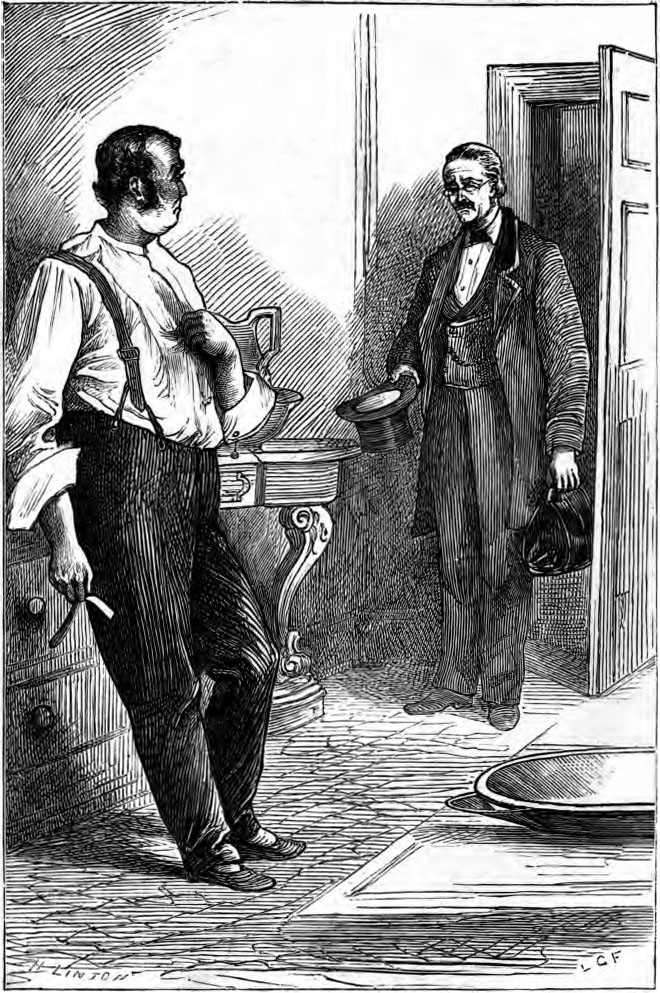
"Eh!" repeated Melmotte. Even though he might have saved himself from
all coming evils by a bold demeanour at that moment, he could not
assume it. But it all flashed upon him at a moment. Brehgert had seen
Croll after he, Melmotte, had left the City, had then discovered
the forgery, and had taken this way of sending back all the forged
documents. He had known Brehgert to be of all men who ever lived the
most good-natured, but he could hardly believe in pure good-nature
such as this. It seemed that the thunderbolt was not yet to fall.
"Mr. Brehgert came to me," continued Croll, "because one signature
was wanting. It was very late, so I took them home with me. I said
I'd bring them to you in the morning."
They both knew that he had forged the documents, Brehgert and Croll;
but how would that concern him, Melmotte, if these two friends had
resolved together that they would not expose him? He had desired
to get the documents back into his own hands, and here they were!
Melmotte's immediate trouble arose from the difficulty of speaking
in a proper manner to his own servant who had just detected him
in forgery. He couldn't speak. There were no words appropriate to
such an occasion. "It vas a strong order, Mr. Melmotte," said Croll.
Melmotte tried to smile but only grinned. "I vill not be back in the
Lane, Mr. Melmotte."
"Not back at the office, Croll?"
"I tink not;--no. De leetle money coming to me, you will send it.
Adieu." And so Mr. Croll took his final leave of his old master after
an intercourse which had lasted twenty years. We may imagine that
Herr Croll found his spirits to be oppressed and his capacity for
business to be obliterated by his patron's misfortunes rather than by
his patron's guilt. But he had not behaved unkindly. He had merely
remarked that the forgery of his own name half-a-dozen times over was
a "strong order."
Melmotte opened the bag, and examined the documents one by one. It
had been necessary that Marie should sign her name some half-dozen
times, and Marie's father had made all the necessary forgeries. It
had been of course necessary that each name should be witnessed;--
but here the forger had scamped his work. Croll's name he had written
five times; but one forged signature he had left unattested! Again
he had himself been at fault. Again he had aided his own ruin by his
own carelessness. One seems inclined to think sometimes that any fool
might do an honest business. But fraud requires a man to be alive and
wide awake at every turn!
Melmotte had desired to have the documents back in his own hands, and
now he had them. Did it matter much that Brehgert and Croll both knew
the crime which he had committed? Had they meant to take legal steps
against him they would not have returned the forgeries to his own
hands. Brehgert, he thought, would never tell the tale,--unless there
should arise some most improbable emergency in which he might make
money by telling it; but he was by no means so sure of Croll. Croll
had signified his intention of leaving Melmotte's service, and would
therefore probably enter some rival service, and thus become an enemy
to his late master. There could be no reason why Croll should keep
the secret. Even if he got no direct profit by telling it, he would
curry favour by making it known. Of course Croll would tell it.
But what harm could the telling of such a secret do him? The girl was
his own daughter! The money had been his own money! The man had been
his own servant! There had been no fraud; no robbery; no purpose of
peculation. Melmotte, as he thought of this, became almost proud of
what he had done, thinking that if the evidence were suppressed the
knowledge of the facts could do him no harm. But the evidence must be
suppressed, and with the view of suppressing it he took the little
bag and all the papers down with him to the study. Then he ate his
breakfast,--and suppressed the evidence by the aid of his gas lamp.
When this was accomplished he hesitated as to the manner in which he
would pass his day. He had now given up all idea of raising the money
for Longestaffe. He had even considered the language in which he
would explain to the assembled gentlemen on the morrow the fact that
a little difficulty still presented itself, and that as he could not
exactly name a day, he must leave the matter in their hands. For he
had resolved that he would not evade the meeting. Cohenlupe had gone
since he had made his promise, and he would throw all the blame on
Cohenlupe. Everybody knows that when panics arise the breaking of one
merchant causes the downfall of another. Cohenlupe should bear the
burden. But as that must be so, he could do no good by going into
the City. His pecuniary downfall had now become too much a matter of
certainty to be staved off by his presence; and his personal security
could hardly be assisted by it. There would be nothing for him to do.
Cohenlupe had gone. Miles Grendall had gone. Croll had gone. He could
hardly go to Cuthbert's Court and face Mr. Brehgert! He would stay
at home till it was time for him to go down to the House, and then
he would face the world there. He would dine down at the House, and
stand about in the smoking-room with his hat on, and be visible in
the lobbies, and take his seat among his brother legislators,--and,
if it were possible, rise on his legs and make a speech to them. He
was about to have a crushing fall,--but the world should say that he
had fallen like a man.
About eleven his daughter came to him as he sat in the study. It
can hardly be said that he had ever been kind to Marie, but perhaps
she was the only person who in the whole course of his career had
received indulgence at his hands. He had often beaten her; but he had
also often made her presents and smiled on her, and in the periods of
his opulence, had allowed her pocket-money almost without limit. Now
she had not only disobeyed him, but by most perverse obstinacy on
her part had driven him to acts of forgery which had already been
detected. He had cause to be angry now with Marie if he had ever had
cause for anger. But he had almost forgotten the transaction. He had
at any rate forgotten the violence of his own feelings at the time of
its occurrence. He was no longer anxious that the release should be
made, and therefore no longer angry with her for her refusal.
"Papa," she said, coming very gently into the room, "I think that
perhaps I was wrong yesterday."
"Of course you were wrong;--but it doesn't matter now."
"If you wish it I'll sign those papers. I don't suppose Lord Nidderdale
means to come any more;--and I'm sure I don't care whether he
does or not."
"What makes you think that, Marie?"
"I was out last night at Lady Julia Goldsheiner's, and he was there.
I'm sure he doesn't mean to come here any more."
"Was he uncivil to you?"
"O dear no. He's never uncivil. But I'm sure of it. Never mind how.
I never told him that I cared for him and I never did care for him.
Papa, is there something going to happen?"
"What do you mean?"
"Some misfortune! Oh, papa, why didn't you let me marry that other
man?"
"He is a penniless adventurer."
"But he would have had this money that I call my money, and then
there would have been enough for us all. Papa, he would marry me
still if you would let him."
"Have you seen him since you went to Liverpool?"
"Never, papa."
"Or heard from him?"
"Not a line."
"Then what makes you think he would marry you?"
"He would if I got hold of him and told him. And he is a baronet. And
there would be plenty of money for us all. And we could go and live
in Germany."
"We could do that just as well without your marrying."
"But I suppose, papa, I am to be considered as somebody. I don't want
after all to run away from London, just as if everybody had turned up
their noses at me. I like him, and I don't like anybody else."
"He wouldn't take the trouble to go to Liverpool with you."
"He got tipsy. I know all about that. I don't mean to say that he's
anything particularly grand. I don't know that anybody is very grand.
He's as good as anybody else."
"It can't be done, Marie."
"Why can't it be done?"
"There are a dozen reasons. Why should my money be given up to him?
And it is too late. There are other things to be thought of now than
marriage."
"You don't want me to sign the papers?"
"No;--I haven't got the papers. But I want you to remember that the
money is mine and not yours. It may be that much may depend on you,
and that I shall have to trust to you for nearly everything. Do not
let me find myself deceived by my daughter."
"I won't,--if you'll let me see Sir Felix Carbury once more."
Then the father's pride again reasserted itself and he became angry.
"I tell you, you little fool, that it is out of the question. Why
cannot you believe me? Has your mother spoken to you about your
jewels? Get them packed up, so that you can carry them away in your
hand if we have to leave this suddenly. You are an idiot to think of
that young man. As you say, I don't know that any of them are very
good, but among them all he is about the worst. Go away and do as I
bid you."
That afternoon the page in Welbeck Street came up to Lady Carbury and
told her that there was a young lady down-stairs who wanted to see
Sir Felix. At this time the dominion of Sir Felix in his mother's
house had been much curtailed. His latch-key had been surreptitiously
taken away from him, and all messages brought for him reached his
hands through those of his mother. The plasters were not removed from
his face, so that he was still subject to that loss of self-assertion
with which we are told that hitherto dominant cocks become afflicted
when they have been daubed with mud. Lady Carbury asked sundry
questions about the lady, suspecting that Ruby Ruggles, of whom she
had heard, had come to seek her lover. The page could give no special
description, merely saying that the young lady wore a black veil.
Lady Carbury directed that the young lady should be shown into her
own presence,--and Marie Melmotte was ushered into the room. "I dare
say you don't remember me, Lady Carbury," Marie said. "I am Marie
Melmotte."
At first Lady Carbury had not recognised her visitor;--but she did so
before she replied. "Yes, Miss Melmotte, I remember you."
"Yes;--I am Mr. Melmotte's daughter. How is your son? I hope he is
better. They told me he had been horribly used by a dreadful man in
the street."
"Sit down, Miss Melmotte. He is getting better." Now Lady Carbury
had heard within the last two days from Mr. Broune that "it was all
over" with Melmotte. Broune had declared his very strong belief, his
thorough conviction, that Melmotte had committed various forgeries,
that his speculations had gone so much against him as to leave him a
ruined man, and, in short, that the great Melmotte bubble was on the
very point of bursting. "Everybody says that he'll be in gaol before
a week is over." That was the information which had reached Lady
Carbury about the Melmottes only on the previous evening.
"I want to see him," said Marie. Lady Carbury, hardly knowing what
answer to make, was silent for a while. "I suppose he told you
everything;--didn't he? You know that we were to have been married?
I loved him very much, and so I do still. I am not ashamed of coming
and telling you."
"I thought it was all off," said Lady Carbury.
"I never said so. Does he say so? Your daughter came to me and was
very good to me. I do so love her. She said that it was all over; but
perhaps she was wrong. It shan't be all over if he will be true."
Lady Carbury was taken greatly by surprise. It seemed to her at
the moment that this young lady, knowing that her own father was
ruined, was looking out for another home, and was doing so with
a considerable amount of audacity. She gave Marie little credit
either for affection or for generosity; but yet she was unwilling to
answer her roughly. "I am afraid," she said, "that it would not be
suitable."
"Why should it not be suitable? They can't take my money away. There
is enough for all of us even if papa wanted to live with us;--but
it is mine. It is ever so much;--I don't know how much, but a great
deal. We should be quite rich enough. I ain't a bit ashamed to come
and tell you, because we were engaged. I know he isn't rich, and I
should have thought it would be suitable."
It then occurred to Lady Carbury that if this were true the marriage
after all might be suitable. But how was she to find out whether it
was true? "I understand that your papa is opposed to it," she said.
"Yes, he is;--but papa can't prevent me, and papa can't make me give
up the money. It's ever so many thousands a year, I know. If I can
dare to do it, why can't he?"
Lady Carbury was so beside herself with doubts, that she found it
impossible to form any decision. It would be necessary that she
should see Mr. Broune. What to do with her son, how to bestow him,
in what way to get rid of him so that in ridding herself of him she
might not aid in destroying him,--this was the great trouble of her
life, the burden that was breaking her back. Now this girl was not
only willing but persistently anxious to take her black sheep and to
endow him,--as she declared,--with ever so many thousands a year. If
the thousands were there,--or even an income of a single thousand
a year,--then what a blessing would such a marriage be! Sir Felix
had already fallen so low that his mother on his behalf would not
be justified in declining a connection with the Melmottes because
the Melmottes had fallen. To get any niche in the world for him in
which he might live with comparative safety would now be to her a
heaven-sent comfort. "My son is up-stairs," she said. "I will go up
and speak to him."
"Tell him I am here and that I have said that I will forgive him
everything, and that I love him still, and that if he will be true to
me, I will be true to him."
"I couldn't go down to her," said Sir Felix, "with my face all in
this way."
"I don't think she would mind that."
"I couldn't do it. Besides, I don't believe about her money. I never
did believe it. That was the real reason why I didn't go to
Liverpool."
"I think I would see her if I were you, Felix. We could find out to
a certainty about her fortune. It is evident at any rate that she is
very fond of you."
"What's the use of that, if he is ruined?" He would not go down to
see the girl,--because he could not endure to expose his face, and
was ashamed of the wounds which he had received in the street. As
regarded the money he half-believed and half-disbelieved Marie's
story. But the fruition of the money, if it were within his reach,
would be far off and to be attained with much trouble; whereas the
nuisance of a scene with Marie would be immediate. How could he kiss
his future bride, with his nose bound up with a bandage?
"What shall I say to her?" asked his mother.
"She oughtn't to have come. I should tell her just that. You might
send the maid to her to tell her that you couldn't see her again."
But Lady Carbury could not treat the girl after that fashion. She
returned to the drawing-room, descending the stairs very slowly, and
thinking what answer she would make. "Miss Melmotte," she said, "my
son feels that everything has been so changed since he and you last
met, that nothing can be gained by a renewal of your acquaintance."
"That is his message;--is it?" Lady Carbury remained silent.
"Then he
is indeed all that they have told me; and I am ashamed that I should
have loved him. I am ashamed;--not of coming here, although you will
think that I have run after him. I don't see why a girl should not
run after a man if they have been engaged together. But I'm ashamed
of thinking so much of so mean a person. Good-bye, Lady Carbury."
"Good-bye, Miss Melmotte. I don't think you should be angry with me."
"No;--no. I am not angry with you. You can forget me now as soon as
you please, and I will try to forget him."
Then with a rapid step she walked back to Bruton Street, going
round by Grosvenor Square and in front of her old house on the way.
What should she now do with herself? What sort of life should she
endeavour to prepare for herself? The life that she had led for the
last year had been thoroughly wretched. The poverty and hardship
which she remembered in her early days had been more endurable. The
servitude to which she had been subjected before she had learned by
intercourse with the world to assert herself, had been preferable. In
these days of her grandeur, in which she had danced with princes, and
seen an emperor in her father's house, and been affianced to lords,
she had encountered degradation which had been abominable to her. She
had really loved;--but had found out that her golden idol was made
of the basest clay. She had then declared to herself that bad as the
clay was she would still love it;--but even the clay had turned away
from her and had refused her love!
She was well aware that some catastrophe was about to happen to her
father. Catastrophes had happened before, and she had been conscious
of their coming. But now the blow would be a very heavy blow. They
would again be driven to pack up and move and seek some other
city,--probably in some very distant part. But go where she might,
she would now be her own mistress. That was the one resolution she
succeeded in forming before she re-entered the house in Bruton
Street.
CHAPTER LXXXIII.
MELMOTTE AGAIN AT THE HOUSE.
On that Thursday afternoon it was known everywhere that there was
to be a general ruin of all the Melmotte affairs. As soon as Cohenlupe
had gone, no man doubted. The City men who had not gone to the din-
ner prided themselves on their foresight, as did also the politicians
who had declined to meet the Emperor of China at the table of the
suspected Financier. They who had got up the dinner and had been
instrumental in taking the Emperor to the house in Grosvenor Square,
and they also who had brought him forward at Westminster and had
fought his battle for him, were aware that they would have to defend
themselves against heavy attacks. No one now had a word to say in
his favour, or a doubt as to his guilt. The Grendalls had retired al-
together out of town, and were no longer even heard of. Lord Alfred
had not been seen since the day of the dinner. The Duchess of Albury,
too, went into the country some weeks earlier than usual, quelled, as
the world said, by the general Melmotte failure. But this departure
had not as yet taken place at the time at which we have now arrived.
When the Speaker took his seat in the House, soon after four o'clock,
there were a great many members present, and a general feeling
prevailed that the world was more than ordinarily alive because
of Melmotte and his failures. It had been confidently asserted
throughout the morning that he would be put upon his trial for
forgery in reference to the purchase of the Pickering property from
Mr. Longestaffe, and it was known that he had not as yet shown
himself anywhere on this day. People had gone to look at the house
in Grosvenor Square,--not knowing that he was still living in Mr.
Longestaffe's house in Bruton Street, and had come away with the
impression that the desolation of ruin and crime was already plainly
to be seen upon it. "I wonder where he is," said Mr. Lupton to Mr.
Beauchamp Beauclerk in one of the lobbies of the House.
"They say he hasn't been in the City all day. I suppose he's in
Longestaffe's house. That poor fellow has got it heavy all round. The
man has got his place in the country and his house in town. There's
Nidderdale. I wonder what he thinks about it all."
"This is awful;--ain't it?" said Nidderdale.
"It might have been worse, I should say, as far as you are
concerned," replied Mr. Lupton.
"Well, yes. But I'll tell you what, Lupton. I don't quite understand
it all yet. Our lawyer said three days ago that the money was
certainly there."
"And Cohenlupe was certainly here three days ago," said Lupton;--"but
he isn't here now. It seems to me that it has just happened in time
for you." Lord Nidderdale shook his head and tried to look very
grave.
"There's Brown," said Sir Orlando Drought, hurrying up to the
commercial gentleman whose mistakes about finance Mr. Melmotte on a
previous occasion had been anxious to correct. "He'll be able to tell
us where he is. It was rumoured, you know, an hour ago, that he was
off to the continent after Cohenlupe." But Mr. Brown shook his head.
Mr. Brown didn't know anything. But Mr. Brown was very strongly of
opinion that the police would know all that there was to be known
about Mr. Melmotte before this time on the following day. Mr. Brown
had been very bitter against Melmotte since that memorable attack
made upon him in the House.
Even ministers as they sat to be badgered by the ordinary question-
mongers of the day were more intent upon Melmotte than upon
their own defence. "Do you know anything about it?" asked the
Chancellor of the Exchequer of the Secretary of State for the Home
Department.
"I understand that no order has been given for his arrest. There is
a general opinion that he has committed forgery; but I doubt whether
they've got their evidence together."
"He's a ruined man, I suppose," said the Chancellor.
"I doubt whether he ever was a rich man. But I'll tell you what;--he
has been about the grandest rogue we've seen yet. He must have spent
over a hundred thousand pounds during the last twelve months on his
personal expenses. I wonder how the Emperor will like it when he
learns the truth." Another minister sitting close to the Secretary of
State was of opinion that the Emperor of China would not care half so
much about it as our own First Lord of the Treasury.
At this moment there came a silence over the House which was almost
audible. They who know the sensation which arises from the continued
hum of many suppressed voices will know also how plain to the
ear is the feeling caused by the discontinuance of the sound.
Everybody looked up, but everybody looked up in perfect silence. An
Under-Secretary of State had just got upon his legs to answer a most
indignant question as to an alteration of the colour of the facings
of a certain regiment, his prepared answer to which, however, was so
happy as to allow him to anticipate quite a little triumph. It is not
often that such a Godsend comes in the way of an under-secretary; and
he was intent upon his performance. But even he was startled into
momentary oblivion of his well-arranged point. Augustus Melmotte, the
member for Westminster, was walking up the centre of the House.
He had succeeded by this time in learning so much of the forms of
the House as to know what to do with his hat,--when to wear it, and
when to take it off,--and how to sit down. As he entered by the door
facing the Speaker, he wore his hat on one side of his head, as was
his custom. Much of the arrogance of his appearance had come from
this habit, which had been adopted probably from a conviction that it
added something to his powers of self-assertion. At this moment he
was more determined than ever that no one should trace in his outer
gait or in any feature of his face any sign of that ruin which, as
he well knew, all men were anticipating. Therefore, perhaps, his hat
was a little more cocked than usual, and the lapels of his coat were
thrown back a little wider, displaying the large jewelled studs which
he wore in his shirt; and the arrogance conveyed by his mouth and
chin was specially conspicuous. He had come down in his brougham, and
as he had walked up Westminster Hall and entered the House by the
private door of the members, and then made his way in across the
great lobby and between the doorkeepers,--no one had spoken a word
to him. He had of course seen many whom he had known. He had indeed
known nearly all whom he had seen;--but he had been aware, from the
beginning of this enterprise of the day, that men would shun him, and
that he must bear their cold looks and colder silence without seeming
to notice them. He had schooled himself to the task, and he was now
performing it. It was not only that he would have to move among men
without being noticed, but that he must endure to pass the whole
evening in the same plight. But he was resolved, and he was now doing
it. He bowed to the Speaker with more than usual courtesy, raising
his hat with more than usual care, and seated himself, as usual,
on the third opposition-bench, but with more than his usual fling.
He was a big man, who always endeavoured to make an effect by
deportment, and was therefore customarily conspicuous in his
movements. He was desirous now of being as he was always, neither
more nor less demonstrative;--but, as a matter of course, he
exceeded; and it seemed to those who looked at him that there was a
special impudence in the manner in which he walked up the House and
took his seat. The Under-Secretary of State, who was on his legs, was
struck almost dumb, and his morsel of wit about the facings was lost
to Parliament for ever.
That unfortunate young man, Lord Nidderdale, occupied the seat next
to that on which Melmotte had placed himself. It had so happened
three or four times since Melmotte had been in the House, as the
young lord, fully intending to marry the Financier's daughter, had
resolved that he would not be ashamed of his father-in-law. He
had understood that countenance of the sort which he as a young
aristocrat could give to the man of millions who had risen no one
knew whence, was part of the bargain in reference to the marriage,
and he was gifted with a mingled honesty and courage which together
made him willing and able to carry out his idea. He had given
Melmotte little lessons as to ordinary forms of the House, and had
done what in him lay to earn the money which was to be forthcoming.
But it had become manifest both to him and to his father during the
last two days,--very painfully manifest to his father,--that the
thing must be abandoned. And if so,--then why should he be any longer
gracious to Melmotte? And, moreover, though he had been ready to be
courteous to a very vulgar and a very disagreeable man, he was not
anxious to extend his civilities to one who, as he was now assured,
had been certainly guilty of forgery. But to get up at once and leave
his seat because Melmotte had placed himself by his side, did not
suit the turn of his mind. He looked round to his neighbour on the
right, with a half-comic look of misery, and then prepared himself to
bear his punishment, whatever it might be.
"Have you been up with Marie to-day?" said Melmotte.
"No;--I've not," replied the lord.
"Why don't you go? She's always asking about you now. I hope we shall
be in our own house again next week, and then we shall be able to
make you comfortable."
Could it be possible that the man did not know that all the world
was united in accusing him of forgery? "I'll tell you what it is,"
said Nidderdale. "I think you had better see my governor again, Mr.
Melmotte."
"There's nothing wrong, I hope."
"Well;--I don't know. You'd better see him. I'm going now. I only
just came down to enter an appearance." He had to cross Melmotte on
his way out, and as he did so Melmotte grasped him by the hand. "Good
night, my boy," said Melmotte quite aloud,--in a voice much louder
than that which members generally allow themselves for conversation.
Nidderdale was confused and unhappy; but there was probably not a man
in the House who did not understand the whole thing. He rushed down
through the gangway and out through the doors with a hurried step,
and as he escaped into the lobby he met Lionel Lupton, who, since his
little conversation with Mr. Beauclerk, had heard further news.
"You know what has happened, Nidderdale?"
"About Melmotte, you mean?"
"Yes, about Melmotte," continued Lupton. "He has been arrested in his
own house within the last half-hour on a charge of forgery."
"I wish he had," said Nidderdale, "with all my heart. If you go in
you'll find him sitting there as large as life. He has been talking
to me as though everything were all right."
"Compton was here not a moment ago, and said that he had been taken
under a warrant from the Lord Mayor."
"The Lord Mayor is a member and had better come and fetch his
prisoner himself. At any rate he's there. I shouldn't wonder if he
wasn't on his legs before long."
Melmotte kept his seat steadily till seven, at which hour the House
adjourned till nine. He was one of the last to leave, and then with
a slow step,--with almost majestic steps,--he descended to the
dining-room and ordered his dinner. There were many men there, and
some little difficulty about a seat. No one was very willing to make
room for him. But at last he secured a place, almost jostling some
unfortunate who was there before him. It was impossible to expel
him,--almost as impossible to sit next him. Even the waiters were
unwilling to serve him;--but with patience and endurance he did at
last get his dinner. He was there in his right, as a member of the
House of Commons, and there was no ground on which such service as
he required could be refused to him. It was not long before he had
the table all to himself. But of this he took no apparent notice.
He spoke loudly to the waiters and drank his bottle of champagne
with much apparent enjoyment. Since his friendly intercourse with
Nidderdale no one had spoken to him, nor had he spoken to any man.
They who watched him declared among themselves that he was happy in
his own audacity;--but in truth he was probably at that moment the
most utterly wretched man in London. He would have better studied
his personal comfort had he gone to his bed, and spent his evening
in groans and wailings. But even he, with all the world now gone
from him, with nothing before him but the extremest misery which the
indignation of offended laws could inflict, was able to spend the
last moments of his freedom in making a reputation at any rate for
audacity. It was thus that Augustus Melmotte wrapped his toga around
him before his death!
He went from the dining-room to the smoking-room, and there, taking
from his pocket a huge case which he always carried, proceeded to
light a cigar about eight inches long. Mr. Brown, from the City, was
in the room, and Melmotte, with a smile and a bow, offered Mr. Brown
one of the same. Mr. Brown was a short, fat, round little man, over
sixty, who was always endeavouring to give to a somewhat commonplace
set of features an air of importance by the contraction of his lips
and the knitting of his brows. It was as good as a play to see Mr.
Brown jumping back from any contact with the wicked one, and putting
on a double frown as he looked at the impudent sinner. "You needn't
think so much, you know, of what I said the other night. I didn't
mean any offence." So spoke Melmotte, and then laughed with a loud,
hoarse laugh, looking round upon the assembled crowd as though he
were enjoying his triumph.
He sat after that and smoked in silence. Once again he burst out
into a laugh, as though peculiarly amused with his own thoughts;--as
though he were declaring to himself with much inward humour that all
these men around him were fools for believing the stories which they
had heard; but he made no further attempt to speak to any one. Soon
after nine he went back again into the House, and again took his old
place. At this time he had swallowed three glasses of brandy and
water, as well as the champagne, and was brave enough almost for
anything. There was some debate going on in reference to the game
laws,--a subject on which Melmotte was as ignorant as one of his own
housemaids,--but, as some speaker sat down, he jumped up to his legs.
Another gentleman had also risen, and when the House called to that
other gentleman Melmotte gave way. The other gentleman had not much
to say, and in a few minutes Melmotte was again on his legs. Who
shall dare to describe the thoughts which would cross the august mind
of a Speaker of the House of Commons at such a moment? Of Melmotte's
villainy he had no official knowledge. And even could he have had
such knowledge it was not for him to act upon it. The man was a
member of the House, and as much entitled to speak as another. But
it seemed on that occasion that the Speaker was anxious to save the
House from disgrace;--for twice and thrice he refused to have his
"eye caught" by the member for Westminster. As long as any other
member would rise he would not have his eye caught. But Melmotte was
persistent, and determined not to be put down. At last no one else
would speak, and the House was about to negative the motion without
a division,--when Melmotte was again on his legs, still persisting.
The Speaker scowled at him and leaned back in his chair. Melmotte
standing erect, turning his head round from one side of the House
to another, as though determined that all should see his audacity,
propping himself with his knees against the seat before him, remained
for half a minute perfectly silent. He was drunk,--but better able
than most drunken men to steady himself, and showing in his face
none of those outward signs of intoxication by which drunkenness is
generally made apparent. But he had forgotten in his audacity that
words are needed for the making of a speech, and now he had not a
word at his command. He stumbled forward, recovered himself, then
looked once more round the House with a glance of anger, and after
that toppled headlong forward over the shoulders of Mr. Beauchamp
Beauclerk, who was now sitting in front of him.
He might have wrapped his toga around him better perhaps had he
remained at home, but if to have himself talked about was his only
object, he could hardly have taken a surer course. The scene, as it
occurred, was one very likely to be remembered when the performer
should have been carried away into enforced obscurity. There was much
commotion in the House. Mr. Beauclerk, a man of natural good nature,
though at the moment put to considerable personal inconvenience,
hastened, when he recovered his own equilibrium, to assist the
drunken man. But Melmotte had by no means lost the power of helping
himself. He quickly recovered his legs, and then reseating himself,
put his hat on, and endeavoured to look as though nothing special had
occurred. The House resumed its business, taking no further notice of
Melmotte, and having no special rule of its own as to the treatment
to be adopted with drunken members. But the member for Westminster
caused no further inconvenience. He remained in his seat for perhaps
ten minutes, and then, not with a very steady step, but still with
capacity sufficient for his own guidance, he made his way down to the
doors. His exit was watched in silence, and the moment was an anxious
one for the Speaker, the clerks, and all who were near him. Had he
fallen some one,--or rather some two or three,--must have picked him
up and carried him out. But he did not fall either there or in the
lobbies, or on his way down to Palace Yard. Many were looking at him,
but none touched him. When he had got through the gates, leaning
against the wall he hallooed for his brougham, and the servant who
was waiting for him soon took him home to Bruton Street. That was
the last which the British Parliament saw of its new member for
Westminster.
Melmotte as soon as he reached home got into his own sitting-room
without difficulty, and called for more brandy and water. Between
eleven and twelve he was left there by his servant with a bottle
of brandy, three or four bottles of soda-water, and his cigar-case.
Neither of the ladies of the family came to him, nor did he speak of
them. Nor was he so drunk then as to give rise to any suspicion in
the mind of the servant. He was habitually left there at night, and
the servant as usual went to his bed. But at nine o'clock on the
following morning the maid-servant found him dead upon the floor.
Drunk as he had been,--more drunk as he probably became during the
night,--still he was able to deliver himself from the indignities
and penalties to which the law might have subjected him by a dose of
prussic acid.
CHAPTER LXXXIV.
PAUL MONTAGUE'S VINDICATION.
It is hoped that the reader need hardly be informed that Hetta
Carbury was a very miserable young woman as soon as she decided that
duty compelled her to divide herself altogether from Paul Montague.
I think that she was irrational; but to her it seemed that the
offence against herself,--the offence against her own dignity as a
woman,--was too great to be forgiven. There can be no doubt that it
would all have been forgiven with the greatest ease had Paul told the
story before it had reached her ears from any other source. Had he
said to her,--when her heart was softest towards him,--I once loved
another woman, and that woman is here now in London, a trouble to me,
persecuting me, and her history is so and so, and the history of my
love for her was after this fashion, and the history of my declining
love is after that fashion, and of this at any rate you may be sure,
that this woman has never been near my heart from the first moment in
which I saw you;--had he told it to her thus, there would not have
been an opening for anger. And he doubtless would have so told it,
had not Hetta's brother interfered too quickly. He was then forced to
exculpate himself, to confess rather than to tell his own story,--and
to admit facts which wore the air of having been concealed, and which
had already been conceived to be altogether damning if true. It
was that journey to Lowestoft, not yet a month old, which did the
mischief,--a journey as to which Hetta was not slow in understanding
all that Roger Carbury had thought about it, though Roger would say
nothing of it to herself. Paul had been staying at the seaside with
this woman in amicable intimacy,--this horrid woman,--in intimacy
worse than amicable, and had been visiting her daily at Islington!
Hetta felt quite sure that he had never passed a day without going
there since the arrival of the woman; and everybody would know what
that meant. And during this very hour he had been,--well, perhaps not
exactly making love to herself, but looking at her and talking to
her, and behaving to her in a manner such as could not but make her
understand that he intended to make love to her. Of course they had
really understood it, since they had met at Madame Melmotte's first
ball, when she had made a plea that she could not allow herself to
dance with him more than,--say half-a-dozen times. Of course she had
not intended him then to know that she would receive his love with
favour; but equally of course she had known that he must so feel it.
She had not only told herself, but had told her mother, that her
heart was given away to this man; and yet the man during this very
time was spending his hours with a--woman, with a strange American
woman, to whom he acknowledged that he had been once engaged. How
could she not quarrel with him? How could she refrain from telling
him that everything must be over between them? Everybody was against
him,--her mother, her brother, and her cousin: and she felt that she
had not a word to say in his defence. A horrid woman! A wretched,
bad, bold American intriguing woman! It was terrible to her that
a friend of hers should ever have attached himself to such a
creature;--but that he should have come to her with a second
tale of love long, long before he had cleared himself from the
first;--perhaps with no intention of clearing himself from the first!
Of course she could not forgive him! No;--she would never forgive
him. She would break her heart for him. That was a matter of course;
but she would never forgive him. She knew well what it was that her
mother wanted. Her mother thought that by forcing her into a quarrel
with Montague she would force her also into a marriage with Roger
Carbury. But her mother would find out that in that she was mistaken.
She would never marry her cousin, though she would be always ready to
acknowledge his worth. She was sure now that she would never marry
any man. As she made this resolve she had a wicked satisfaction in
feeling that it would be a trouble to her mother;--for though she
was altogether in accord with Lady Carbury as to the iniquities of
Paul Montague she was not the less angry with her mother for being
so ready to expose those iniquities.
Oh, with what slow, cautious fingers, with what heartbroken
tenderness did she take out from its guardian case the brooch which
Paul had given her! It had as yet been an only present, and in
thanking him for it, which she had done with full, free-spoken words
of love, she had begged him to send her no other, so that that might
ever be to her,--to her dying day,--the one precious thing that had
been given to her by her lover while she was yet a girl. Now it must
be sent back;--and, no doubt, it would go to that abominable woman!
But her fingers lingered over it as she touched it, and she would
fain have kissed it, had she not told herself that she would have
been disgraced, even in her solitude, by such a demonstration of
affection. She had given her answer to Paul Montague; and, as she
would have no further personal correspondence with him, she took the
brooch to her mother with a request that it might be returned.
"Of course, my dear, I will send it back to him. Is there nothing
else?"
"No, mamma;--nothing else. I have no letters, and no other present.
You always knew everything that took place. If you will just send
that back to him,--without a word. You won't say anything,--will you,
mamma?"
"There is nothing for me to say if you have really made him
understand you."
"I think he understood me, mamma. You need not doubt about that."
"He has behaved very, very badly,--from the beginning," said Lady
Carbury.
But Hetta did not really think that the young man had behaved very
badly from the beginning, and certainly did not wish to be told of
his misbehaviour. No doubt she thought that the young man had be-
haved very well in falling in love with her directly he saw her;--only
that he had behaved so badly in taking Mrs. Hurtle to Lowestoft
afterwards! "It's no good talking about that, mamma. I hope you will
never talk of him any more."
"He is quite unworthy," said Lady Carbury.
"I can't bear to--have him--abused," said Hetta sobbing.
"My dear Hetta, I have no doubt this has made you for the time
unhappy. Such little accidents do make people unhappy--for the time.
But it will be much for the best that you should endeavour not to be
so sensitive about it. The world is too rough and too hard for people
to allow their feelings full play. You have to look out for the
future, and you can best do so by resolving that Paul Montague shall
be forgotten at once."
"Oh, mamma, don't. How is a person to resolve? Oh, mamma, don't say
any more."
"But, my dear, there is more that I must say. Your future life is
before you, and I must think of it, and you must think of it. Of
course you must be married."
"There is no of course at all."
"Of course you must be married," continued Lady Carbury, "and of
course it is your duty to think of the way in which this may be best
done. My income is becoming less and less every day. I already owe
money to your cousin, and I owe money to Mr. Broune."
"Money to Mr. Broune!"
"Yes,--to Mr. Broune. I had to pay a sum for Felix which Mr. Broune
told me ought to be paid. And I owe money to tradesmen. I fear that
I shall not be able to keep on this house. And they tell me,--your
cousin and Mr. Broune,--that it is my duty to take Felix out of
London,--probably abroad."
"Of course I shall go with you."
"It may be so at first; but, perhaps, even that may not be necessary.
Why should you? What pleasure could you have in it? Think what my
life must be with Felix in some French or German town!"
"Mamma, why don't you let me be a comfort to you? Why do you
speak of me always as though I were a burden?"
"Everybody is a burden to other people. It is the way of life. But
you,--if you will only yield in ever so little,--you may go where you
will be no burden, where you will be accepted simply as a blessing.
You have the opportunity of securing comfort for your whole life,
and of making a friend, not only for yourself, but for me and your
brother, of one whose friendship we cannot fail to want."
"Mamma, you cannot really mean to talk about that now?"
"Why should I not mean it? What is the use of indulging in high-flown
nonsense? Make up your mind to be the wife of your cousin Roger."
"This is horrid," said Hetta, bursting out in her agony. "Cannot
you understand that I am broken-hearted about Paul, that I love him
from my very soul, that parting from him is like tearing my heart
in pieces? I know that I must, because he has behaved so very
badly,--and because of that wicked woman! And so I have. But I did
not think that in the very next hour you would bid me give myself
to somebody else! I will never marry Roger Carbury. You may be
quite--quite sure that I shall never marry any one. If you won't
take me with you when you go away with Felix, I must stay behind and
try and earn my bread. I suppose I could go out as a nurse." Then,
without waiting for a reply she left the room and betook herself to
her own apartment.
Lady Carbury did not even understand her daughter. She could not
conceive that she had in any way acted unkindly in taking the
opportunity of Montague's rejection for pressing the suit of the
other lover. She was simply anxious to get a husband for her
daughter,--as she had been anxious to get a wife for her son,--in
order that her child might live comfortably. But she felt that
whenever she spoke common sense to Hetta, her daughter took it as
an offence, and flew into tantrums, being altogether unable to
accommodate herself to the hard truths of the world. Deep as was the
sorrow which her son brought upon her, and great as was the disgrace,
she could feel more sympathy for him than for the girl. If there was
anything that she could not forgive in life it was romance. And yet
she, at any rate, believed that she delighted in romantic poetry! At
the present moment she was very wretched; and was certainly unselfish
in her wish to see her daughter comfortably settled before she com-
menced those miserable roamings with her son which seemed to be
her coming destiny.
In these days she thought a good deal of Mr. Broune's offer, and of
her own refusal. It was odd that since that refusal she had seen more
of him, and had certainly known much more of him than she had ever
seen or known before. Previous to that little episode their intimacy
had been very fictitious, as are many intimacies. They had played at
being friends, knowing but very little of each other. But now, during
the last five or six weeks,--since she had refused his offer,--they
had really learned to know each other. In the exquisite misery of
her troubles, she had told him the truth about herself and her son,
and he had responded, not by compliments, but by real aid and true
counsel. His whole tone was altered to her, as was hers to him.
There was no longer any egregious flattery between them,--and he, in
speaking to her, would be almost rough to her. Once he had told her
that she would be a fool if she did not do so and so. The consequence
was that she almost regretted that she had allowed him to escape.
But she certainly made no effort to recover the lost prize, for
she told him all her troubles. It was on that afternoon, after her
disagreement with her daughter, that Marie Melmotte came to her. And,
on that same evening, closeted with Mr. Broune in her back room, she
told him of both occurrences. "If the girl has got the money--," she
began, regretting her son's obstinacy.
"I don't believe a bit of it," said Broune. "From all that I can
hear, I don't think that there is any money. And if there is, you may
be sure that Melmotte would not let it slip through his fingers in
that way. I would not have anything to do with it."
"You think it is all over with the Melmottes?"
"A rumour reached me just now that he had been already arrested." It
was now between nine and ten in the evening. "But as I came away from
my room, I heard that he was down at the House. That he will have to
stand a trial for forgery, I think there cannot be a doubt, and I
imagine that it will be found that not a shilling will be saved out
of the property."
"What a wonderful career it has been!"
"Yes,--the strangest thing that has come up in our days. I am
inclined to think that the utter ruin at this moment has been brought
about by his reckless personal expenditure."
"Why did he spend such a lot of money?"
"Because he thought that he could conquer the world by it, and obtain
universal credit. He very nearly succeeded too. Only he had forgotten
to calculate the force of the envy of his competitors."
"You think he has committed forgery?"
"Certainly, I think so. Of course we know nothing as yet."
"Then I suppose it is better that Felix should not have married her."
"Certainly better. No redemption was to have been had on that side,
and I don't think you should regret the loss of such money as his."
Lady Carbury shook her head, meaning probably to imply that even
Melmotte's money would have had no bad odour to one so dreadfully in
want of assistance as her son. "At any rate do not think of it any
more." Then she told him her grief about Hetta. "Ah, there," said he,
"I feel myself less able to express an authoritative opinion."
"He doesn't owe a shilling," said Lady Carbury, "and he is really a
fine gentleman."
"But if she doesn't like him?"
"Oh, but she does. She thinks him to be the finest person in the
world. She would obey him a great deal sooner than she would me. But
she has her mind stuffed with nonsense about love."
"A great many people, Lady Carbury, have their minds stuffed with
that nonsense."
"Yes;--and ruin themselves with it, as she will do. Love is like any
other luxury. You have no right to it unless you can afford it. And
those who will have it when they can't afford it, will come to the
ground like this Mr. Melmotte. How odd it seems! It isn't a fortnight
since we all thought him the greatest man in London." Mr. Broune only
smiled, not thinking it worth his while to declare that he had never
held that opinion about the late idol of Abchurch Lane.
On the following morning, very early, while Melmotte was still lying,
as yet undiscovered, on the floor of Mr. Longestaffe's room, a letter
was brought up to Hetta by the maid-servant, who told her that Mr.
Montague had delivered it with his own hands. She took it greedily,
and then repressing herself, put it with an assumed gesture of
indifference beneath her pillow. But as soon as the girl had left the
room she at once seized her treasure. It never occurred to her as
yet to think whether she would or would not receive a letter from
her dismissed lover. She had told him that he must go, and go for
ever, and had taken it for granted that he would do so,--probably
willingly. No doubt he would be delighted to return to the American
woman. But now that she had the letter, she allowed no doubt to come
between her and the reading of it. As soon as she was alone she
opened it, and she ran through its contents without allowing herself
a moment for thinking, as she went on, whether the excuses made by
her lover were or were not such as she ought to accept.
DEAREST HETTA,
I think you have been most unjust to me, and if you have
ever loved me I cannot understand your injustice. I have
never deceived you in anything, not by a word, or for a
moment. Unless you mean to throw me over because I did
once love another woman, I do not know what cause of anger
you have. I could not tell you about Mrs. Hurtle till you
had accepted me, and, as you yourself must know, I had had
no opportunity to tell you anything afterwards till the
story had reached your ears. I hardly know what I said the
other day, I was so miserable at your accusation. But I
suppose I said then, and I again declare now, that I had
made up my mind that circumstances would not admit of her
becoming my wife before I had ever seen you, and that I
have certainly never wavered in my determination since
I saw you. I can with safety refer to Roger as to this,
because I was with him when I so determined, and made up
my mind very much at his instance. This was before I had
ever even met you.
If I understand it all right you are angry because I have
associated with Mrs. Hurtle since I so determined. I am
not going back to my first acquaintance with her now. You
may blame me for that if you please,--though it cannot
have been a fault against you. But, after what had
occurred, was I to refuse to see her when she came to
England to see me? I think that would have been cowardly.
Of course I went to her. And when she was all alone here,
without a single other friend, and telling me that she was
unwell, and asking me to take her down to the seaside, was
I to refuse? I think that that would have been unkind. It
was a dreadful trouble to me. But of course I did it.
She asked me to renew my engagement. I am bound to tell
you that, but I know in telling you that it will go no
farther. I declined, telling her that it was my purpose to
ask another woman to be my wife. Of course there has been
anger and sorrow,--anger on her part and sorrow on mine.
But there has been no doubt. And at last she yielded. As
far as she was concerned my trouble was over,--except in
so far that her unhappiness has been a great trouble to
me,--when, on a sudden, I found that the story had reached
you in such a form as to make you determined to quarrel
with me!
Of course you do not know it all, for I cannot tell you
all without telling her history. But you know everything
that in the least concerns yourself, and I do say that you
have no cause whatever for anger. I am writing at night.
This evening your brooch was brought to me with three
or four cutting words from your mother. But I cannot
understand that if you really love me, you should wish to
separate yourself from me,--or that, if you ever loved me,
you should cease to love me now because of Mrs. Hurtle.
I am so absolutely confused by the blow that I hardly know
what I am writing, and take first one outrageous idea into
my head and then another. My love for you is so thorough
and so intense that I cannot bring myself to look forward
to living without you, now that you have once owned that
you have loved me. I cannot think it possible that love,
such as I suppose yours must have been, could be made to
cease all at a moment. Mine can't. I don't think it is
natural that we should be parted.
If you want corroboration of my story go yourself to Mrs.
Hurtle. Anything is better than that we both should be
broken-hearted.
Yours most affectionately,
PAUL MONTAGUE.f
CHAPTER LXXXV.
BREAKFAST IN BERKELEY SQUARE.
Lord Nidderdale was greatly disgusted with his own part of the
performance when he left the House of Commons, and was, we may
say, disgusted with his own position generally, when he considered all
its circumstances. That had been at the commencement of the eve-
ning, and Melmotte had not then been tipsy; but he had behaved with
unsurpassable arrogance and vulgarity, and had made the young lord
drink the cup of his own disgrace to the very dregs. Everybody now
knew it as a positive fact that the charges made against the man were
to become matter of investigation before the chief magistrate for
the City, everybody knew that he had committed forgery upon forgery,
everybody knew that he could not pay for the property which he had
pretended to buy, and that he was actually a ruined man;--and yet he
had seized Nidderdale by the hand, and called the young lord "his
dear boy" before the whole House.
And then he had made himself conspicuous as this man's advocate. If
he had not himself spoken openly of his coming marriage with the
girl, he had allowed other men to speak to him about it. He had
quarrelled with one man for saying that Melmotte was a rogue, and
had confidentially told his most intimate friends that in spite of
a little vulgarity of manner, Melmotte at bottom was a very good
fellow. How was he now to back out of his intimacy with the Melmottes
generally? He was engaged to marry the girl, and there was nothing
of which he could accuse her. He acknowledged to himself that she
deserved well at his hands. Though at this moment he hated the father
most bitterly, as those odious words, and the tone in which they had
been pronounced, rang in his ears, nevertheless he had some kindly
feeling for the girl. Of course he could not marry her now. That was
manifestly out of the question. She herself, as well as all others,
had known that she was to be married for her money, and now that
bubble had been burst. But he felt that he owed it to her, as to a
comrade who had on the whole been loyal to him, to have some per-
sonal explanation with herself. He arranged in his own mind the sort of
speech that he would make to her. "Of course you know it can't be.
It was all arranged because you were to have a lot of money, and now
it turns out that you haven't got any. And I haven't got any, and we
should have nothing to live upon. It's out of the question. But, upon
my word, I'm very sorry, for I like you very much, and I really think
we should have got on uncommon well together." That was the kind of
speech that he suggested to himself, but he did not know how to find
for himself the opportunity of making it. He thought that he must put
it all into a letter. But then that would be tantamount to a written
confession that he had made her an offer of marriage, and he feared
that Melmotte,--or Madame Melmotte on his behalf, if the great man
himself were absent, in prison,--might make an ungenerous use of such
an admission.
Between seven and eight he went into the Beargarden, and there he saw
Dolly Longestaffe and others. Everybody was talking about Melmotte,
the prevailing belief being that he was at this moment in custody.
Dolly was full of his own griefs; but consoled amidst them by a sense
of his own importance. "I wonder whether it's true," he was saying to
Lord Grasslough. "He has an appointment to meet me and my governor
at twelve o'clock to-morrow, and to pay us what he owes us. He swore
yesterday that he would have the money to-morrow. But he can't keep
his appointment, you know, if he's in prison."
"You won't see the money, Dolly, you may swear to that," said
Grasslough.
"I don't suppose I shall. By George, what an ass my governor has
been. He had no more right than you have to give up the property.
Here's Nidderdale. He could tell us where he is; but I'm afraid to
speak to him since he cut up so rough the other night."
In a moment the conversation was stopped; but when Lord Grass-
lough asked Nidderdale in a whisper whether he knew anything about
Melmotte, the latter answered out loud, "Yes;--I left him in the
House half an hour ago."
"People are saying that he has been arrested."
"I heard that also; but he certainly had not been arrested when
I left the House." Then he went up and put his hand on Dolly
Longestaffe's shoulder, and spoke to him. "I suppose you were about
right the other night and I was about wrong; but you could understand
what it was that I meant. I'm afraid this is a bad look out for both
of us."
"Yes;--I understand. It's deuced bad for me," said Dolly. "I think
you're very well out of it. But I'm glad there's not to be a quarrel.
Suppose we have a rubber of whist."
Later on in the night news was brought to the club that Melmotte had
tried to make a speech in the House, that he had been very drunk, and
that he had tumbled over, upsetting Beauchamp Beauclerk in his fall.
"By George, I should like to have seen that!" said Dolly.
"I am very glad I was not there," said Nidderdale. It was three
o'clock before they left the card table, at which time Melmotte was
lying dead upon the floor in Mr. Longestaffe's house.
On the following morning, at ten o'clock, Lord Nidderdale sat at
breakfast with his father in the old lord's house in Berkeley Square.
From thence the house which Melmotte had hired was not above a few
hundred yards distant. At this time the young lord was living with
his father, and the two had now met by appointment in order that
something might be settled between them as to the proposed marriage.
The Marquis was not a very pleasant companion when the affairs in
which he was interested did not go exactly as he would have them. He
could be very cross and say most disagreeable words,--so that the
ladies of the family, and others connected with him, for the most
part, found it impossible to live with him. But his eldest son had
endured him;--partly perhaps because, being the eldest, he had been
treated with a nearer approach to courtesy, but chiefly by means
of his own extreme good humour. What did a few hard words matter?
If his father was ungracious to him, of course he knew what all
that meant. As long as his father would make fair allowance for his
own peccadilloes,--he also would make allowances for his father's
roughness. All this was based on his grand theory of live and let
live. He expected his father to be a little cross on this occasion,
and he acknowledged to himself that there was cause for it.
He was a little late himself, and he found his father already
buttering his toast. "I don't believe you'd get out of bed a moment
sooner than you liked if you could save the whole property by it."
"You show me how I can make a guinea by it, sir, and see if I don't
earn the money." Then he sat down and poured himself out a cup of
tea, and looked at the kidneys and looked at the fish.
"I suppose you were drinking last night," said the old lord.
"Not particular." The old man turned round and gnashed his teeth at
him. "The fact is, sir, I don't drink. Everybody knows that."
"I know when you're in the country you can't live without champagne.
Well;--what have you got to say about all this?"
"What have you got to say?"
"You've made a pretty kettle of fish of it."
"I've been guided by you in everything. Come, now; you ought to own
that. I suppose the whole thing is over?"
"I don't see why it should be over. I'm told she has got her own
money." Then Nidderdale described to his father Melmotte's behaviour
in the House on the preceding evening. "What the devil does that
matter?" said the old man. "You're not going to marry the man
himself."
"I shouldn't wonder if he's in gaol now."
"And what does that matter? She's not in gaol. And if the money is
hers, she can't lose it because he goes to prison. Beggars mustn't be
choosers. How do you mean to live if you don't marry this girl?"
"I shall scrape on, I suppose. I must look for somebody else." The
Marquis showed very plainly by his demeanour that he did not give his
son much credit either for diligence or for ingenuity in making such
a search. "At any rate, sir, I can't marry the daughter of a man who
is to be put upon his trial for forgery."
"I can't see what that has to do with you."
"I couldn't do it, sir. I'd do anything else to oblige you, but I
couldn't do that. And, moreover, I don't believe in the money."
"Then you may just go to the devil," said the old Marquis turning
himself round in his chair, and lighting a cigar as he took up
the newspaper. Nidderdale went on with his breakfast with perfect
equanimity, and when he had finished lighted his cigar. "They tell
me," said the old man, "that one of those Goldsheiner girls will have
a lot of money."
"A Jewess," suggested Nidderdale.
"What difference does that make?"
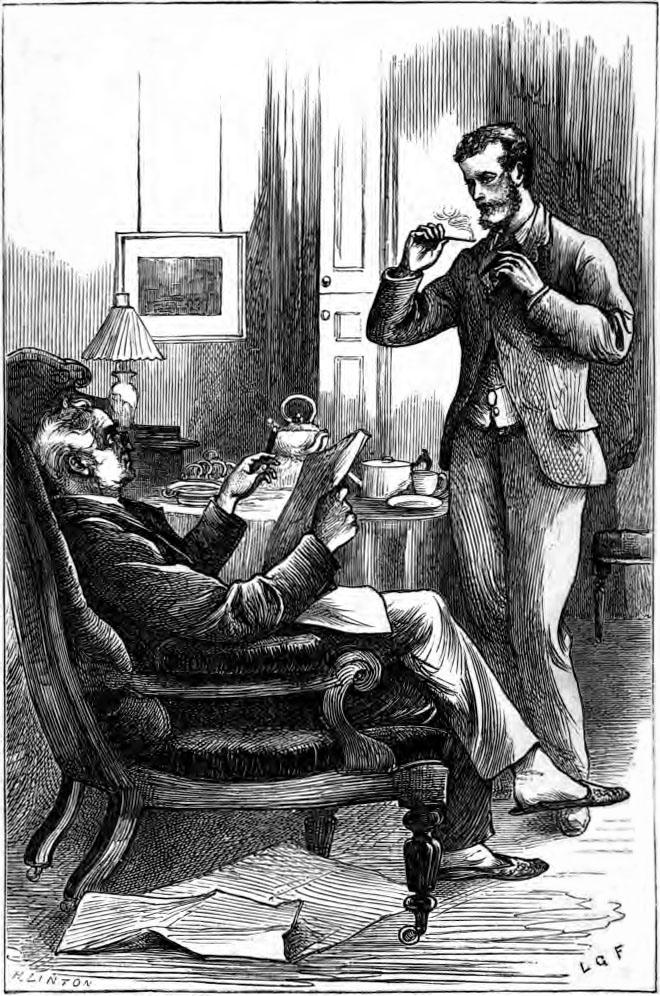
"Oh no;--not in the least;--if the money's really there. Have you
heard any sum named, sir?" The old man only grunted. "There are
two sisters and two brothers. I don't suppose the girls would have a
hundred thousand each."
"They say the widow of that brewer who died the other day has about
twenty thousand a year."
"It's only for her life, sir."
"She could insure her life. D----me, sir, we must do something. If
you turn up your nose at one woman after another how do you mean to
live?"
"I don't think that a woman of forty with only a life interest would
be a good speculation. Of course I'll think of it if you press it."
The old man growled again. "You see, sir, I've been so much in
earnest about this girl that I haven't thought of inquiring about
any one else. There always is some one up with a lot of money. It's
a pity there shouldn't be a regular statement published with the
amount of money, and what is expected in return. It 'd save a deal of
trouble."
"If you can't talk more seriously than that you'd better go away,"
said the old Marquis.
At that moment a footman came into the room and told Lord Nidder-
dale that a man particularly wished to see him in the hall. He was not
always anxious to see those who called on him, and he asked the
servant whether he knew who the man was. "I believe, my lord, he's
one of the domestics from Mr. Melmotte's in Bruton Street," said the
footman, who was no doubt fully acquainted with all the circumstances
of Lord Nidderdale's engagement. The son, who was still smoking,
looked at his father as though in doubt. "You'd better go and see,"
said the Marquis. But Nidderdale before he went asked a question as
to what he had better do if Melmotte had sent for him. "Go and see
Melmotte. Why should you be afraid to see him? Tell him that you are
ready to marry the girl if you can see the money down, but that you
won't stir a step till it has been actually paid over."
"He knows that already," said Nidderdale as he left the room.
In the hall he found a man whom he recognised as Melmotte's butler, a
ponderous, elderly, heavy man who now had a letter in his hand. But
the lord could tell by the man's face and manner that he himself had
some story to tell. "Is there anything the matter?"
"Yes, my lord,--yes. Oh, dear,--oh, dear! I think you'll be sorry to
hear it. There was none who came there he seemed to take to so much
as your lordship."
"They've taken him to prison!" exclaimed Nidderdale. But the man
shook his head. "What is it then? He can't be dead." Then the man
nodded his head, and, putting his hand up to his face, burst into
tears. "Mr. Melmotte dead! He was in the House of Commons last night.
I saw him myself. How did he die?" But the fat, ponderous man was
so affected by the tragedy he had witnessed, that he could not as
yet give any account of the scene of his master's death, but simply
handed the note which he had in his hand to Lord Nidderdale. It was
from Marie, and had been written within half an hour of the time at
which news had been brought to her of what had occurred. The note
was as follows:--
DEAR LORD NIDDERDALE,
The man will tell you what has happened. I feel as though
I was mad. I do not know who to send to. Will you come to
me, only for a few minutes?
MARIE.
He read it standing up in the hall, and then again asked the man as
to the manner of his master's death. And now the Marquis, gathering
from a word or two that he heard and from his son's delay that
something special had occurred, hobbled out into the hall. "Mr.
Melmotte is--dead," said his son. The old man dropped his stick,
and fell back against the wall. "This man says that he is dead, and
here is a letter from Marie asking me to go there. How was it that
he--died?"
"It was--poison," said the butler solemnly. "There has been a
doctor already, and there isn't no doubt of that. He took it all by
himself last night. He came home, perhaps a little fresh, and he
had in brandy and soda and cigars;--and sat himself down all to him-
self. Then in the morning, when the young woman went in,--there he
was,--poisoned! I see him lay on the ground, and I helped to lift him
up, and there was that smell of prussic acid that I knew what he had
been and done just the same as when the doctor came and told us."
Before the man could be allowed to go back, there was a consultation
between the father and son as to a compliance with the request which
Marie had made in her first misery. The Marquis thought that his son
had better not go to Bruton Street. "What's the use? What good can
you do? She'll only be falling into your arms, and that's what you've
got to avoid,--at any rate, till you know how things are."
But Nidderdale's better feelings would not allow him to submit to
this advice. He had been engaged to marry the girl, and she in her
abject misery had turned to him as the friend she knew best. At any
rate for the time the heartlessness of his usual life deserted him,
and he felt willing to devote himself to the girl not for what he
could get,--but because she had so nearly been so near to him. "I
couldn't refuse her," he said over and over again. "I couldn't bring
myself to do it. Oh, no;--I shall certainly go."
"You'll get into a mess if you do."
"Then I must get into a mess. I shall certainly go. I will go at
once. It is very disagreeable, but I cannot possibly refuse. It would
be abominable." Then going back to the hall, he sent a message by the
butler to Marie, saying that he would be with her in less than half
an hour.
"Don't you go and make a fool of yourself," his father said to him
when he was alone. "This is just one of those times when a man may
ruin himself by being soft-hearted." Nidderdale simply shook his head
as he took his hat and gloves to go across to Bruton Street.
CHAPTER LXXXVI.
THE MEETING IN BRUTON STREET.
When the news of her husband's death was in some very rough way
conveyed to Madame Melmotte, it crushed her for the time altogether.
Marie first heard that she no longer had a living parent as she stood
by the poor woman's bedside, and she was enabled, as much perhaps by
the necessity incumbent upon her of attending to the wretched woman
as by her own superior strength of character, to save herself from
that prostration and collapse of power which a great and sudden blow
is apt to produce. She stared at the woman who first conveyed to her
tidings of the tragedy, and then for a moment seated herself at the
bedside. But the violent sobbings and hysterical screams of Madame
Melmotte soon brought her again to her feet, and from that moment she
was not only active but efficacious. No;--she would not go down to
the room; she could do no good by going thither. But they must send
for a doctor. They should send for a doctor immediately. She was then
told that a doctor and an inspector of police were already in the
rooms below. The necessity of throwing whatever responsibility there
might be on to other shoulders had been at once apparent to the
servants, and they had sent out right and left, so that the house
might be filled with persons fit to give directions in such an emer-
gency. The officers from the police station were already there when
the woman who now filled Didon's place in the house communicated
to Madame Melmotte the fact that she was a widow.
It was afterwards said by some of those who had seen her at the time,
that Marie Melmotte had shown a hard heart on the occasion. But the
condemnation was wrong. Her feeling for her father was certainly not
that which we are accustomed to see among our daughters and sisters.
He had never been to her the petted divinity of the household, whose
slightest wish had been law, whose little comforts had become matters
of serious care, whose frowns were horrid clouds, whose smiles were
glorious sunshine, whose kisses were daily looked for, and if missed
would be missed with mourning. How should it have been so with
her? In all the intercourses of her family, since the first rough
usage which she remembered, there had never been anything sweet
or gracious. Though she had recognised a certain duty, as due from
herself to her father, she had found herself bound to measure it,
so that more should not be exacted from her than duty required. She
had long known that her father would fain make her a slave for his
own purposes, and that if she put no limits to her own obedience he
certainly would put none. She had drawn no comparison between him
and other fathers, or between herself and other daughters, because
she had never become conversant with the ways of other families.
After a fashion she had loved him, because nature creates love in a
daughter's heart; but she had never respected him, and had spent the
best energies of her character on a resolve that she would never fear
him. "He may cut me into pieces, but he shall not make me do for his
advantage that which I do not think he has a right to exact from
me." That had been the state of her mind towards her father; and now
that he had taken himself away with terrible suddenness, leaving
her to face the difficulties of the world with no protector and no
assistance, the feeling which dominated her was no doubt one of awe
rather than of broken-hearted sorrow. Those who depart must have
earned such sorrow before it can be really felt. They who are left
may be overwhelmed by the death--even of their most cruel tormentors.
Madame Melmotte was altogether overwhelmed; but it could not probably
be said of her with truth that she was crushed by pure grief. There
was fear of all things, fear of solitude, fear of sudden change, fear
of terrible revelations, fear of some necessary movement she knew
not whither, fear that she might be discovered to be a poor wretched
impostor who never could have been justified in standing in the
same presence with emperors and princes, with duchesses and cabinet
ministers. This and the fact that the dead body of the man who had so
lately been her tyrant was lying near her, so that she might hardly
dare to leave her room lest she should encounter him dead, and thus
more dreadful even than when alive, utterly conquered her. Feelings
of the same kind, the same fears, and the same awe were powerful
also with Marie;--but they did not conquer her. She was strong and
conquered them; and she did not care to affect a weakness to which
she was in truth superior. In such a household the death of such a
father after such a fashion will hardly produce that tender sorrow
which comes from real love.
She soon knew it all. Her father had destroyed himself, and had
doubtless done so because his troubles in regard to money had been
greater than he could bear. When he had told her that she was to sign
those deeds because ruin was impending, he must indeed have told her
the truth. He had so often lied to her that she had had no means of
knowing whether he was lying then or telling her a true story. But
she had offered to sign the deeds since that, and he had told her
that it would be of no avail,--and at that time had not been angry
with her as he would have been had her refusal been the cause of his
ruin. She took some comfort in thinking of that.
But what was she to do? What was to be done generally by that
over-cumbered household? She and her pseudo-mother had been
instructed to pack up their jewellery, and they had both obeyed
the order. But she herself at this moment cared but little for any
property. How ought she to behave herself? Where should she go? On
whose arm could she lean for some support at this terrible time?
As for love, and engagements, and marriage,--that was all over. In
her difficulty she never for a moment thought of Sir Felix Carbury.
Though she had been silly enough to love the man because he was
pleasant to look at, she had never been so far gone in silliness
as to suppose that he was a staff upon which any one might lean.
Had that marriage taken place, she would have been the staff. But
it might be possible that Lord Nidderdale would help her. He was
good-natured and manly, and would be efficacious,--if only he would
come to her. He was near, and she thought that at any rate she would
try. So she had written her note and sent it by the butler,--thinking
as she did so of the words she would use to make the young man
understand that all the nonsense they had talked as to marrying each
other was, of course, to mean nothing now.
It was past eleven when he reached the house, and he was shown
up-stairs into one of the sitting-rooms on the first-floor. As he
passed the door of the study, which was at the moment partly open,
he saw the dress of a policeman within, and knew that the body of
the dead man was still lying there. But he went by rapidly without a
glance within, remembering the look of the man as he had last seen
his burly figure, and that grasp of his hand, and those odious words.
And now the man was dead,--having destroyed his own life. Surely the
man must have known when he uttered those words what it was that
he intended to do! When he had made that last appeal about Marie,
conscious as he was that everyone was deserting him, he must even
then have looked his fate in the face and have told himself that it
was better that he should die! His misfortunes, whatever might be
their nature, must have been heavy on him then with all their weight;
and he himself and all the world had known that he was ruined.
And yet he had pretended to be anxious about the girl's marriage,
and had spoken of it as though he still believed that it would be
accomplished!
Nidderdale had hardly put his hat down on the table before Marie
was with him. He walked up to her, took her by both hands, and
looked into her face. There was no trace of a tear, but her whole
countenance seemed to him to be altered. She was the first to speak.
"I thought you would come when I sent for you."
"Of course I came."
"I knew you would be a friend, and I knew no one else who would. You
won't be afraid, Lord Nidderdale, that I shall ever think any more of
all those things which he was planning?" She paused a moment, but he
was not ready enough to have a word to say in answer to this. "You
know what has happened?"
"Your servant told us."
"What are we to do? Oh, Lord Nidderdale, it is so dreadful! Poor
papa! Poor papa! When I think of all that he must have suffered I
wish that I could be dead too."
"Has your mother been told?"
"Oh yes. She knows. No one tried to conceal anything for a moment.
It was better that it should be so;--better at last. But we have
no friends who would be considerate enough to try to save us from
sorrow. But I think it was better. Mamma is very bad. She is always
nervous and timid. Of course this has nearly killed her. What ought
we to do? It is Mr. Longestaffe's house, and we were to have left it
to-morrow."
"He will not mind that now."
"Where must we go? We can't go back to that big place in Grosvenor
Square. Who will manage for us? Who will see the doctor and the
policemen?"
"I will do that."
"But there will be things that I cannot ask you to do. Why should I
ask you to do anything?"
"Because we are friends."
"No," she said, "no. You cannot really regard me as a friend. I have
been an impostor. I know that. I had no business to know a person
like you at all. Oh, if the next six months could be over! Poor
papa;--poor papa!" And then for the first time she burst into tears.
"I wish I knew what might comfort you," he said.
"How can there be any comfort? There never can be comfort again! As
for comfort, when were we ever comfortable? It has been one trouble
after another,--one fear after another! And now we are friendless and
homeless. I suppose they will take everything that we have."
"Your papa had a lawyer, I suppose?"
"I think he had ever so many,--but I do not know who they were. His
own clerk, who had lived with him for over twenty years, left him
yesterday. I suppose they will know something in Abchurch Lane; but
now that Herr Croll has gone I am not acquainted even with the name
of one of them. Mr. Miles Grendall used to be with him."
"I do not think that he could be of much service."
"Nor Lord Alfred? Lord Alfred was always with him till very lately."
Nidderdale shook his head. "I suppose not. They only came because
papa had a big house." The young lord could not but feel that he
was included in the same rebuke. "Oh, what a life it has been! And
now,--now it's over." As she said this it seemed that for the moment
her strength failed her, for she fell backwards on the corner of the
sofa. He tried to raise her, but she shook him away, burying her
face in her hands. He was standing close to her, still holding her
arm, when he heard a knock at the front door, which was immediately
opened, as the servants were hanging about in the hall. "Who are
they?" said Marie, whose sharp ears caught the sound of various
steps. Lord Nidderdale went out on to the head of the stairs, and
immediately heard the voice of Dolly Longestaffe.
Dolly Longestaffe had on that morning put himself early into the care
of Mr. Squercum, and it had happened that he with his lawyer had met
his father with Mr. Bideawhile at the corner of the square. They were
all coming according to appointment to receive the money which Mr.
Melmotte had promised to pay them at this very hour. Of course they
had none of them as yet heard of the way in which the Financier had
made his last grand payment, and as they walked together to the door
had been intent only in reference to their own money. Squercum, who
had heard a good deal on the previous day, was very certain that the
money would not be forthcoming, whereas Bideawhile was sanguine of
success. "Don't we wish we may get it?" Dolly had said, and by saying
so had very much offended his father, who had resented the want of
reverence implied in the use of that word "we." They had all been
admitted together, and Dolly had at once loudly claimed an old
acquaintance with some of the articles around him. "I knew I'd got a
coat just like that," said Dolly, "and I never could make out what my
fellow had done with it." This was the speech which Nidderdale had
heard, standing on the top of the stairs.
The two lawyers had at once seen, from the face of the man who had
opened the door and from the presence of three or four servants in
the hall, that things were not going on in their usual course. Before
Dolly had completed his buffoonery the butler had whispered to Mr.
Bideawhile that Mr. Melmotte--"was no more."
"Dead!" exclaimed Mr. Bideawhile. Squercum put his hands into his
trowsers pockets and opened his mouth wide. "Dead!" muttered Mr.
Longestaffe senior. "Dead!" said Dolly. "Who's dead?" The butler
shook his head. Then Squercum whispered a word into the butler's
ear, and the butler thereupon nodded his head. "It's about what I
expected," said Squercum. Then the butler whispered the word to Mr.
Longestaffe, and whispered it also to Mr. Bideawhile, and they all
knew that the millionaire had swallowed poison during the night.
It was known to the servants that Mr. Longestaffe was the owner of
the house, and he was therefore, as having authority there, shown
into the room where the body of Melmotte was lying on a sofa. The two
lawyers and Dolly of course followed, as did also Lord Nidderdale,
who had now joined them from the lobby above. There was a policeman
in the room who seemed to be simply watching the body, and who
rose from his seat when the gentlemen entered. Two or three of the
servants followed them, so that there was almost a crowd round the
dead man's bier. There was no further tale to be told. That Melmotte
had been in the House on the previous night, and had there disgraced
himself by intoxication, they had known already. That he had been
found dead that morning had been already announced. They could only
stand round and gaze on the square, sullen, livid features of the
big-framed man, and each lament that he had ever heard the name of
Melmotte.
"Are you in the house here?" said Dolly to Lord Nidderdale in a
whisper.
"She sent for me. We live quite close, you know. She wanted somebody
to tell her something. I must go up to her again now."
"Had you seen him before?"
"No indeed. I only came down when I heard your voices. I fear it will
be rather bad for you;--won't it?"
"He was regularly smashed, I suppose?" asked Dolly.
"I know nothing myself. He talked to me about his affairs once, but
he was such a liar that not a word that he said was worth anything.
I believed him then. How it will go, I can't say."
"That other thing is all over of course," suggested Dolly.
Nidderdale intimated by a gesture of his head that the other thing
was all over, and then returned to Marie. There was nothing further
that the four gentlemen could do, and they soon departed from the
house;--not, however, till Mr. Bideawhile had given certain short
injunctions to the butler concerning the property contained in Mr.
Longestaffe's town residence.
"They had come to see him," said Lord Nidderdale in a whisper. "There
was some appointment. He had told them to be all here at this hour."
"They didn't know, then?" asked Marie.
"Nothing,--till the man told them."
"And did you go in?"
"Yes; we all went into the room." Marie shuddered, and again hid her
face. "I think the best thing I can do," said Nidderdale, "is to go
to Abchurch Lane, and find out from Smith who is the lawyer whom he
chiefly trusted. I know Smith had to do with his own affairs, because
he has told me so at the Board; and if necessary I will find out
Croll. No doubt I can trace him. Then we had better employ the lawyer
to arrange everything for you."
"And where had we better go to?"
"Where would Madame Melmotte wish to go?"
"Anywhere, so that we could hide ourselves. Perhaps Frankfort would
be the best. But shouldn't we stay till something has been done
here? And couldn't we have lodgings, so as to get away from Mr.
Longestaffe's house?" Nidderdale promised that he himself would look
for lodgings, as soon as he had seen the lawyer. "And now, my lord,
I suppose that I never shall see you again," said Marie.
"I don't know why you should say that."
"Because it will be best. Why should you? All this will be trouble
enough to you when people begin to say what we are. But I don't think
it has been my fault."
"Nothing has ever been your fault."
"Good-bye, my lord. I shall always think of you as one of the kindest
people I ever knew. I thought it best to send to you for different
reasons, but I do not want you to come back."
"Good-bye, Marie. I shall always remember you." And so they parted.
After that he did go into the City, and succeeded in finding both
Mr. Smith and Herr Croll. When he reached Abchurch Lane, the news of
Melmotte's death had already been spread abroad; and more was known,
or said to be known, of his circumstances than Nidderdale had as yet
heard. The crushing blow to him, so said Herr Croll, had been the
desertion of Cohenlupe,--that and the sudden fall in the value of the
South Central Pacific and Mexican Railway shares, consequent on the
rumours spread about the City respecting the Pickering property. It
was asserted in Abchurch Lane that had he not at that moment touched
the Pickering property, or entertained the Emperor, or stood for
Westminster, he must, by the end of the autumn, have been able to do
any or all of those things without danger, simply as the result of
the money which would then have been realised by the railway. But he
had allowed himself to become hampered by the want of comparatively
small sums of ready money, and in seeking relief had rushed from one
danger to another, till at last the waters around him had become
too deep even for him, and had overwhelmed him. As to his immediate
death, Herr Croll expressed not the slightest astonishment. It was
just the thing, Herr Croll said, that he had been sure that Melmotte
would do, should his difficulties ever become too great for him. "And
dere vas a leetle ting he lay himself open by de oder day," said
Croll, "dat vas nasty,--very nasty." Nidderdale shook his head, but
asked no questions. Croll had alluded to the use of his own name, but
did not on this occasion make any further revelation. Then Croll made
a further statement to Lord Nidderdale, which I think he must have
done in pure good-nature. "My lor," he said, whispering very gravely,
"de money of de yong lady is all her own." Then he nodded his head
three times. "Nobody can toch it, not if he vas in debt millions."
Again he nodded his head.
"I am very glad to hear it for her sake," said Lord Nidderdale as he
took his leave.
CHAPTER LXXXVII.
DOWN AT CARBURY.
When Roger Carbury returned to Suffolk, after seeing his cousins in
Welbeck Street, he was by no means contented with himself. That he
should be discontented generally with the circumstances of his life
was a matter of course. He knew that he was farther removed than
ever from the object on which his whole mind was set. Had Hetta
Carbury learned all the circumstances of Paul's engagement with
Mrs. Hurtle before she had confessed her love to Paul,--so that her
heart might have been turned against the man before she had made her
confession,--then, he thought, she might at last have listened to
him. Even though she had loved the other man, she might have at last
done so, as her love would have been buried in her own bosom. But the
tale had been told after the fashion which was most antagonistic to
his own interests. Hetta had never heard Mrs. Hurtle's name till she
had given herself away, and had declared to all her friends that she
had given herself away to this man, who was so unworthy of her. The
more Roger thought of this, the more angry he was with Paul Montague,
and the more convinced that that man had done him an injury which he
could never forgive.
But his grief extended even beyond that. Though he was never tired
of swearing to himself that he would not forgive Paul Montague, yet
there was present to him a feeling that an injury was being done to
the man, and that he was in some sort responsible for that injury.
He had declined to tell Hetta any part of the story about Mrs.
Hurtle,--actuated by a feeling that he ought not to betray the trust
put in him by a man who was at the time his friend; and he had told
nothing. But no one knew so well as he did the fact that all the
attention latterly given by Paul to the American woman had by no
means been the effect of love, but had come from a feeling on Paul's
part that he could not desert the woman he had once loved, when
she asked him for his kindness. If Hetta could know everything
exactly,--if she could look back and read the state of Paul's mind as
he, Roger, could read it,--then she would probably forgive the man,
or perhaps tell herself that there was nothing for her to forgive.
Roger was anxious that Hetta's anger should burn hot,--because of
the injury done to himself. He thought that there were ample reasons
why Paul Montague should be punished,--why Paul should be utterly
expelled from among them, and allowed to go his own course. But it
was not right that the man should be punished on false grounds. It
seemed to Roger now that he was doing an injustice to his enemy by
refraining from telling all that he knew.
As to the girl's misery in losing her lover, much as he loved her,
true as it was that he was willing to devote himself and all that
he had to her happiness, I do not think that at the present moment
he was disturbed in that direction. It is hardly natural, perhaps,
that a man should love a woman with such devotion as to wish to
make her happy by giving her to another man. Roger told himself that
Paul would be an unsafe husband, a fickle husband,--one who might
be carried hither and thither both in his circumstances and his
feelings,--and that it would be better for Hetta that she should not
marry him; but at the same time he was unhappy as he reflected that
he himself was a party to a certain amount of deceit.
And yet he had said not a word. He had referred Hetta to the man
himself. He thought that he knew, and he did indeed accurately know,
the state of Hetta's mind. She was wretched because she thought that
while her lover was winning her love, while she herself was willingly
allowing him to win her love, he was dallying with another woman, and
making to that other woman promises the same as those he made to her.
This was not true. Roger knew that it was not true. But when he tried
to quiet his conscience by saying that they must fight it out among
themselves, he felt himself to be uneasy under that assurance.
His life at Carbury, at this time, was very desolate. He had become
tired of the priest, who, in spite of various repulses, had never for
a moment relaxed his efforts to convert his friend. Roger had told
him once that he must beg that religion might not be made the subject
of further conversation between them. In answer to this, Father
Barham had declared that he would never consent to remain as an
intimate associate with any man on those terms. Roger had persisted
in his stipulation, and the priest had then suggested that it was
his host's intention to banish him from Carbury Hall. Roger had made
no reply, and the priest had of course been banished. But even this
added to his misery. Father Barham was a gentleman, was a good man,
and in great penury. To ill-treat such a one, to expel such a one
from his house, seemed to Roger to be an abominable cruelty. He was
unhappy with himself about the priest, and yet he could not bid the
man come back to him. It was already being said of him among his
neighbours, at Eardly, at Caversham, and at the Bishop's palace, that
he either had become or was becoming a Roman Catholic, under the
priest's influence. Mrs. Yeld had even taken upon herself to write
to him a most affectionate letter, in which she said very little as
to any evidence that had reached her as to Roger's defection, but
dilated at very great length on the abominations of a certain lady
who is supposed to indulge in gorgeous colours.
He was troubled, too, about old Daniel Ruggles, the farmer at Sheep's
Acre, who had been so angry because his niece would not marry John
Crumb. Old Ruggles, when abandoned by Ruby and accused by his
neighbours of personal cruelty to the girl, had taken freely to that
source of consolation which he found to be most easily within his
reach. Since Ruby had gone he had been drunk every day, and was
making himself generally a scandal and a nuisance. His landlord
had interfered with his usual kindness, and the old man had always
declared that his niece and John Crumb were the cause of it all;
for now, in his maudlin misery, he attributed as much blame to the
lover as he did to the girl. John Crumb wasn't in earnest. If he
had been in earnest he would have gone after her to London at once.
No;--he wouldn't invite Ruby to come back. If Ruby would come back,
repentant, full of sorrow,--and hadn't been and made a fool of
herself in the meantime,--then he'd think of taking her back. In the
meantime, with circumstances in their present condition, he evidently
thought that he could best face the difficulties of the world by an
unfaltering adhesion to gin, early in the day and all day long. This,
too, was a grievance to Roger Carbury.
But he did not neglect his work, the chief of which at the present
moment was the care of the farm which he kept in his own hands. He
was making hay at this time in certain meadows down by the river
side; and was standing by while the men were loading a cart, when he
saw John Crumb approaching across the field. He had not seen John
since the eventful journey to London; nor had he seen him in London;
but he knew well all that had occurred,--how the dealer in pollard
had thrashed his cousin, Sir Felix, how he had been locked up by the
police and then liberated,--and how he was now regarded in Bungay
as a hero, as far as arms were concerned, but as being very "soft"
in the matter of love. The reader need hardly be told that Roger was
not at all disposed to quarrel with Mr. Crumb, because the victim
of Crumb's heroism had been his own cousin. Crumb had acted well,
and had never said a word about Sir Felix since his return to the
country. No doubt he had now come to talk about his love,--and in
order that his confessions might not be made before all the assembled
haymakers, Roger Carbury hurried to meet him. There was soon
evident on Crumb's broad face a whole sunshine of delight. As Roger
approached him he began to laugh aloud, and to wave a bit of paper
that he had in his hands. "She's a coomin; she's a coomin," were the
first words he uttered. Roger knew very well that in his friend's
mind there was but one "she" in the world, and that the name of that
she was Ruby Ruggles.
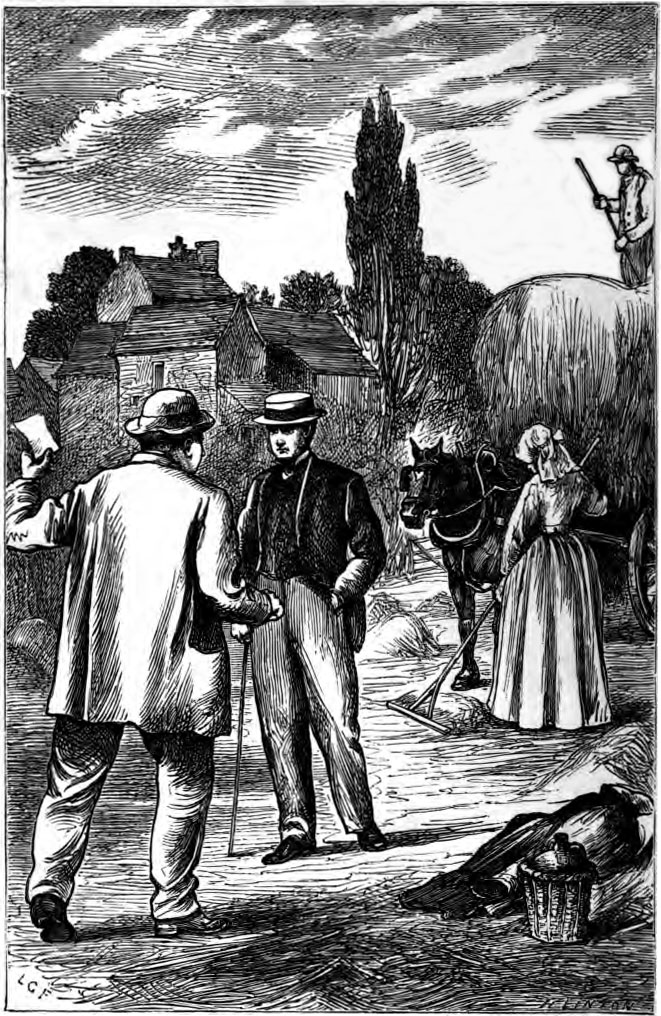
"I am delighted to hear it," said Roger. "She has made it up with her
grandfather?"
"Don't know now't about grandfeyther. She have made it up wi' me.
Know'd she would when I'd polish'd t'other un off a bit;--know'd she
would."
"Has she written to you, then?"
"Well, squoire,--she ain't; not just herself. I do suppose that isn't
the way they does it. But it's all as one." And then Mr. Crumb thrust
Mrs. Hurtle's note into Roger Carbury's hand.
Roger certainly was not predisposed to think well or kindly of Mrs.
Hurtle. Since he had first known Mrs. Hurtle's name, when Paul
Montague had told the story of his engagement on his return from
America, Roger had regarded her as a wicked, intriguing, bad woman.
It may, perhaps, be confessed that he was prejudiced against all
Americans, looking upon Washington much as he did upon Jack Cade or
Wat Tyler; and he pictured to himself all American women as being
loud, masculine, and atheistical. But it certainly did seem that in
this instance Mrs. Hurtle was endeavouring to do a good turn from
pure charity. "She is a lady," Crumb began to explain, "who do be
living with Mrs. Pipkin; and she is a lady as is a lady."
Roger could not fully admit the truth of this assertion; but he
explained that he, too, knew something of Mrs. Hurtle, and that he
thought it probable that what she said of Ruby might be true. "True,
squoire!" said Crumb, laughing with his whole face. "I ha' nae a
doubt it's true. What's again its being true? When I had dropped into
t'other fellow, of course she made her choice. It was me as was to
blame, because I didn't do it before. I ought to ha' dropped into him
when I first heard as he was arter her. It's that as girls like. So,
squoire, I'm just going again to Lon'on right away."
Roger suggested that old Ruggles would, of course, receive his niece;
but as to this John expressed his supreme indifference. The old man
was nothing to him. Of course he would like to have the old man's
money; but the old man couldn't live for ever, and he supposed that
things would come right in time. But this he knew,--that he wasn't
going to cringe to the old man about his money. When Roger observed
that it would be better that Ruby should have some home to which she
might at once return, John adverted with a renewed grin to all the
substantial comforts of his own house. It seemed to be his idea, that
on arriving in London he would at once take Ruby away to church and
be married to her out of hand. He had thrashed his rival, and what
cause could there now be for delay?
But before he left the field he made one other speech to the squire.
"You ain't a'taken it amiss, squoire, 'cause he was coosin to
yourself?"
"Not in the least, Mr. Crumb."
"That's koind now. I ain't a done the yong man a ha'porth o' harm,
and I don't feel no grudge again him, and when me and Ruby's once
spliced, I'm darned if I don't give 'un a bottle of wine the first
day as he'll come to Bungay."
Roger did not feel himself justified in accepting this invitation on
the part of Sir Felix; but he renewed his assurance that he, on his
own part, thought that Crumb had behaved well in that matter of the
street encounter, and he expressed a strong wish for the immediate
and continued happiness of Mr. and Mrs. John Crumb.
"Oh, ay, we'll be 'appy, squoire," said Crumb as he went exulting out
of the field.
On the day after this Roger Carbury received a letter which disturbed
him very much, and to which he hardly knew whether to return any
answer, or what answer. It was from Paul Montague, and was written by
him but a few hours after he had left his letter for Hetta with his
own hands, at the door of her mother's house. Paul's letter to Roger
was as follows:--
MY DEAR ROGER,--
Though I know that you have cast me off from you I cannot
write to you in any other way, as any other way would be
untrue. You can answer me, of course, as you please, but
I do think that you will owe me an answer, as I appeal to
you in the name of justice.
You know what has taken place between Hetta and myself.
She had accepted me, and therefore I am justified in
feeling sure that she must have loved me. But she has now
quarrelled with me altogether, and has told me that I am
never to see her again. Of course I don't mean to put up
with this. Who would? You will say that it is no business
of yours. But I think that you would not wish that she
should be left under a false impression, if you could put
her right.
Somebody has told her the story of Mrs. Hurtle. I suppose
it was Felix, and that he had learned it from those people
at Islington. But she has been told that which is untrue.
Nobody knows and nobody can know the truth as you do. She
supposes that I have willingly been passing my time with
Mrs. Hurtle during the last two months, although during
that very time I have asked for and have received the
assurance of her love. Now, whether or no I have been to
blame about Mrs. Hurtle,--as to which nothing at present
need be said,--it is certainly the truth that her coming
to England was not only not desired by me, but was felt by
me to be the greatest possible misfortune. But after all
that had passed I certainly owed it to her not to neglect
her;--and this duty was the more incumbent on me as she
was a foreigner and unknown to any one. I went down to
Lowestoft with her at her request, having named the place
to her as one known to myself, and because I could not
refuse her so small a favour. You know that it was so, and
you know also, as no one else does, that whatever courtesy
I have shown to Mrs. Hurtle in England, I have been
constrained to show her.
I appeal to you to let Hetta know that this is true.
She had made me understand that not only her mother and
brother, but you also, are well acquainted with the story
of my acquaintance with Mrs. Hurtle. Neither Lady Carbury
nor Sir Felix has ever known anything about it. You, and
you only, have known the truth. And now, though at the
present you are angry with me, I call upon you to tell
Hetta the truth as you know it. You will understand me
when I say that I feel that I am being destroyed by a
false representation. I think that you, who abhor a
falsehood, will see the justice of setting me right, at
any rate as far as the truth can do so. I do not want you
to say a word for me beyond that.
Yours always,
PAUL MONTAGUE.
What business is all that of mine? This, of course, was the first
feeling produced in Roger's mind by Montague's letter. If Hetta had
received any false impression, it had not come from him. He had told
no stories against his rival, whether true or false. He had been so
scrupulous that he had refused to say a word at all. And if any false
impression had been made on Hetta's mind, either by circumstances
or by untrue words, had not Montague deserved any evil that might
fall upon him? Though every word in Montague's letter might be true,
nevertheless, in the end, no more than justice would be done him,
even should he be robbed at last of his mistress under erroneous
impressions. The fact that he had once disgraced himself by offering
to make Mrs. Hurtle his wife, rendered him unworthy of Hetta Carbury.
Such, at least, was Roger Carbury's verdict as he thought over all
the circumstances. At any rate, it was no business of his to correct
these wrong impressions.
And yet he was ill at ease as he thought of it all. He did believe
that every word in Montague's letter was true. Though he had been
very indignant when he met Paul and Mrs. Hurtle together on the sands
at Lowestoft, he was perfectly convinced that the cause of their
coming there had been precisely that which Montague had stated.
It took him two days to think over all this, two days of great
discomfort and unhappiness. After all, why should he be a dog in the
manger? The girl did not care for him,--looked upon him as an old man
to be regarded in a fashion altogether different from that in which
she regarded Paul Montague. He had let his time for love-making go
by, and now it behoved him, as a man, to take the world as he found
it, and not to lose himself in regrets for a kind of happiness which
he could never attain. In such an emergency as this he should do what
was fair and honest, without reference to his own feelings. And yet
the passion which dominated John Crumb altogether, which made the
mealman so intent on the attainment of his object as to render all
other things indifferent to him for the time, was equally strong with
Roger Carbury. Unfortunately for Roger, strong as his passion was,
it was embarrassed by other feelings. It never occurred to Crumb to
think whether he was a fit husband for Ruby, or whether Ruby, having
a decided preference for another man, could be a fit wife for him.
But with Roger there were a thousand surrounding difficulties to
hamper him. John Crumb never doubted for a moment what he should
do. He had to get the girl, if possible, and he meant to get her
whatever she might cost him. He was always confident though sometimes
perplexed. But Roger had no confidence. He knew that he should never
win the game. In his sadder moments he felt that he ought not to
win it. The people around him, from old fashion, still called him
the young squire! Why;--he felt himself at times to be eighty years
old,--so old that he was unfitted for intercourse with such juvenile
spirits as those of his neighbour the bishop, and of his friend
Hepworth. Could he, by any training, bring himself to take her
happiness in hand, altogether sacrificing his own?
In such a mood as this he did at last answer his enemy's letter,--and
he answered it as follows:--
I do not know that I am concerned to meddle in your
affairs at all. I have told no tale against you, and I
do not know that I have any that I wish to tell in your
favour, or that I could so tell if I did wish. I think
that you have behaved badly to me, cruelly to Mrs. Hurtle,
and disrespectfully to my cousin. Nevertheless, as you
appeal to me on a certain point for evidence which I
can give, and which you say no one else can give, I do
acknowledge that, in my opinion, Mrs. Hurtle's presence in
England has not been in accordance with your wishes, and
that you accompanied her to Lowestoft, not as her lover
but as an old friend whom you could not neglect.
ROGER CARBURY.
Paul Montague, Esq.
You are at liberty to show this letter to Miss Carbury,
if you please; but if she reads part she should read the
whole!
There was more perhaps of hostility in this letter than of that
spirit of self-sacrifice to which Roger intended to train himself;
and so he himself felt after the letter had been dispatched.
CHAPTER LXXXVIII.
THE INQUEST.
Melmotte had been found dead on Friday morning, and late on the
evening of the same day Madame Melmotte and Marie were removed to
lodgings far away from the scene of the tragedy, up at Hampstead.
Herr Croll had known of the place, and at Lord Nidderdale's instance
had busied himself in the matter, and had seen that the rooms were
made instantly ready for the widow of his late employer. Nidderdale
himself had assisted them in their departure; and the German, with
the poor woman's maid, with the jewels also, which had been packed
according to Melmotte's last orders to his wife, followed the
carriage which took the mother and the daughter. They did not start
till nine o'clock in the evening, and Madame Melmotte at the moment
would fain have been allowed to rest one other night in Bruton
Street. But Lord Nidderdale, with one hardly uttered word, made Marie
understand that the inquest would be held early on the following
morning, and Marie was imperious with her mother and carried her
point. So the poor woman was taken away from Mr. Longestaffe's
residence, and never again saw the grandeur of her own house in
Grosvenor Square, which she had not visited since the night on which
she had helped to entertain the Emperor of China.
On Saturday morning the inquest was held. There was not the slight-
est doubt as to any one of the incidents of the catastrophe. The
servants, the doctor, and the inspector of police between them,
learned that he had come home alone, that nobody had been near
him during the night, that he had been found dead, and that he had
undoubtedly been poisoned by prussic acid. It was also proved that he
had been drunk in the House of Commons, a fact to which one of the
clerks of the House, very much against his will, was called upon to
testify. That he had destroyed himself there was no doubt,--nor was
there any doubt as to the cause.
In such cases as this it is for the jury to say whether the
unfortunate one who has found his life too hard for endurance,
and has rushed away to see whether he could not find an improved
condition of things elsewhere, has or has not been mad at the moment.
Surviving friends are of course anxious for a verdict of insanity, as
in that case no further punishment is exacted. The body can be bur-
ied like any other body, and it can always be said afterwards that the
poor man was mad. Perhaps it would be well that all suicides should
be said to have been mad, for certainly the jurymen are not generally
guided in their verdicts by any accurately ascertained facts. If the
poor wretch has, up to his last days, been apparently living a decent
life; if he be not hated, or has not in his last moments made himself
specially obnoxious to the world at large, then he is declared to
have been mad. Who would be heavy on a poor clergyman who has
been at last driven by horrid doubts to rid himself of a difficulty from
which he saw no escape in any other way? Who would not give the
benefit of the doubt to the poor woman whose lover and lord had
deserted her? Who would remit to unhallowed earth the body of the
once beneficent philosopher who has simply thought that he might
as well go now, finding himself powerless to do further good upon
earth? Such, and such like, have of course been temporarily insane,
though no touch even of strangeness may have marked their conduct
up to their last known dealings with their fellow-mortals. But let
a Melmotte be found dead, with a bottle of prussic acid by his
side--a man who has become horrid to the world because of his late
iniquities, a man who has so well pretended to be rich that he has
been able to buy and to sell properties without paying for them, a
wretch who has made himself odious by his ruin to friends who had
taken him up as a pillar of strength in regard to wealth, a brute
who had got into the House of Commons by false pretences, and had
disgraced the House by being drunk there,--and, of course, he will
not be saved by a verdict of insanity from the cross roads, or
whatever scornful grave may be allowed to those who have killed
themselves, with their wits about them. Just at this moment there was
a very strong feeling against Melmotte, owing perhaps as much to his
having tumbled over poor Mr. Beauclerk in the House of Commons as
to the stories of the forgeries he had committed, and the virtue of
the day vindicated itself by declaring him to have been responsible
for his actions when he took the poison. He was felo de se, and
therefore carried away to the cross roads--or elsewhere. But it may
be imagined, I think, that during that night he may have become as
mad as any other wretch, have been driven as far beyond his powers
of endurance as any other poor creature who ever at any time felt
himself constrained to go. He had not been so drunk but that he knew
all that happened, and could foresee pretty well what would happen.
The summons to attend upon the Lord Mayor had been served upon him.
There were some, among them Croll and Mr. Brehgert, who absolutely
knew that he had committed forgery. He had no money for the
Longestaffes, and he was well aware what Squercum would do at once.
He had assured himself long ago,--he had assured himself indeed not
very long ago,--that he would brave it all like a man. But we none
of us know what load we can bear, and what would break our backs.
Melmotte's back had been so utterly crushed that I almost think that
he was mad enough to have justified a verdict of temporary insanity.
But he was carried away, no one knew whither, and for a week his
name was hateful. But after that, a certain amount of whitewashing
took place, and, in some degree, a restitution of fame was made
to the manes of the departed. In Westminster he was always odious.
Westminster, which had adopted him, never forgave him. But in other
districts it came to be said of him that he had been more sinned
against than sinning; and that, but for the jealousy of the old
stagers in the mercantile world, he would have done very wonderful
things. Marylebone, which is always merciful, took him up quite with
affection, and would have returned his ghost to Parliament could his
ghost have paid for committee rooms. Finsbury delighted for a while
to talk of the great Financier, and even Chelsea thought that he had
been done to death by ungenerous tongues. It was, however, Marylebone
alone that spoke of a monument.
Mr. Longestaffe came back to his house, taking formal possession of
it a few days after the verdict. Of course he was alone. There had
been no further question of bringing the ladies of the family up to
town; and Dolly altogether declined to share with his father the
honour of encountering the dead man's spirit. But there was very much
for Mr. Longestaffe to do, and very much also for his son. It was
becoming a question with both of them how far they had been ruined by
their connection with the horrible man. It was clear that they could
not get back the title-deeds of the Pickering property without paying
the amount which had been advanced upon them, and it was equally
clear that they could not pay that sum unless they were enabled to
do so by funds coming out of the Melmotte estate. Dolly, as he sat
smoking upon the stool in Mr. Squercum's office, where he now passed
a considerable portion of his time, looked upon himself as a miracle
of ill-usage.
"By George, you know, I shall have to go to law with the governor.
There's nothing else for it; is there, Squercum?"
Squercum suggested that they had better wait till they found what
pickings there might be out of the Melmotte estate. He had made
inquiries too about that, and had been assured that there must
be property, but property so involved and tied up as to make it
impossible to lay hands upon it suddenly. "They say that the things
in the square, and the plate, and the carriages and horses, and all
that, ought to fetch between twenty and thirty thousand. There were
a lot of jewels, but the women have taken them," said Squercum.
"By George, they ought to be made to give up everything. Did you ever
hear of such a thing;--the very house pulled down;--my house; and all
done without a word from me in the matter? I don't suppose such a
thing was ever known before, since properties were properties." Then
he uttered sundry threats against the Bideawhiles, in reference to
whom he declared his intention of "making it very hot for them."
It was an annoyance added to the elder Mr. Longestaffe that the
management of Melmotte's affairs fell at last almost exclusively
into the hands of Mr. Brehgert. Now Brehgert, in spite of his many
dealings with Melmotte, was an honest man, and, which was perhaps
of as much immediate consequence, both an energetic and a patient
man. But then he was the man who had wanted to marry Georgiana
Longestaffe, and he was the man to whom Mr. Longestaffe had been
particularly uncivil. Then there arose necessities for the presence
of Mr. Brehgert in the house in which Melmotte had lately lived and
had died. The dead man's papers were still there,--deeds, documents,
and such letters as he had not chosen to destroy;--and these could
not be removed quite at once. "Mr. Brehgert must of course have
access to my private room, as long as it is necessary,--absolutely
necessary," said Mr. Longestaffe in answer to a message which
was brought to him; "but he will of course see the expediency of
relieving me from such intrusion as soon as possible." But he soon
found it preferable to come to terms with the rejected suitor,
especially as the man was singularly good-natured and forbearing
after the injuries he had received.
All minor debts were to be paid at once; an arrangement to which Mr.
Longestaffe cordially agreed, as it included a sum of £300 due to him
for the rent of his house in Bruton Street. Then by degrees it became
known that there would certainly be a dividend of not less than fifty
per cent. payable on debts which could be proved to have been owing
by Melmotte, and perhaps of more;--an arrangement which was very
comfortable to Dolly, as it had been already agreed between all the
parties interested that the debt due to him should be satisfied
before the father took anything. Mr. Longestaffe resolved during
these weeks that he remained in town that, as regarded himself and
his own family, the house in London should not only not be kept
up, but that it should be absolutely sold, with all its belongings,
and that the servants at Caversham should be reduced in number,
and should cease to wear powder. All this was communicated to Lady
Pomona in a very long letter, which she was instructed to read to her
daughters. "I have suffered great wrongs," said Mr. Longestaffe, "but
I must submit to them, and as I submit so must my wife and children.
If our son were different from what he is the sacrifice might
probably be made lighter. His nature I cannot alter, but from my
daughters I expect cheerful obedience." From what incidents of his
past life he was led to expect cheerfulness at Caversham it might be
difficult to say; but the obedience was there. Georgey was for the
time broken down; Sophia was satisfied with her nuptial prospects,
and Lady Pomona had certainly no spirits left for a combat. I think
the loss of the hair-powder afflicted her most; but she said not a
word even about that.
But in all this the details necessary for the telling of our story
are anticipated. Mr. Longestaffe had remained in London actually over
the 1st of September, which in Suffolk is the one great festival of
the year, before the letter was written to which allusion has been
made. In the meantime he saw much of Mr. Brehgert, and absolutely
formed a kind of friendship for that gentleman, in spite of the
abomination of his religion,--so that on one occasion he even
condescended to ask Mr. Brehgert to dine alone with him in Bruton
Street. This, too, was in the early days of the arrangement of the
Melmotte affairs, when Mr. Longestaffe's heart had been softened
by that arrangement with reference to the rent. Mr. Brehgert came,
and there arose a somewhat singular conversation between the two
gentlemen as they sat together over a bottle of Mr. Longestaffe's old
port wine. Hitherto not a word had passed between them respecting the
connection which had once been proposed, since the day on which the
young lady's father had said so many bitter things to the expectant
bridegroom. But in this evening Mr. Brehgert, who was by no means a
coward in such matters and whose feelings were not perhaps painfully
fine, spoke his mind in a way that at first startled Mr. Longestaffe.
The subject was introduced by a reference which Brehgert had made
to his own affairs. His loss would be, at any rate, double that which
Mr. Longestaffe would have to bear;--but he spoke of it in an easy
way, as though it did not sit very near his heart. "Of course there's
a difference between me and you," he said. Mr. Longestaffe bowed his
head graciously, as much as to say that there was of course a very
wide difference. "In our affairs," continued Brehgert, "we expect
gains, and of course look for occasional losses. When a gentleman in
your position sells a property he expects to get the purchase-money."
"Of course he does, Mr. Brehgert. That's what made it so hard."
"I can't even yet quite understand how it was with him, or why he
took upon himself to spend such an enormous deal of money here in
London. His business was quite irregular, but there was very much of
it, and some of it immensely profitable. He took us in completely."
"I suppose so."
"It was old Mr. Todd that first took to him;--but I was deceived as
much as Todd, and then I ventured on a speculation with him outside
of our house. The long and the short of it is that I shall lose
something about sixty thousand pounds."
"That's a large sum of money."
"Very large;--so large as to affect my daily mode of life. In my
correspondence with your daughter, I considered it to be my duty to
point out to her that it would be so. I do not know whether she told
you."
This reference to his daughter for the moment altogether upset Mr.
Longestaffe. The reference was certainly most indelicate, most
deserving of censure; but Mr. Longestaffe did not know how to
pronounce his censure on the spur of the moment, and was moreover
at the present time so very anxious for Brehgert's assistance in the
arrangement of his affairs that, so to say, he could not afford to
quarrel with the man. But he assumed something more than his normal
dignity as he asserted that his daughter had never mentioned the
fact.
"It was so," said Brehgert.
"No doubt;"--and Mr. Longestaffe assumed a great deal of dignity.
"Yes; it was so. I had promised your daughter when she was good
enough to listen to the proposition which I made to her, that I would
maintain a second house when we should be married."
"It was impossible," said Mr. Longestaffe,--meaning to assert that
such hymeneals were altogether unnatural and out of the question.
"It would have been quite possible as things were when that
proposition was made. But looking forward to the loss which
I afterwards anticipated from the affairs of our deceased friend,
I found it to be prudent to relinquish my intention for the present,
and I thought myself bound to inform Miss Longestaffe."
"There were other reasons," muttered Mr. Longestaffe, in a suppres-
sed voice, almost in a whisper,--in a whisper which was intended to
convey a sense of present horror and a desire for future reticence.
"There may have been; but in the last letter which Miss Longestaffe
did me the honour to write to me,--a letter with which I have not
the slightest right to find any fault,--she seemed to me to confine
herself almost exclusively to that reason."
"Why mention this now, Mr. Brehgert; why mention this now? The
subject is painful."
"Just because it is not painful to me, Mr. Longestaffe; and because
I wish that all they who have heard of the matter should know that it
is not painful. I think that throughout I behaved like a gentleman."
Mr. Longestaffe, in an agony, first shook his head twice, and then
bowed it three times, leaving the Jew to take what answer he could
from so dubious an oracle. "I am sure," continued Brehgert, "that I
behaved like an honest man; and I didn't quite like that the matter
should be passed over as if I was in any way ashamed of myself."
"Perhaps on so delicate a subject the less said the soonest mended."
"I've nothing more to say, and I've nothing at all to mend."
Finishing the conversation with this little speech Brehgert arose to
take his leave, making some promise at the time that he would use
all the expedition in his power to complete the arrangement of the
Melmotte affairs.
As soon as he was gone Mr. Longestaffe opened the door and walked
about the room and blew out long puffs of breath, as though to
cleanse himself from the impurities of his late contact. He told
himself that he could not touch pitch and not be defiled! How vulgar
had the man been, how indelicate, how regardless of all feeling, how
little grateful for the honour which Mr. Longestaffe had conferred
upon him by asking him to dinner! Yes;--yes! A horrid Jew! Were not
all Jews necessarily an abomination? Yet Mr. Longestaffe was aware
that in the present crisis of his fortunes he could not afford to
quarrel with Mr. Brehgert.
CHAPTER LXXXIX.
"THE WHEEL OF FORTUNE."
It was a long time now since Lady Carbury's great historical work
on the Criminal Queens of the World had been completed and given to
the world. Any reader careful as to dates will remember that it was
as far back as in February that she had solicited the assistance of
certain of her literary friends who were connected with the daily and
weekly press. These gentlemen had responded to her call with more or
less zealous aid, so that the "Criminal Queens" had been regarded
in the trade as one of the successful books of the season. Messrs.
Leadham and Loiter had published a second, and then, very quickly, a
fourth and fifth edition; and had been able in their advertisements
to give testimony from various criticisms showing that Lady Carbury's
book was about the greatest historical work which had emanated from
the press in the present century. With this object a passage was
extracted even from the columns of the "Evening Pulpit,"--which
showed very great ingenuity on the part of some young man connected
with the establishment of Messrs. Leadham and Loiter. Lady Carbury
had suffered something in the struggle. What efforts can mortals make
as to which there will not be some disappointment? Paper and print
cannot be had for nothing, and advertisements are very costly. An
edition may be sold with startling rapidity, but it may have been but
a scanty edition. When Lady Carbury received from Messrs. Leadham and
Loiter their second very moderate cheque, with the expression of a
fear on their part that there would not probably be a third,--unless
some unforeseen demand should arise,--she repeated to herself those
well-known lines from the satirist,--
"Oh, Amos Cottle, for a moment think
What meagre profits spread from pen and ink."
But not on that account did she for a moment hesitate as to further
attempts. Indeed she had hardly completed the last chapter of her
"Criminal Queens" before she was busy on another work; and although
the last six months had been to her a period of incessant trouble,
and sometimes of torture, though the conduct of her son had more
than once forced her to declare to herself that her mind would fail her,
still she had persevered. From day to day, with all her cares heavy
upon her, she had sat at her work, with a firm resolve that so many
lines should be always forthcoming, let the difficulty of making them
be what it might. Messrs. Leadham and Loiter had thought that they
might be justified in offering her certain terms for a novel,--terms
not very high indeed, and those contingent on the approval of the
manuscript by their reader. The smallness of the sum offered, and
the want of certainty, and the pain of the work in her present
circumstances, had all been felt by her to be very hard. But she
had persevered, and the novel was now complete.
It cannot with truth be said of her that she had had any special tale
to tell. She had taken to the writing of a novel because Mr. Loiter
had told her that upon the whole novels did better than anything
else. She would have written a volume of sermons on the same
encouragement, and have gone about the work exactly after the same
fashion. The length of her novel had been her first question. It must
be in three volumes, and each volume must have three hundred pages.
But what fewest number of words might be supposed sufficient to fill
a page? The money offered was too trifling to allow of very liberal
measure on her part. She had to live, and if possible to write
another novel,--and, as she hoped, upon better terms,--when this
should be finished. Then what should be the name of her novel; what
the name of her hero; and above all what the name of her heroine? It
must be a love story of course; but she thought that she would leave
the complications of the plot to come by chance,--and they did come.
"Don't let it end unhappily, Lady Carbury," Mr. Loiter had said,
"because though people like it in a play, they hate it in a book. And
whatever you do, Lady Carbury, don't be historical. Your historical
novel, Lady Carbury, isn't worth a--" Mr. Loiter stopping himself
suddenly, and remembering that he was addressing himself to a lady,
satisfied his energy at last by the use of the word "straw." Lady
Carbury had followed these instructions with accuracy.
The name for the story had been the great thing. It did not occur to
the authoress that, as the plot was to be allowed to develop itself
and was, at this moment when she was perplexed as to the title,
altogether uncreated, she might as well wait to see what appellation
might best suit her work when its purpose should have declared
itself. A novel, she knew well, was most unlike a rose, which by
any other name will smell as sweet. "The Faultless Father," "The
Mysterious Mother," "The Lame Lover,"--such names as that she was
aware would be useless now. "Mary Jane Walker," if she could be very
simple, would do, or "Blanche De Veau," if she were able to maintain
throughout a somewhat high-stilted style of feminine rapture. But
as she considered that she could best deal with rapid action and
strange coincidences, she thought that something more startling and
descriptive would better suit her purpose. After an hour's thought a
name did occur to her, and she wrote it down, and with considerable
energy of purpose framed her work in accordance with her chosen
title, "The Wheel of Fortune!" She had no particular fortune
in her
mind when she chose it, and no particular wheel;--but the very idea
conveyed by the words gave her the plot which she wanted. A young
lady was blessed with great wealth, and lost it all by an uncle,
and got it all back by an honest lawyer, and gave it all up to a
distressed lover, and found it all again in the third volume. And the
lady's name was Cordinga, selected by Lady Carbury as never having
been heard before either in the world of fact or in that of fiction.
And now with all her troubles thick about her,--while her son was
still hanging about the house in a condition that would break any
mother's heart, while her daughter was so wretched and sore that she
regarded all those around her as her enemies, Lady Carbury finished
her work, and having just written the last words in which the final
glow of enduring happiness was given to the young married heroine
whose wheel had now come full round, sat with the sheets piled at her
right hand. She had allowed herself a certain number of weeks for
the task, and had completed it exactly in the time fixed. As she sat
with her hand near the pile, she did give herself credit for her
diligence. Whether the work might have been better done she never
asked herself. I do not think that she prided herself much on the
literary merit of the tale. But if she could bring the papers to
praise it, if she could induce Mudie to circulate it, if she could
manage that the air for a month should be so loaded with "The Wheel
of Fortune," as to make it necessary for the reading world to have
read or to have said that it had read the book,--then she would pride
herself very much upon her work.
As she was so sitting on a Sunday afternoon, in her own room, Mr. Alf
was announced. According to her habit, she expressed warm delight at
seeing him. Nothing could be kinder than such a visit just at such a
time,--when there was so very much to occupy such a one as Mr. Alf!
Mr. Alf, in his usual mildly satirical way, declared that he was not
peculiarly occupied just at present. "The Emperor has left Europe
at last," he said. "Poor Melmotte poisoned himself on Friday, and
the inquest sat yesterday. I don't know that there is anything of
interest to-day." Of course Lady Carbury was intent upon her book,
rather even than on the exciting death of a man whom she had herself
known. Oh, if she could only get Mr. Alf! She had tried it before,
and had failed lamentably. She was well aware of that; and she had
a deep-seated conviction that it would be almost impossible to get
Mr. Alf. But then she had another deep-seated conviction, that that
which is almost impossible may possibly be done. How great would be
the glory, how infinite the service! And did it not seem as though
Providence had blessed her with this special opportunity, sending Mr.
Alf to her just at the one moment at which she might introduce the
subject of her novel without seeming premeditation?
"I am so tired," she said, affecting to throw herself back as though
stretching her arms out for ease.
"I hope I am not adding to your fatigue," said Mr. Alf.
"Oh dear no. It is not the fatigue of the moment, but of the last six
months. Just as you knocked at the door, I had finished the novel at
which I have been working, oh, with such diligence!"
"Oh,--a novel! When is it to appear, Lady Carbury?"
"You must ask Leadham and Loiter that question. I have done my part
of the work. I suppose you never wrote a novel, Mr. Alf?"
"I? Oh dear no; I never write anything."
"I have sometimes wondered whether I have hated or loved it the most.
One becomes so absorbed in one's plot and one's characters! One loves
the loveable so intensely, and hates with such fixed aversion those
who are intended to be hated. When the mind is attuned to it, one
is tempted to think that it is all so good. One cries at one's own
pathos, laughs at one's own humour, and is lost in admiration at
one's own sagacity and knowledge."
"How very nice!"
"But then there comes the reversed picture, the other side of the
coin. On a sudden everything becomes flat, tedious, and unnatural.
The heroine who was yesterday alive with the celestial spark is found
to-day to be a lump of motionless clay. The dialogue that was so
cheery on the first perusal is utterly uninteresting at a second
reading. Yesterday I was sure that there was my monument," and she
put her hand upon the manuscript; "to-day I feel it to be only too
heavy for a gravestone!"
"One's judgment about one's-self always does vacillate," said Mr. Alf
in a tone as phlegmatic as were the words.
"And yet it is so important that one should be able to judge
correctly of one's own work! I can at any rate trust myself to be
honest, which is more perhaps than can be said of all the critics."
"Dishonesty is not the general fault of the critics, Lady
Carbury,--at least not as far as I have observed the business. It is
incapacity. In what little I have done in the matter, that is the
sin which I have striven to conquer. When we want shoes we go to a
professed shoemaker; but for criticism we have certainly not gone to
professed critics. I think that when I gave up the 'Evening Pulpit,'
I left upon it a staff of writers who are entitled to be regarded as
knowing their business."
"You given up the 'Pulpit'? asked Lady Carbury with astonishment,
readjusting her mind at once, so that she might perceive whether any
and if so what advantage might be taken of Mr. Alf's new position. He
was no longer editor, and therefore his heavy sense of responsibility
would no longer exist;--but he must still have influence. Might he
not be persuaded to do one act of real friendship? Might she not
succeed if she would come down from her high seat, sink on the ground
before him, tell him the plain truth, and beg for a favour as a poor
struggling woman?
"Yes, Lady Carbury, I have given it up. It was a matter of course
that I should do so when I stood for Parliament. Now that the new
member has so suddenly vacated his seat, I shall probably stand
again."
"And you are no longer an editor?"
"I have given it up, and I suppose I have now satisfied the scruples
of those gentlemen who seemed to think that I was committing a crime
against the Constitution in attempting to get into Parliament while
I was managing a newspaper. I never heard such nonsense. Of course
I know where it came from."
"Where did it come from?"
"Where should it come from but the 'Breakfast Table'? Broune and I
have been very good friends, but I do think that of all the men I
know he is the most jealous."
"That is so little," said Lady Carbury. She was really very fond of
Mr. Broune, but at the present moment she was obliged to humour Mr.
Alf.
"It seems to me that no man can be better qualified to sit in
Parliament than an editor of a newspaper,--that is if he is capable
as an editor."
"No one, I think, has ever doubted that of you."
"The only question is whether he be strong enough for the double
work. I have doubted about myself, and have therefore given up the
paper. I almost regret it."
"I dare say you do," said Lady Carbury, feeling intensely anxious
to talk about her own affairs instead of his. "I suppose you still
retain an interest in the paper?"
"Some pecuniary interest;--nothing more."
"Oh, Mr. Alf,--you could do me such a favour!"
"Can I? If I can, you may be sure I will." False-hearted, false-
tongued man! Of course he knew at the moment what was the
favour Lady Carbury intended to ask, and of course he had made
up his mind that he would not do as he was asked.
"Will you?" And Lady Carbury clasped her hands together as she poured
forth the words of her prayer. "I never asked you to do anything for
me as long as you were editing the paper. Did I? I did not think it
right, and I would not do it. I took my chance like others, and I am
sure you must own that I bore what was said of me with a good grace.
I never complained. Did I?"
"Certainly not."
"But now that you have left it yourself,--if you would have the
'Wheel of Fortune' done for me,--really well done!"
"The 'Wheel of Fortune'!"
"That is the name of my novel," said Lady Carbury, putting her hand
softly upon the manuscript. "Just at this moment it would be the
making of a fortune for me! And, oh, Mr. Alf, if you could but know
how I want such assistance!"
"I have nothing further to do with the editorial management, Lady
Carbury."
"Of course you could get it done. A word from you would make it
certain. A novel is different from an historical work, you know.
I have taken so much pains with it."
"Then no doubt it will be praised on its own merits."
"Don't say that, Mr. Alf. The 'Evening Pulpit' is like,--oh, it is
like,--like,--like the throne of heaven! Who can be justified before
it? Don't talk about its own merits, but say that you will have it
done. It couldn't do any man any harm, and it would sell five hundred
copies at once,--that is if it were done really con amore." Mr. Alf
looked at her almost piteously, and shook his head. "The paper stands
so high, it can't hurt it to do that kind of thing once. A woman is
asking you, Mr. Alf. It is for my children that I am struggling. The
thing is done every day of the week, with much less noble motives."
"I do not think that it has ever been done by the 'Evening Pulpit.'"
"I have seen books praised."
"Of course you have."
"I think I saw a novel spoken highly of."
Mr. Alf laughed. "Why not? You do not suppose that it is the object
of the 'Pulpit' to cry down novels?"
"I thought it was; but I thought you might make an exception here.
I would be so thankful;--so grateful."
"My dear Lady Carbury, pray believe me when I say that I have nothing
to do with it. I need not preach to you sermons about literary
virtue."
"Oh, no," she said, not quite understanding what he meant.
"The sceptre has passed from my hands, and I need not vindicate the
justice of my successor."
"I shall never know your successor."
"But I must assure you that on no account should I think of meddling
with the literary arrangement of the paper. I would not do it for
my sister." Lady Carbury looked greatly pained. "Send the book out,
and let it take its chance. How much prouder you will be to have it
praised because it deserves praise, than to know that it has been
eulogised as a mark of friendship."
"No, I shan't," said Lady Carbury. "I don't believe that anything
like real selling praise is ever given to anybody, except to friends.
I don't know how they manage it, but they do." Mr. Alf shook his
head. "Oh yes; that is all very well from you. Of course you have
been a dragon of virtue; but they tell me that the authoress of the
'New Cleopatra' is a very handsome woman." Lady Carbury must have
been worried much beyond her wont, when she allowed herself so far
to lose her temper as to bring against Mr. Alf the double charge of
being too fond of the authoress in question, and of having sacrificed
the justice of his columns to that improper affection.
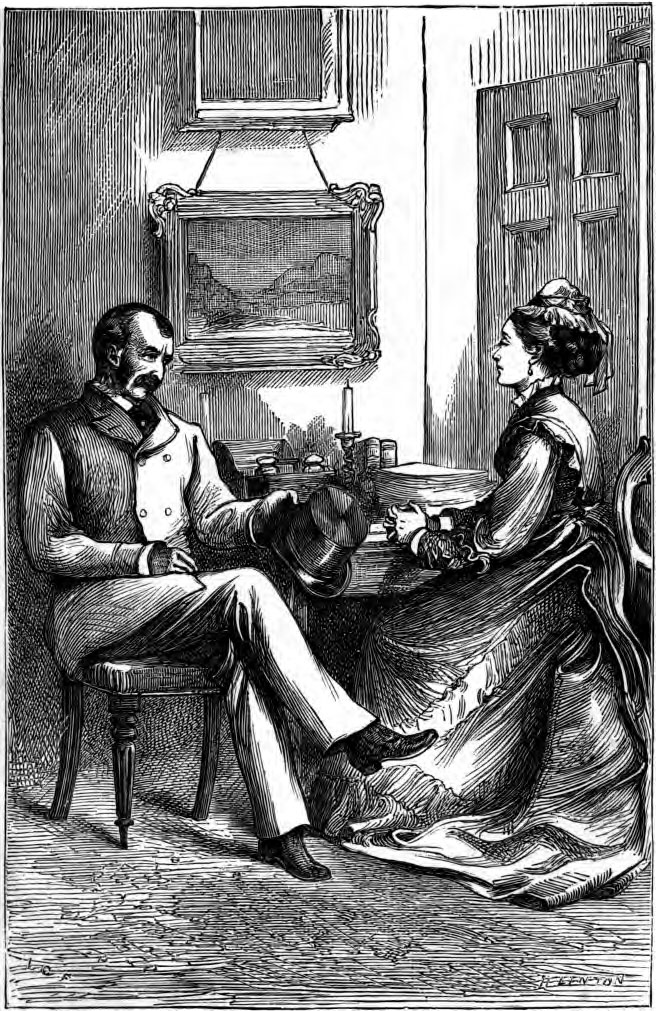
"At this moment I do not remember the name of the lady to whom you
allude," said Mr. Alf, getting up to take his leave; "and I am quite
sure that the gentleman who reviewed the book,--if there be any
such lady and any such book,--had never seen her!" And so Mr. Alf
departed.
Lady Carbury was very angry with herself, and very angry also with
Mr. Alf. She had not only meant to be piteous, but had made the
attempt and then had allowed herself to be carried away into anger.
She had degraded herself to humility, and had then wasted any
possible good result by a foolish fit of chagrin. The world in which
she had to live was almost too hard for her. When left alone she sat
weeping over her sorrows; but when from time to time she thought of
Mr. Alf and his conduct, she could hardly repress her scorn. What
lies he had told her! Of course he could have done it had he chosen.
But the assumed honesty of the man was infinitely worse to her than
his lies. No doubt the "Pulpit" had two objects in its criticisms.
Other papers probably had but one. The object common to all papers,
that of helping friends and destroying enemies, of course prevailed
with the "Pulpit." There was the second purpose of enticing readers
by crushing authors,--as crowds used to be enticed to see men hanged
when executions were done in public. But neither the one object nor
the other was compatible with that Aristidean justice which Mr. Alf
arrogated to himself and to his paper. She hoped with all her heart
that Mr. Alf would spend a great deal of money at Westminster, and
then lose his seat.
On the following morning she herself took the manuscript to Messrs.
Leadham and Loiter, and was hurt again by the small amount of respect
which seemed to be paid to the collected sheets. There was the work
of six months; her very blood and brains,--the concentrated essence
of her mind,--as she would say herself when talking with energy of
her own performances; and Mr. Leadham pitched it across to a clerk,
apparently perhaps sixteen years of age, and the lad chucked the
parcel unceremoniously under a counter. An author feels that his work
should be taken from him with fast-clutching but reverential hands,
and held thoughtfully, out of harm's way, till it be deposited within
the very sanctum of an absolutely fireproof safe. Oh, heavens, if it
should be lost!--or burned!--or stolen! Those scraps of paper, so
easily destroyed, apparently so little respected, may hereafter be
acknowledged to have had a value greater, so far greater, than their
weight in gold! If "Robinson Crusoe" had been lost! If "Tom Jones"
had been consumed by flames! And who knows but that this may be
another "Robinson Crusoe,"--a better than "Tom Jones"? "Will it be
safe there?" asked Lady Carbury.
"Quite safe,--quite safe," said Mr. Leadham, who was rather busy,
and who perhaps saw Lady Carbury more frequently than the nature and
amount of her authorship seemed to him to require.
"It seemed to be,--put down there,--under the counter!"
"That's quite right, Lady Carbury. They're left there till they're
packed."
"Packed!"
"There are two or three dozen going to our reader this week. He's
down in Skye, and we keep them till there's enough to fill the sack."
"Do they go by post, Mr. Leadham?"
"Not by post, Lady Carbury. There are not many of them would pay the
expense. We send them by long sea to Glasgow, because just at this
time of the year there is not much hurry. We can't publish before the
winter." Oh, heavens! If that ship should be lost on its journey by
long sea to Glasgow!
That evening, as was now almost his daily habit, Mr. Broune came to
her. There was something in the absolute friendship which now existed
between Lady Carbury and the editor of the "Morning Breakfast Table,"
which almost made her scrupulous as to asking from him any further
literary favour. She fully recognised,--no woman perhaps more
fully,--the necessity of making use of all aid and furtherance
which might come within reach. With such a son, with such need for
struggling before her, would she not be wicked not to catch even
at every straw? But this man had now become so true to her, that
she hardly knew how to beg him to do that which she, with all her
mistaken feelings, did in truth know that he ought not to do. He had
asked her to marry him, for which,--though she had refused him,--
she felt infinitely grateful. And though she had refused him, he had
lent her money, and had supported her in her misery by his continued
counsel. If he would offer to do this thing for her she would accept
his kindness on her knees,--but even she could not bring herself to
ask to have this added to his other favours. Her first word to him
was about Mr. Alf. "So he has given up the paper?"
"Well, yes;--nominally."
"Is that all?"
"I don't suppose he'll really let it go out of his own hands. Nobody
likes to lose power. He'll share the work, and keep the authority. As
for Westminster, I don't believe he has a chance. If that poor wretch
Melmotte could beat him when everybody was already talking about
the forgeries, how is it likely that he should stand against such a
candidate as they'll get now?"
"He was here yesterday."
"And full of triumph, I suppose?"
"He never talks to me much of himself. We were speaking of my new
book,--my novel. He assured me most positively that he had nothing
further to do with the paper."
"He did not care to make you a promise, I dare say."
"That was just it. Of course I did not believe him."
"Neither will I make a promise, but we'll see what we can do. If we
can't be good-natured, at any rate we will say nothing ill-natured.
Let me see,--what is the name?"
"'The Wheel of Fortune.'" Lady Carbury as she told the title of her
new book to her old friend seemed to be almost ashamed of it.
"Let them send it early,--a day or two before it's out, if they can.
I can't answer, of course, for the opinion of the gentleman it will
go to, but nothing shall go in that you would dislike. Good-bye.
God bless you." And as he took her hand, he looked at her almost as
though the old susceptibility were returning to him.
As she sat alone after he had gone, thinking over it all,--thinking
of her own circumstances and of his kindness,--it did not occur
to her to call him an old goose again. She felt now that she had
mistaken her man when she had so regarded him. That first and
only kiss which he had given her, which she had treated with so
much derision, for which she had rebuked him so mildly and yet so
haughtily, had now a somewhat sacred spot in her memory. Through it
all the man must have really loved her! Was it not marvellous that
such a thing should be? And how had it come to pass that she in all
her tenderness had rejected him when he had given her the chance of
becoming his wife?
CHAPTER XC.
HETTA'S SORROW.
When Hetta Carbury received that letter from her lover which was
given to the reader some chapters back, it certainly did not tend
in any way to alleviate her misery. Even when she had read it over
half-a-dozen times, she could not bring herself to think it possible
that she could be reconciled to the man. It was not only that he had
sinned against her by giving his society to another woman to whom
he had at any rate been engaged not long since, at the very time at
which he was becoming engaged to her,--but also that he had done this
in such a manner as to make his offence known to all her friends.
Perhaps she had been too quick;--but there was the fact that with
her own consent she had acceded to her mother's demand that the man
should be rejected. The man had been rejected, and even Roger Carbury
knew that it was so. After this it was, she thought, impossible that
she should recall him. But they should all know that her heart was
unchanged. Roger Carbury should certainly know that, if he ever asked
her further question on the matter. She would never deny it; and
though she knew that the man had behaved badly,--having entangled
himself with a nasty American woman,--yet she would be true to him as
far as her own heart was concerned.
And now he told her that she had been most unjust to him. He said
that he could not understand her injustice. He did not fill his
letter with entreaties, but with reproaches. And certainly his re-
proaches moved her more than any prayer would have done. It was too
late now to remedy the evil; but she was not quite sure within her
own bosom that she had not been unjust to him. The more she thought
of it the more puzzled her mind became. Had she quarrelled with him
because he had once been in love with Mrs. Hurtle, or because she had
grounds for regarding Mrs. Hurtle as her present rival? She hated
Mrs. Hurtle, and she was very angry with him in that he had ever been
on affectionate terms with a woman she hated;--but that had not been
the reason put forward by her for quarrelling with him. Perhaps it
was true that he, too, had of late loved Mrs. Hurtle hardly better
than she did herself. It might be that he had been indeed constrained
by hard circumstances to go with the woman to Lowestoft. Having so
gone with her, it was no doubt right that he should be rejected;--for
how can it be that a man who is engaged shall be allowed to travel
about the country with another woman to whom also he was engaged a
few months back? But still there might be hardship in it. To her, to
Hetta herself, the circumstances were very hard. She loved the man
with all her heart. She could look forward to no happiness in life
without him. But yet it must be so.
At the end of his letter he had told her to go to Mrs. Hurtle herself
if she wanted corroboration of the story as told by him. Of course
he had known when he wrote it that she could not and would not go to
Mrs. Hurtle. But when the letter had been in her possession three or
four days,--unanswered, for, as a matter of course, no answer to it
from herself was possible,--and had been read and re-read till she
knew every word of it by heart, she began to think that if she could
hear the story as it might be told by Mrs. Hurtle, a good deal that
was now dark might become light to her. As she continued to read
the letter, and to brood over it all, by degrees her anger was turned
from her lover to her mother, her brother, and to her cousin Roger.
Paul had of course behaved badly, very badly,--but had it not been
for them she might have had an opportunity of forgiving him. They had
driven her on to the declaration of a purpose from which she could
now see no escape. There had been a plot against her, and she was a
victim. In the first dismay and agony occasioned by that awful story
of the American woman,--which had, at the moment, struck her with
a horror which was now becoming less and less every hour,--she had
fallen head foremost into the trap laid for her. She acknowledged to
herself that it was too late to recover her ground. She was, at any
rate, almost sure that it must be too late. But yet she was disposed
to do battle with her mother and her cousin in the matter--if
only with the object of showing that she would not submit her own
feelings to their control. She was savage to the point of rebellion
against all authority. Roger Carbury would of course think that
any communication between herself and Mrs. Hurtle must be most
improper,--altogether indelicate. Two or three days ago she thought
so herself. But the world was going so hard with her, that she
was beginning to feel herself capable of throwing propriety and
delicacy to the winds. This man whom she had once accepted, whom
she altogether loved, and who, in spite of all his faults, certainly
still loved her,--of that she was beginning to have no further
doubt,--accused her of dishonesty, and referred her to her rival for
a corroboration of his story. She would appeal to Mrs. Hurtle. The
woman was odious, abominable, a nasty intriguing American female.
But her lover desired that she should hear the woman's story; and
she would hear the story,--if the woman would tell it.
So resolving, she wrote as follows to Mrs. Hurtle, finding great
difficulty in the composition of a letter which should tell neither
too little nor too much, and determined that she would be restrained
by no mock modesty, by no girlish fear of declaring the truth about
herself. The letter at last was stiff and hard, but it sufficed for
its purpose.
MADAM,--
Mr. Paul Montague has referred me to you as to certain
circumstances which have taken place between him and
you. It is right that I should tell you that I was a short time
since engaged to marry him, but that I have found myself
obliged to break off that engagement in consequence of
what I have been told as to his acquaintance with you. I
make this proposition to you, not thinking that anything
you will say to me can change my mind, but because he has
asked me to do so, and has, at the same time, accused me
of injustice towards him. I do not wish to rest under
an accusation of injustice from one to whom I was once
warmly attached. If you will receive me, I will make it my
business to call any afternoon you may name.
Yours truly,
HENRIETTA CARBURY.
When the letter was written she was not only ashamed of it, but very
much afraid of it also. What if the American woman should put it in
a newspaper! She had heard that everything was put into newspapers
in America. What if this Mrs. Hurtle should send back to her some
horribly insolent answer;--or should send such answer to her mother,
instead of herself! And then, again, if the American woman consented
to receive her, would not the American woman, as a matter of course,
trample upon her with rough words? Once or twice she put the letter
aside, and almost determined that it should not be sent;--but at
last, with desperate fortitude, she took it out with her and posted
it herself. She told no word of it to any one. Her mother, she
thought, had been cruel to her, had disregarded her feelings, and
made her wretched for ever. She could not ask her mother for sympathy
in her present distress. There was no friend who would sympathise
with her. She must do everything alone.
Mrs. Hurtle, it will be remembered, had at last determined that she
would retire from the contest and own herself to have been worsted.
It is, I fear, impossible to describe adequately the various half
resolutions which she formed, and the changing phases of her mind
before she brought herself to this conclusion. And soon after she had
assured herself that this should be the conclusion,--after she had
told Paul Montague that it should be so,--there came back upon her
at times other half resolutions to a contrary effect. She had written
a letter to the man threatening desperate revenge, and had then
abstained from sending it, and had then shown it to the man,--not
intending to give it to him as a letter upon which he would have to
act, but only that she might ask him whether, had he received it, he
would have said that he had not deserved it. Then she had parted with
him, refusing either to hear or to say a word of farewell, and had
told Mrs. Pipkin that she was no longer engaged to be married. At
that moment everything was done that could be done. The game had been
played and the stakes lost,--and she had schooled herself into such
restraint as to have abandoned all idea of vengeance. But from time
to time there arose in her heart a feeling that such softness was
unworthy of her. Who had ever been soft to her? Who had spared her?
Had she not long since found out that she must fight with her very
nails and teeth for every inch of ground, if she did not mean to be
trodden into the dust? Had she not held her own among rough people
after a very rough fashion, and should she now simply retire that
she might weep in a corner like a love-sick schoolgirl? And she had
been so stoutly determined that she would at any rate avenge her own
wrongs, if she could not turn those wrongs into triumph! There were
moments in which she thought that she could still seize the man by
the throat, where all the world might see her, and dare him to deny
that he was false, perjured, and mean.
Then she received a long passionate letter from Paul Montague,
written at the same time as those other letters to Roger Carbury and
Hetta, in which he told her all the circumstances of his engagement
to Hetta Carbury, and implored her to substantiate the truth of his
own story. It was certainly marvellous to her that the man who had
so long been her own lover and who had parted with her after such a
fashion should write such a letter to her. But it had no tendency to
increase either her anger or her sorrow. Of course she had known that
it was so, and at certain times she had told herself that it was only
natural,--had almost told herself that it was right. She and this
young Englishman were not fit to be mated. He was to her thinking
a tame, sleek household animal, whereas she knew herself to be
wild,--fitter for the woods than for polished cities. It had been one
of the faults of her life that she had allowed herself to be bound
by tenderness of feeling to this soft over-civilised man. The result
had been disastrous, as might have been expected. She was angry with
him,--almost to the extent of tearing him to pieces,--but she did not
become more angry because he wrote to her of her rival.
Her only present friend was Mrs. Pipkin, who treated her with the
greatest deference, but who was never tired of asking questions about
the lost lover. "That letter was from Mr. Montague?" said Mrs. Pipkin
on the morning after it had been received.
"How can you know that?"
"I'm sure it was. One does get to know handwritings when letters come
frequent."
"It was from him. And why not?"
"Oh dear no;--why not certainly? I wish he'd write every day of his
life, so that things would come round again. Nothing ever troubles
me so much as broken love. Why don't he come again himself, Mrs.
Hurtle?"
"It is not at all likely that he should come again. It is all over,
and there is no good in talking of it. I shall return to New York on
Saturday week."
"Oh, Mrs. Hurtle!"
"I can't remain here, you know, all my life doing nothing. I came
over here for a certain purpose, and that has--gone by. Now I may
just go back again."
"I know he has ill-treated you. I know he has."
"I am not disposed to talk about it, Mrs. Pipkin."
"I should have thought it would have done you good to speak your mind
out free. I know it would me if I'd been served in that way."
"If I had anything to say at all after that fashion it would be to
the gentleman, and not to any other else. As it is I shall never
speak of it again to any one. You have been very kind to me, Mrs.
Pipkin, and I shall be sorry to leave you."
"Oh, Mrs. Hurtle, you can't understand what it is to me. It isn't
only my feelings. The likes of me can't stand by their feelings
only, as their betters do. I've never been above telling you what a
godsend you've been to me this summer;--have I? I've paid everything,
butcher, baker, rates and all, just like clockwork. And now you're
going away!" Then Mrs. Pipkin began to sob.
"I suppose I shall see Mr. Crumb before I go," said Mrs. Hurtle.
"She don't deserve it; do she? And even now she never says a word
about him that I call respectful. She looks on him as just being
better than Mrs. Buggins's children. That's all."
"She'll be all right when he has once got her home."
"And I shall be all alone by myself," said Mrs. Pipkin, with her
apron up to her eyes.
It was after this that Mrs. Hurtle received Hetta's letter. She had
as yet returned no answer to Paul Montague,--nor had she intended
to send any written answer. Were she to comply with his request she
could do so best by writing to the girl who was concerned rather than
to him. And though she wrote no such letter she thought of it,--of
the words she would use were she to write it, and of the tale which
she would have to tell. She sat for hours thinking of it, trying to
resolve whether she would tell the tale,--if she told it at all,--in
a manner to suit Paul's purpose, or so as to bring that purpose
utterly to shipwreck. She did not doubt that she could cause the
shipwreck were she so minded. She could certainly have her revenge
after that fashion. But it was a woman's fashion, and, as such,
did not recommend itself to Mrs. Hurtle's feelings. A pistol or a
horsewhip, a violent seizing by the neck, with sharp taunts and
bitter-ringing words, would have made the fitting revenge. If she
abandoned that she could do herself no good by telling a story of her
wrongs to another woman.
Then came Hetta's note, so stiff, so cold, so true,--so like the
letter of an Englishwoman, as Mrs. Hurtle said to herself. Mrs.
Hurtle smiled as she read the letter. "I make this proposition not
thinking that anything you can say to me can change my mind." Of
course the girl's mind would be changed. The girl's mind, indeed,
required no change. Mrs. Hurtle could see well enough that the girl's
heart was set upon the man. Nevertheless she did not doubt but
that she could tell the story after such a fashion as to make it
impossible that the girl should marry him,--if she chose to do so.
At first she thought that she would not answer the letter at all.
What was it to her? Let them fight their own lovers' battles out
after their own childish fashion. If the man meant at last to be
honest, there could be no doubt, Mrs. Hurtle thought, that the girl
would go to him. It would require no interference of hers. But after
a while she thought that she might as well see this English chit who
had superseded herself in the affections of the Englishman she had
condescended to love. And if it were the case that all revenge was to
be abandoned, that no punishment was to be exacted in return for all
the injury that had been done, why should she not say a kind word
so as to smooth away the existing difficulties? Wild cat as she was,
kindness was more congenial to her nature than cruelty. So she wrote
to Hetta making an appointment.
DEAR MISS CARBURY,--
If you could make it convenient to yourself to call here
either Thursday or Friday at any hour between two and
four, I shall be very happy to see you.
Yours sincerely,
WINIFRID HURTLE.
CHAPTER XCI.
THE RIVALS.
During these days the intercourse between Lady Carbury and her
daughter was constrained and far from pleasant. Hetta, thinking that
she was ill-used, kept herself aloof, and would not speak to her
mother of herself or of her troubles. Lady Carbury watching her,
but not daring to say much, was at last almost frightened at her
girl's silence. She had assured herself, when she found that Hetta
was disposed to quarrel with her lover and to send him back his
brooch, that "things would come round," that Paul would be forgotten
quickly,--or laid aside as though he were forgotten,--and that Hetta
would soon perceive it to be her interest to marry her cousin. With
such a prospect before her, Lady Carbury thought it to be her duty
as a mother to show no tendency to sympathise with her girl's sorrow.
Such heart-breakings were occurring daily in the world around them.
Who were the happy people that were driven neither by ambition, nor
poverty, nor greed, nor the cross purposes of unhappy love, to stifle
and trample upon their feelings? She had known no one so blessed.
She had never been happy after that fashion. She herself had within
the last few weeks refused to join her lot with that of a man she
really liked, because her wicked son was so grievous a burden on her
shoulders. A woman, she thought, if she were unfortunate enough to be
a lady without wealth of her own, must give up everything, her body,
her heart,--her very soul if she were that way troubled,--to the
procuring of a fitting maintenance for herself. Why should Hetta hope
to be more fortunate than others? And then the position which chance
now offered to her was fortunate. This cousin of hers, who was so
devoted to her, was in all respects good. He would not torture her by
harsh restraint and cruel temper. He would not drink. He would not
spend his money foolishly. He would allow her all the belongings of
a fair, free life. Lady Carbury reiterated to herself the assertion
that she was manifestly doing a mother's duty by her endeavours to
constrain her girl to marry such a man. With a settled purpose she
was severe and hard. But when she found how harsh her daughter could
be in response to this,--how gloomy, how silent, and how severe in
retaliation,--she was almost frightened at what she herself was
doing. She had not known how stern and how enduring her daughter
could be. "Hetta," she said, "why don't you speak to me?" On this
very day it was Hetta's purpose to visit Mrs. Hurtle at Islington.
She had said no word of her intention to any one. She had chosen
the Friday because on that day she knew her mother would go in the
afternoon to her publisher. There should be no deceit. Immediately
on her return she would tell her mother what she had done. But she
considered herself to be emancipated from control. Among them they
had robbed her of her lover. She had submitted to the robbery, but
she would submit to nothing else. "Hetta, why don't you speak to me?"
said Lady Carbury.
"Because, mamma, there is nothing we can talk about without making
each other unhappy."
"What a dreadful thing to say! Is there no subject in the world to
interest you except that wretched young man?"
"None other at all," said Hetta obstinately.
"What folly it is,--I will not say only to speak like that, but to
allow yourself to entertain such thoughts!"
"How am I to control my thoughts? Do you think, mamma, that after
I had owned to you that I loved a man,--after I had owned it to him
and, worst of all, to myself,--I could have myself separated from
him, and then not think about it? It is a cloud upon everything. It
is as though I had lost my eyesight and my speech. It is as it would
be to you if Felix were to die. It crushes me."
There was an accusation in this allusion to her brother which the
mother felt,--as she was intended to feel it,--but to which she could
make no reply. It accused her of being too much concerned for her son
to feel any real affection for her daughter. "You are ignorant of the
world, Hetta," she said.
"I am having a lesson in it now, at any rate."
"Do you think it is worse than others have suffered before you? In
what little you see around you do you think that girls are generally
able to marry the men upon whom they set their hearts?" She paused,
but Hetta made no answer to this. "Marie Melmotte was as warmly
attached to your brother as you can be to Mr. Montague."
"Marie Melmotte!"
"She thinks as much of her feelings as you do of yours. The truth is
you are indulging a dream. You must wake from it, and shake yourself,
and find out that you, like others, have got to do the best you can
for yourself in order that you may live. The world at large has to
eat dry bread, and cannot get cakes and sweetmeats. A girl, when she
thinks of giving herself to a husband, has to remember this. If she
has a fortune of her own she can pick and choose, but if she have
none she must allow herself to be chosen."
"Then a girl is to marry without stopping even to think whether she
likes the man or not?"
"She should teach herself to like the man, if the marriage be
suitable. I would not have you take a vicious man because he was
rich, or one known to be cruel and imperious. Your cousin Roger, you
know--"
"Mamma," said Hetta, getting up from her seat, "you may as well
believe me. No earthly inducement shall ever make me marry my cousin
Roger. It is to me horrible that you should propose it to me when you
know that I love that other man with my whole heart."
"How can you speak so of one who has treated you with the utmost
contumely?"
"I know nothing of any contumely. What reason have I to be offended
because he has liked a woman whom he knew before he ever saw me?
It has been unfortunate, wretched, miserable; but I do not know that I
have any right whatever to be angry with Mr. Paul Montague." Having
so spoken she walked out of the room without waiting for a further
reply.
It was all very sad to Lady Carbury. She perceived now that she had
driven her daughter to pronounce an absolution of Paul Montague's
sins, and that in this way she had lessened and loosened the barrier
which she had striven to construct between them. But that which
pained her most was the unrealistic, romantic view of life which
pervaded all Hetta's thoughts. How was any girl to live in this world
who could not be taught the folly of such idle dreams?
That afternoon Hetta trusted herself all alone to the mysteries of
the Marylebone underground railway, and emerged with accuracy at
King's Cross. She had studied her geography, and she walked from
thence to Islington. She knew well the name of the street and the
number at which Mrs. Hurtle lived. But when she reached the door she
did not at first dare to stand and raise the knocker. She passed on
to the end of the silent, vacant street, endeavouring to collect her
thoughts, striving to find and to arrange the words with which she
would commence her strange petition. And she endeavoured to dictate
to herself some defined conduct should the woman be insolent to
her. Personally she was not a coward, but she doubted her power of
replying to a rough speech. She could at any rate escape. Should the
worst come to the worst, the woman would hardly venture to impede
her departure. Having gone to the end of the street, she returned
with a very quick step and knocked at the door. It was opened almost
immediately by Ruby Ruggles, to whom she gave her name.
"Oh laws,--Miss Carbury!" said Ruby, looking up into the stranger's
face. "Yes;--sure enough she must be Felix's sister." But Ruby did
not dare to ask any question. She had admitted to all around her
that Sir Felix should not be her lover any more, and that John Crumb
should be allowed to return. But, nevertheless, her heart twittered
as she showed Miss Carbury up to the lodger's sitting-room.
Though it was midsummer Hetta entered the room with her veil down.
She adjusted it as she followed Ruby up the stairs, moved by a sudden
fear of her rival's scrutiny. Mrs. Hurtle rose from her chair and
came forward to greet her visitor, putting out both her hands to do
so. She was dressed with the most scrupulous care,--simply, and in
black, without an ornament of any kind, without a ribbon or a chain
or a flower. But with some woman's purpose at her heart she had so
attired herself as to look her very best. Was it that she thought
that she would vindicate to her rival their joint lover's first choice,
or that she was minded to teach the English girl that an American
woman might have graces of her own? As she came forward she
was gentle and soft in her movements, and a pleasant smile played
round her mouth. Hetta at the first moment was almost dumbfounded by
her beauty,--by that and by her ease and exquisite self-possession.
"Miss Carbury," she said with that low, rich voice which in old
days had charmed Paul almost as much as her loveliness, "I need not
tell you how interested I am in seeing you. May I not ask you to
lay aside your veil, so that we may look at each other fairly?"
Hetta, dumbfounded, not knowing how to speak a word, stood gazing
at the woman when she had removed her veil. She had had no personal
description of Mrs. Hurtle, but had expected something very different
from this! She had thought that the woman would be coarse and big,
with fine eyes and a bright colour. As it was they were both of
the same complexion, both dark, with hair nearly black, with eyes
of the same colour. Hetta thought of all that at the moment,--but
acknowledged to herself that she had no pretension to beauty such as
that which this woman owned. "And so you have come to see me," said
Mrs. Hurtle. "Sit down so that I may look at you. I am glad that you
have come to see me, Miss Carbury."
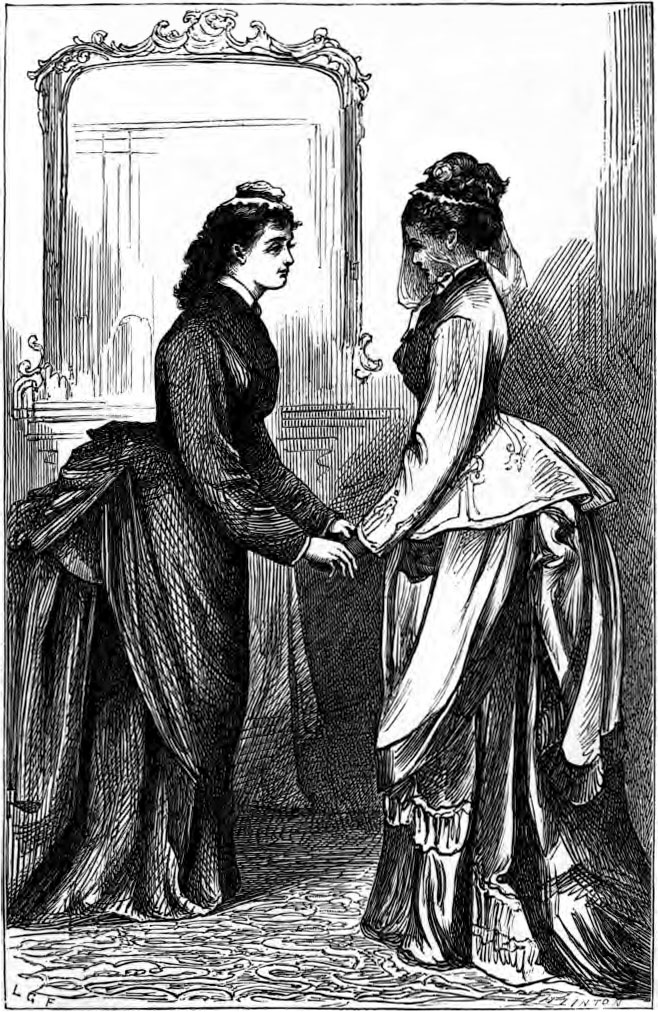
"I am glad at any rate that you are not angry."
"Why should I be angry? Had the idea been distasteful to me I should
have declined. I know not why, but it is a sort of pleasure to me to
see you. It is a poor time we women have,--is it not,--in becoming
playthings to men? So this Lothario that was once mine, is behaving
badly to you also. Is it so? He is no longer mine, and you may ask me
freely for aid, if there be any that I can give you. If he were an
American I should say that he had behaved badly to me;--but as he is
an Englishman perhaps it is different. Now tell me;--what can I do,
or what can I say?"
"He told me that you could tell me the truth."
"What truth? I will certainly tell you nothing that is not true. You
have quarrelled with him too. Is it not so?"
"Certainly I have quarrelled with him."
"I am not curious;--but perhaps you had better tell me of that. I
know him so well that I can guess that he should give offence. He
can be full of youthful ardour one day, and cautious as old age itself
the next. But I do not suppose that there has been need for such
caution with you. What is it, Miss Carbury?"
Hetta found the telling of her story to be very difficult. "Mrs.
Hurtle," she said, "I had never heard your name when he first asked
me to be his wife."
"I dare say not. Why should he have told you anything of me?"
"Because,--oh, because--. Surely he ought, if it is true that he had
once promised to marry you."
"That certainly is true."
"And you were here, and I knew nothing of it. Of course I should have
been very different to him had I known that,--that,--that--"
"That there was such a woman as Winifrid Hurtle interfering with him.
Then you heard it by chance, and you were offended. Was it not so?"
"And now he tells me that I have been unjust to him and he bids me
ask you. I have not been unjust."
"I am not so sure of that. Shall I tell you what I think? I think
that he has been unjust to me, and that therefore your injustice to
him is no more than his due. I cannot plead for him, Miss Carbury.
To me he has been the last and worst of a long series of, I think,
undeserved misfortune. But whether you will avenge my wrongs must
be for you to decide."
"Why did he go with you to Lowestoft?"
"Because I asked him,--and because, like many men, he cannot be
ill-natured although he can be cruel. He would have given a hand not
to have gone, but he could not say me nay. As you have come here,
Miss Carbury, you may as well know the truth. He did love me, but he
had been talked out of his love by my enemies and his own friends
long before he had ever seen you. I am almost ashamed to tell you my
own part of the story, and yet I know not why I should be ashamed. I
followed him here to England--because I loved him. I came after him,
as perhaps a woman should not do, because I was true of heart. He had
told me that he did not want me;--but I wanted to be wanted, and I
hoped that I might lure him back to his troth. I have utterly failed,
and I must return to my own country,--I will not say a broken-hearted
woman, for I will not admit of such a condition,--but a creature with
a broken spirit. He has misused me foully, and I have simply forgiven
him; not because I am a Christian, but because I am not strong e-
nough to punish one that I still love. I could not put a dagger into
him,--or I would; or a bullet,--or I would. He has reduced me to a
nothing by his falseness, and yet I cannot injure him! I, who have
sworn to myself that no man should ever lay a finger on me in scorn
without feeling my wrath in return, I cannot punish him. But if you
choose to do so it is not for me to set you against such an act of
justice." Then she paused and looked up to Hetta as though expecting
a reply.
But Hetta had no reply to make. All had been said that she had come
to hear. Every word that the woman had spoken had in truth been a
comfort to her. She had told herself that her visit was to be made in
order that she might be justified in her condemnation of her lover.
She had believed that it was her intention to arm herself with proof
that she had done right in rejecting him. Now she was told that
however false her lover might have been to this other woman he had
been absolutely true to her. The woman had not spoken kindly of
Paul,--had seemed to intend to speak of him with the utmost severity;
but she had so spoken as to acquit him of all sin against Hetta.
What was it to Hetta that her lover had been false to this American
stranger? It did not seem to her to be at all necessary that she
should be angry with her lover on that head. Mrs. Hurtle had told her
that she herself must decide whether she would take upon herself to
avenge her rival's wrongs. In saying that Mrs. Hurtle had taught her
to feel that there were no other wrongs which she need avenge. It was
all done now. If she could only thank the woman for the pleasantness
of her demeanour, and then go, she could, when alone, make up her
mind as to what she would do next. She had not yet told herself she
would submit herself again to Paul Montague. She had only told
herself that, within her own breast, she was bound to forgive him.
"You have been very kind," she said at last,--speaking only because
it was necessary that she should say something.
"It is well that there should be some kindness where there has been
so much that is unkind. Forgive me, Miss Carbury, if I speak plainly
to you. Of course you will go back to him. Of course you will be his
wife. You have told me that you love him dearly, as plainly as I have
told you the same story of myself. Your coming here would of itself
have declared it, even if I did not see your satisfaction at my
account of his treachery to me."
"Oh, Mrs. Hurtle, do not say that of me!"
"But it is true, and I do not in the least quarrel with you on that
account. He has preferred you to me, and as far as I am concerned
there is an end of it. You are a girl, whereas I am a woman,--and he
likes your youth. I have undergone the cruel roughness of the world,
which has not as yet touched you; and therefore you are softer to the
touch. I do not know that you are very superior in other attractions;
but that has sufficed, and you are the victor. I am strong enough
to acknowledge that I have nothing to forgive in you;--and am weak
enough to forgive all his treachery." Hetta was now holding the woman
by the hand, and was weeping, she knew not why. "I am so glad to
have seen you," continued Mrs. Hurtle, "so that I may know what his
wife was like. In a few days I shall return to the States, and then
neither of you will ever be troubled further by Winifrid Hurtle. Tell
him that if he will come and see me once before I go, I will not be
more unkind to him than I can help."
When Hetta did not decline to be the bearer of this message she
must have at any rate resolved that she would see Paul Montague
again,--and to see him would be to tell him that she was again his
own. She now got herself quickly out of the room, absolutely kissing
the woman whom she had both dreaded and despised. As soon as she
was alone in the street she tried to think of it all. How full of beauty
was the face of that American female,--how rich and glorious her
voice in spite of a slight taint of the well-known nasal twang;--and
above all how powerful and at the same time how easy and how gracious
was her manner! That she would be an unfit wife for Paul Montague was
certain to Hetta, but that he or any man should have loved her and
have been loved by her, and then have been willing to part from her,
was wonderful. And yet Paul Montague had preferred herself, Hetta
Carbury, to this woman! Paul had certainly done well for his own
cause when he had referred the younger lady to the elder.
Of her own quarrel of course there must be an end. She had been
unjust to the man, and injustice must of course be remedied by
repentance and confession. As she walked quickly back to the railway
station she brought herself to love her lover more fondly than she
had ever done. He had been true to her from the first hour of their
acquaintance. What truth higher than that has any woman a right to
desire? No doubt she gave to him a virgin heart. No other man had
ever touched her lips, or been allowed to press her hand, or to look
into her eyes with unrebuked admiration. It was her pride to give
herself to the man she loved after this fashion, pure and white as
snow on which no foot has trodden. But in taking him, all that she
wanted was that he should be true to her now and henceforward. The
future must be her own work. As to the "now," she felt that Mrs.
Hurtle had given her sufficient assurance.
She must at once let her mother know this change in her mind. When
she re-entered the house she was no longer sullen, no longer anxious
to be silent, very willing to be gracious if she might be received
with favour,--but quite determined that nothing should shake her
purpose. She went at once into her mother's room, having heard from
the boy at the door that Lady Carbury had returned.
"Hetta, wherever have you been?" asked Lady Carbury.
"Mamma," she said, "I mean to write to Mr. Montague and tell him that
I have been unjust to him."
"Hetta, you must do nothing of the kind," said Lady Carbury, rising
from her seat.
"Yes, mamma. I have been unjust, and I must do so."
"It will be asking him to come back to you."
"Yes, mamma:--that is what I mean. I shall tell him that if he will
come, I will receive him. I know he will come. Oh, mamma, let us be
friends, and I will tell you everything. Why should you grudge me my
love?"
"You have sent him back his brooch," said Lady Carbury hoarsely.
"He shall give it me again. Hear what I have done. I have seen that
American lady."
"Mrs. Hurtle!"
"Yes;--I have been to her. She is a wonderful woman."
"And she has told you wonderful lies."
"Why should she lie to me? She has told me no lies. She said nothing
in his favour."
"I can well believe that. What can any one say in his favour?"
"But she told me that which has assured me that Mr. Montague has
never behaved badly to me. I shall write to him at once. If you like
I will show you the letter."
"Any letter to him, I will tear," said Lady Carbury, full of anger.
"Mamma, I have told you everything, but in this I must judge for
myself." Then Hetta, seeing that her mother would not relent, left
the room without further speech, and immediately opened her desk that
the letter might be written.
CHAPTER XCII.
HAMILTON K. FISKER AGAIN.
Ten days had passed since the meeting narrated in the last
chapter,--ten days, during which Hetta's letter had been sent to her
lover, but in which she had received no reply,--when two gentlemen
met each other in a certain room in Liverpool, who were seen together
in the same room in the early part of this chronicle. These were our
young friend Paul Montague, and our not much older friend Hamilton
K. Fisker. Melmotte had died on the 18th of July, and tidings of the
event had been at once sent by telegraph to San Francisco. Some weeks
before this Montague had written to his partner, giving his account
of the South Central Pacific and Mexican Railway Company,--describing
its condition in England as he then believed it to be,--and urging
Fisker to come over to London. On receipt of a message from his
American correspondent he had gone down to Liverpool, and had
there awaited Fisker's arrival, taking counsel with his friend
Mr. Ramsbottom. In the mean time Hetta's letter was lying at the
Beargarden, Paul having written from his club and having omitted to
desire that the answer should be sent to his lodgings. Just at this
moment things at the Beargarden were not well managed. They were
indeed so ill managed that Paul never received that letter,--which
would have had for him charms greater than those of any letter ever
before written.
"This is a terrible business," said Fisker, immediately on entering
the room in which Montague was waiting him. "He was the last man I'd
have thought would be cut up in that way."
"He was utterly ruined."
"He wouldn't have been ruined,--and couldn't have thought so if he'd
known all he ought to have known. The South Central would have pulled
him through a'most anything if he'd have understood how to play it."
"We don't think much of the South Central here now," said Paul.
"Ah;--that's because you've never above half spirit enough for a big
thing. You nibble at it instead of swallowing it whole,--and then, of
course, folks see that you're only nibbling. I thought that Melmotte
would have had spirit."
"There is, I fear, no doubt that he had committed forgery. It was the
dread of detection as to that which drove him to destroy himself."
"I call it dam clumsy from beginning to end;--dam clumsy. I took him
to be a different man, and I feel more than half ashamed of myself
because I trusted such a fellow. That chap Cohenlupe has got off with
a lot of swag. Only think of Melmotte allowing Cohenlupe to get the
better of him!"
"I suppose the thing will be broken up now at San Francisco,"
suggested Paul.
"Bu'st up at Frisco! Not if I know it. Why should it be bu'st up?
D'you think we're all going to smash there because a fool like
Melmotte blows his brains out in London?"
"He took poison."
"Or p'ison either. That's not just our way. I'll tell you what I'm
going to do; and why I'm over here so uncommon sharp. These shares
are at a'most nothing now in London. I'll buy every share in the
market. I wired for as many as I dar'd, so as not to spoil our own
game, and I'll make a clean sweep of every one of them. Bu'st up! I'm
sorry for him because I thought him a biggish man;--but what he's
done 'll just be the making of us over there. Will you get out of it,
or will you come back to Frisco with me?"
In answer to this Paul asserted most strenuously that he would
not return to San Francisco, and, perhaps too ingenuously, gave
his partner to understand that he was altogether sick of the great
railway, and would under no circumstances have anything more to
do with it. Fisker shrugged his shoulders, and was not displeased
at the proposed rupture. He was prepared to deal fairly,--nay,
generously,--by his partner, having recognised the wisdom of that
great commercial rule which teaches us that honour should prevail
among associates of a certain class; but he had fully convinced
himself that Paul Montague was not a fit partner for Hamilton K.
Fisker. Fisker was not only unscrupulous himself, but he had a
thorough contempt for scruples in others. According to his theory of
life, nine hundred and ninety-nine men were obscure because of their
scruples, whilst the thousandth man predominated and cropped up into
the splendour of commercial wealth because he was free from such
bondage. He had his own theories, too, as to commercial honesty. That
which he had promised to do he would do, if it was within his power.
He was anxious that his bond should be good, and his word equally
so. But the work of robbing mankind in gross by magnificently false
representations, was not only the duty, but also the delight and the
ambition of his life. How could a man so great endure a partnership
with one so small as Paul Montague? "And now what about Winifrid
Hurtle?" asked Fisker.
"What makes you ask? She's in London."
"Oh yes, I know she's in London, and Hurtle's at Frisco, swearing
that he'll come after her. He would, only he hasn't got the dollars."
"He's not dead then?" muttered Paul.
"Dead!--no, nor likely to die. She'll have a bad time of it with him
yet."
"But she divorced him."
"She got a Kansas lawyer to say so, and he's got a Frisco lawyer to
say that there's nothing of the kind. She hasn't played her game
badly neither, for she's had the handling of her own money, and has
put it so that he can't get hold of a dollar. Even if it suited other
ways, you know, I wouldn't marry her myself till I saw my way clearer
out of the wood."
"I'm not thinking of marrying her,--if you mean that."
"There was a talk about it in Frisco;--that's all. And I have heard
Hurtle say when he was a little farther gone than usual that she was
here with you, and that he meant to drop in on you some of these
days." To this Paul made no answer, thinking that he had now both
heard enough and said enough about Mrs. Hurtle.
On the following day the two men, who were still partners, went
together to London, and Fisker immediately became immersed in the
arrangement of Melmotte's affairs. He put himself into communica-
tion with Mr. Brehgert, went in and out of the offices in Abchurch
Lane and the rooms which had belonged to the Railway Company,
cross-examined Croll, mastered the books of the Company as far as
they were to be mastered, and actually summoned both the Grendalls,
father and son, up to London. Lord Alfred, and Miles with him, had
left London a day or two before Melmotte's death,--having probably
perceived that there was no further occasion for their services. To
Fisker's appeal Lord Alfred was proudly indifferent. Who was this
American that he should call upon a director of the London Company
to appear? Does not every one know that a director of a company need
not direct unless he pleases? Lord Alfred, therefore, did not even
condescend to answer Fisker's letter;--but he advised his son to run
up to town. "I should just go, because I'd taken a salary from the
d---- Company," said the careful father, "but when there I wouldn't
say a word." So Miles Grendall, obeying his parent, reappeared upon
the scene.
But Fisker's attention was perhaps most usefully and most sedulously
paid to Madame Melmotte and her daughter. Till Fisker arrived no one
had visited them in their solitude at Hampstead, except Croll, the
clerk. Mr. Brehgert had abstained, thinking that a widow, who had
become a widow under such terrible circumstances, would prefer to be
alone. Lord Nidderdale had made his adieux, and felt that he could do
no more. It need hardly be said that Lord Alfred had too much good
taste to interfere at such a time, although for some months he had
been domestically intimate with the poor woman, or that Sir Felix
would not be prompted by the father's death to renew his suit to
the daughter. But Fisker had not been two days in London before
he went out to Hampstead, and was admitted to Madame Melmotte's
presence;--and he had not been there four days before he was a-
ware that in spite of all misfortunes, Marie Melmotte was still the
undoubted possessor of a large fortune.
In regard to Melmotte's effects generally the Crown had been induced
to abstain from interfering,--giving up the right to all the man's
plate and chairs and tables which it had acquired by the finding of
the coroner's verdict,--not from tenderness to Madame Melmotte, for
whom no great commiseration was felt, but on behalf of such creditors
as poor Mr. Longestaffe and his son. But Marie's money was quite
distinct from this. She had been right in her own belief as to
this property, and had been right, too, in refusing to sign those
papers,--unless it may be that that refusal led to her father's act.
She herself was sure that it was not so, because she had withdrawn
her refusal, and had offered to sign the papers before her father's
death. What might have been the ultimate result had she done so when
he first made the request, no one could now say. That the money
would have gone there could be no doubt. The money was now hers,--
a fact which Fisker soon learned with that peculiar cleverness which
belonged to him.
Poor Madame Melmotte felt the visits of the American to be a relief
to her in her misery. The world makes great mistakes as to that
which is and is not beneficial to those whom Death has bereaved of
a companion. It may be, no doubt sometimes it is the case, that
grief shall be so heavy, so absolutely crushing, as to make any
interference with it an additional trouble, and this is felt also in
acute bodily pain, and in periods of terrible mental suffering. It
may also be, and, no doubt, often is the case, that the bereaved one
chooses to affect such overbearing sorrow, and that friends abstain,
because even such affectation has its own rights and privileges. But
Madame Melmotte was neither crushed by grief nor did she affect to
be so crushed. She had been numbed by the suddenness and by the awe
of the catastrophe. The man who had been her merciless tyrant for
years, who had seemed to her to be a very incarnation of cruel power,
had succumbed, and shown himself to be powerless against his own
misfortunes. She was a woman of very few words, and had spoken almost
none on this occasion even to her own daughter; but when Fisker came
to her, and told her more than she had ever known before of her
husband's affairs, and spoke to her of her future life, and mixed for
her a small glass of brandy-and-water warm, and told her that Frisco
would be the fittest place for her future residence, she certainly
did not find him to be intrusive.
And even Marie liked Fisker, though she had been wooed and almost
won both by a lord and a baronet, and had understood, if not much,
at least more than her mother, of the life to which she had been
introduced. There was something of real sorrow in her heart for her
father. She was prone to love,--though, perhaps, not prone to deep
affection. Melmotte had certainly been often cruel to her, but he
had also been very indulgent. And as she had never been specially
grateful for the one, so neither had she ever specially resented the
other. Tenderness, care, real solicitude for her well-being, she
had never known, and had come to regard the unevenness of her life,
vacillating between knocks and knick-knacks, with a blow one day and
a jewel the next, as the condition of things which was natural to
her. When her father was dead she remembered for a while the jewels
and the knick-knacks, and forgot the knocks and blows. But she
was not beyond consolation, and she also found consolation in Mr.
Fisker's visits.
"I used to sign a paper every quarter," she said to Fisker, as they
were walking together one evening in the lanes round Hampstead.
"You'll have to do the same now, only instead of giving the paper to
any one you'll have to leave it in a banker's hands to draw the money
for yourself."
"And can that be done over in California?"
"Just the same as here. Your bankers will manage it all for you
without the slightest trouble. For the matter of that I'll do it,
if you'll trust me. There's only one thing against it all, Miss
Melmotte."
"And what's that?"
"After the sort of society you've been used to here, I don't know how
you'll get on among us Americans. We're a pretty rough lot, I guess.
Though, perhaps, what you lose in the look of the fruit, you'll make
up in the flavour." This Fisker said in a somewhat plaintive tone,
as though fearing that the manifest substantial advantages of Frisco
would not suffice to atone for the loss of that fashion to which Miss
Melmotte had been used.
"I hate swells," said Marie, flashing round upon him.
"Do you now?"
"Like poison. What's the use of 'em? They never mean a word that they
say,--and they don't say so many words either. They're never more
than half awake, and don't care the least about anybody. I hate
London."
"Do you now?"
"Oh, don't I?"
"I wonder whether you'd hate Frisco?"
"I rather think it would be a jolly sort of place."
"Very jolly I find it. And I wonder whether you'd hate--me?"
"Mr. Fisker, that's nonsense. Why should I hate anybody?"
"But you do. I've found out one or two that you don't love. If you
do come to Frisco, I hope you won't just hate me, you know." Then he
took her gently by the arm;--but she, whisking herself away rapidly,
bade him behave himself. Then they returned to their lodgings, and
Mr. Fisker, before he went back to London, mixed a little warm
brandy-and-water for Madame Melmotte. I think that upon the whole
Madame Melmotte was more comfortable at Hampstead than she had
been either in Grosvenor Square or Bruton Street, although she was
certainly not a thing beautiful to look at in her widow's weeds.
"I don't think much of you as a book-keeper, you know," Fisker said
to Miles Grendall in the now almost deserted Board-room of the
South Central Pacific and Mexican Railway. Miles, remembering his
father's advice, answered not a word, but merely looked with assumed
amazement at the impertinent stranger who dared thus to censure his
performances. Fisker had made three or four remarks previous to
this, and had appealed both to Paul Montague and to Croll, who were
present. He had invited also the attendance of Sir Felix Carbury,
Lord Nidderdale, and Mr. Longestaffe, who were all Directors;--but
none of them had come. Sir Felix had paid no attention to Fisker's
letter. Lord Nidderdale had written a short but characteristic reply.
"Dear Mr. Fisker,--I really don't know anything about it. Yours,
Nidderdale." Mr. Longestaffe, with laborious zeal, had closely
covered four pages with his reasons for non-attendance, with which
the reader shall not be troubled, and which it may be doubted whether
even Fisker perused to the end. "Upon my word," continued Fisker,
"it's astonishing to me that Melmotte should have put up with this
kind of thing. I suppose you understand something of business, Mr.
Croll?"
"It vas not my department, Mr. Fisker," said the German.
"Nor anybody else's either," said the domineering American. "Of
course it's on the cards, Mr. Grendall, that we shall have to put you
into a witness-box, because there are certain things we must get at."
Miles was silent as the grave, but at once made up his mind that he
would pass his autumn at some pleasant but economical German retreat,
and that his autumnal retirement should be commenced within a very
few days;--or perhaps hours might suffice.
But Fisker was not in earnest in his threat. In truth the greater
the confusion in the London office, the better, he thought, were the
prospects of the Company at San Francisco. Miles underwent purgatory
on this occasion for three or four hours, and when dismissed had
certainly revealed none of Melmotte's secrets. He did, however, go
to Germany, finding that a temporary absence from England would be
comfortable to him in more respects than one,--and need not be heard
of again in these pages.
When Melmotte's affairs were ultimately wound up there was found
to be nearly enough of property to satisfy all his proved liabilities.
Very many men started up with huge claims, asserting that they had
been robbed, and in the confusion it was hard to ascertain who had
been robbed, or who had simply been unsuccessful in their attempts to
rob others. Some, no doubt, as was the case with poor Mr. Brehgert,
had speculated in dependence on Melmotte's sagacity, and had lost
heavily without dishonesty. But of those who, like the Longestaffes,
were able to prove direct debts, the condition at last was not very
sad. Our excellent friend Dolly got his money early in the day, and
was able, under Mr. Squercum's guidance, to start himself on a new
career. Having paid his debts, and with still a large balance at his
bankers', he assured his friend Nidderdale that he meant to turn over
an entirely new leaf. "I shall just make Squercum allow me so much a
month, and I shall have all the bills and that kind of thing sent to
him, and he will do everything, and pull me up if I'm getting wrong.
I like Squercum."
"Won't he rob you, old fellow?" suggested Nidderdale.
"Of course he will;--but he won't let any one else do it. One has
to be plucked, but it's everything to have it done on a system. If
he'll only let me have ten shillings out of every sovereign I think
I can get along." Let us hope that Mr. Squercum was merciful, and
that Dolly was enabled to live in accordance with his virtuous
resolutions.
But these things did not arrange themselves till late in the
winter,--long after Mr. Fisker's departure for California. That,
however, was protracted till a day much later than he had anticipated
before he had become intimate with Madame Melmotte and Marie. Madame
Melmotte's affairs occupied him for a while almost exclusively. The
furniture and plate were of course sold for the creditors, but Madame
Melmotte was allowed to take whatever she declared to be specially
her own property;--and, though much was said about the jewels, no
attempt was made to recover them. Marie advised Madame Melmotte to
give them up, assuring the old woman that she should have whatever
she wanted for her maintenance. But it was not likely that Melmotte's
widow would willingly abandon any property, and she did not abandon
her jewels. It was agreed between her and Fisker that they were to
be taken to New York. "You'll get as much there as in London, if you
like to part with them; and nobody 'll say anything about it there.
You couldn't sell a locket or a chain here without all the world
talking about it."
In all these things Madame Melmotte put herself into Fisker's hands
with the most absolute confidence,--and, indeed, with a confidence
that was justified by its results. It was not by robbing an old woman
that Fisker intended to make himself great. To Madame Melmotte's
thinking, Fisker was the finest gentleman she had ever met,--so
infinitely pleasanter in his manner than Lord Alfred even when Lord
Alfred had been most gracious, with so much more to say for himself
than Miles Grendall, understanding her so much better than any man
had ever done,--especially when he supplied her with those small warm
beakers of sweet brandy-and-water. "I shall do whatever he tells me,"
she said to Marie. "I'm sure I've nothing to keep me here in this
country."
"I'm willing to go," said Marie. "I don't want to stay in London."
"I suppose you'll take him if he asks you?"
"I don't know anything about that," said Marie. "A man may be very
well without one's wanting to marry him. I don't think I'll marry
anybody. What's the use? It's only money. Nobody cares for anything
else. Fisker's all very well; but he only wants the money. Do you
think Fisker'd ask me to marry him if I hadn't got anything? Not he!
He ain't slow enough for that."
"I think he's a very nice young man," said Madame Melmotte.
CHAPTER XCIII.
A TRUE LOVER.
Hetta Carbury, out of the fulness of her heart, having made up her
mind that she had been unjust to her lover, wrote to him a letter
full of penitence, full of love, telling him at great length all
the details of her meeting with Mrs. Hurtle, and bidding him come
back to her, and bring the brooch with him. But this letter she had
unfortunately addressed to the Beargarden, as he had written to her
from that club; and partly through his own fault, and partly through
the demoralisation of that once perfect establishment, the letter
never reached his hands. When, therefore, he returned to London he
was justified in supposing that she had refused even to notice his
appeal. He was, however, determined that he would still make further
struggles. He had, he felt, to contend with many difficulties. Mrs.
Hurtle, Roger Carbury, and Hetta's mother were, he thought, all
inimical to him. Mrs. Hurtle, though she had declared that she would
not rage as a lioness, could hardly be his friend in the matter.
Roger had repeatedly declared his determination to regard him as
a traitor. And Lady Carbury, as he well knew, had always been and
always would be opposed to the match. But Hetta had owned that she
loved him, had submitted to his caresses, and had been proud of
his admiration. And Paul, though he did not probably analyze very
carefully the character of his beloved, still felt instinctively
that, having so far prevailed with such a girl, his prospects could
not be altogether hopeless. And yet how should he continue the
struggle? With what weapons should he carry on the fight? The writing
of letters is but a one-sided, troublesome proceeding, when the
person to whom they are written will not answer them; and the calling
at a door at which the servant has been instructed to refuse a
visitor admission, becomes, disagreeable,--if not degrading,--after a
time.
But Hetta had written a second epistle,--not to her lover, but to one
who received his letters with more regularity. When she rashly and
with precipitate wrath quarrelled with Paul Montague, she at once
communicated the fact to her mother, and through her mother to her
cousin Roger. Though she would not recognise Roger as a lover, she
did acknowledge him to be the head of her family, and her own special
friend, and entitled in some special way to know all that she herself
did, and all that was done in regard to her. She therefore wrote to
her cousin, telling him that she had made a mistake about Paul, that
she was convinced that Paul had always behaved to her with absolute
sincerity, and, in short, that Paul was the best, and dearest, and
most ill-used of human beings. In her enthusiasm she went on to
declare that there could be no other chance of happiness for her in
this world than that of becoming Paul's wife, and to beseech her
dearest friend and cousin Roger not to turn against her, but to lend
her an aiding hand. There are those whom strong words in letters
never affect at all,--who, perhaps, hardly read them, and take what
they do read as meaning no more than half what is said. But Roger
Carbury was certainly not one of these. As he sat on the garden
wall at Carbury, with his cousin's letter in his hand, her words had
their full weight with him. He did not try to convince himself
that all this was the verbiage of an enthusiastic girl, who might
soon be turned and trained to another mode of thinking by fitting
admonitions. To him now, as he read and re-read Hetta's letter
sitting on the wall, there was not at any rate further hope for
himself. Though he was altogether unchanged himself, though he was
altogether incapable of change,--though he could not rally himself
sufficiently to look forward to even a passive enjoyment of life
without the girl whom he had loved,--yet he told himself what he
believed to be the truth. At last he owned directly and plainly that,
whether happy or unhappy, he must do without her. He had let time
slip by with him too fast and too far before he had ventured to love.
He must now stomach his disappointment, and make the best he could
of such a broken, ill-conditioned life as was left to him. But, if
he acknowledged this,--and he did acknowledge it,--in what fashion
should he in future treat the man and woman who had reduced him so
low?
At this moment his mind was tuned to high thoughts. If it were
possible he would be unselfish. He could not, indeed, bring himself
to think with kindness of Paul Montague. He could not say to himself
that the man had not been treacherous to him, nor could he forgive
the man's supposed treason. But he did tell himself very plainly that
in comparison with Hetta the man was nothing to him. It could hardly
be worth his while to maintain a quarrel with the man if he were once
able to assure Hetta that she, as the wife of another man, should
still be dear to him as a friend might be dear. He was well aware
that such assurance, such forgiveness, must contain very much. If it
were to be so, Hetta's child must take the name of Carbury, and must
be to him as his heir,--as near as possible his own child. In her
favour he must throw aside that law of primogeniture which to him was
so sacred that he had been hitherto minded to make Sir Felix his heir
in spite of the absolute unfitness of the wretched young man. All
this must be changed, should he be able to persuade himself to give
his consent to the marriage. In such case Carbury must be the home
of the married couple, as far as he could induce them to make it
so. There must be born the future infant to whose existence he was
already looking forward with some idea that in his old age he might
there find comfort. In such case, though he should never again be
able to love Paul Montague in his heart of hearts, he must live
with him for her sake on affectionate terms. He must forgive Hetta
altogether,--as though there had been no fault; and he must strive to
forgive the man's fault as best he might. Struggling as he was to be
generous, passionately fond as he was of justice, yet he did not know
how to be just himself. He could not see that he in truth had been to
no extent ill-used. And ever and again, as he thought of the great
prayer as to the forgiveness of trespasses, he could not refrain from
asking himself whether it could really be intended that he should
forgive such trespass as that committed against him by Paul Montague!
Nevertheless, when he rose from the wall he had resolved that Hetta
should be pardoned entirely, and that Paul Montague should be treated
as though he were pardoned. As for himself,--the chances of the world
had been unkind to him, and he would submit to them!
Nevertheless he wrote no answer to Hetta's letter. Perhaps he felt,
with some undefined but still existing hope, that the writing of such
a letter would deprive him of his last chance. Hetta's letter to
himself hardly required an immediate answer,--did not, indeed, demand
any answer. She had simply told him that, whereas she had for certain
reasons quarrelled with the man she had loved, she had now come to
the conclusion that she would quarrel with him no longer. She had
asked for her cousin's assent to her own views, but that, as Roger
felt, was to be given rather by the discontinuance of opposition than
by any positive action. Roger's influence with her mother was the
assistance which Hetta really wanted from him, and that influence
could hardly be given by the writing of any letter. Thinking of all
this, Roger determined that he would again go up to London. He would
have the vacant hours of the journey in which to think of it all
again, and tell himself whether it was possible for him to bring his
heart to agree to the marriage;--and then he would see the people,
and perhaps learn something further from their manner and their
words, before he finally committed himself to the abandonment of his
own hopes and the completion of theirs.
He went up to town, and I do not know that those vacant hours served
him much. To a man not accustomed to thinking there is nothing in
the world so difficult as to think. After some loose fashion we turn
over things in our mind and ultimately reach some decision, guided
probably by our feelings at the last moment rather than by any
process of ratiocination;--and then we think that we have thought.
But to follow out one argument to an end, and then to found on the
base so reached the commencement of another, is not common to us.
Such a process was hardly within the compass of Roger's mind,--who
when he was made wretched by the dust, and by a female who had a
basket of objectionable provisions opposite to him, almost forswore
his charitable resolutions of the day before; but who again, as he
walked lonely at night round the square which was near to his hotel,
looking up at the bright moon with a full appreciation of the beauty
of the heavens, asked himself what was he that he should wish to
interfere with the happiness of two human beings much younger than
himself, and much fitter to enjoy the world. But he had had a bath,
and had got rid of the dust, and had eaten his dinner.
The next morning he was in Welbeck Street at an early hour. When he
knocked he had not made up his mind whether he would ask for Lady
Carbury or her daughter, and did at last inquire whether "the ladies"
were at home. The ladies were reported as being at home, and he was
at once shown into the drawing-room, where Hetta was sitting. She
hurried up to him, and he at once took her in his arms and kissed
her. He had never done such a thing before. He had never even kissed
her hand. Though they were cousins and dear friends, he had never
treated her after that fashion. Her instinct told her immediately
that such a greeting from him was a sign of affectionate compliance
with her wishes. That this man should kiss her as her best and
dearest relation, as her most trusted friend, as almost her brother,
was certainly to her no offence. She could cling to him in fondest
love,--if he would only consent not to be her lover. "Oh, Roger, I am
so glad to see you," she said, escaping gently from his arms.
"I could not write an answer, and so I came."
"You always do the kindest thing that can be done."
"I don't know. I don't know that I can do anything now,--kind or
unkind. It is all done without any aid from me. Hetta, you have been
all the world to me."
"Do not reproach me," she said.
"No;--no. Why should I reproach you? You have committed no fault. I
should not have come had I intended to reproach any one."
"I love you so much for saying that."
"Let it be as you wish it,--if it must. I have made up my mind to
bear it, and there shall be an end of it." As he said this he took
her by the hand, and she put her head upon his shoulder and began to
weep. "And still you will be all the world to me," he continued, with
his arm round her waist. "As you will not be my wife, you shall be my
daughter."
"I will be your sister, Roger."
"My daughter rather. You shall be all that I have in the world. I
will hurry to grow old that I may feel for you as the old feel for
the young. And if you have a child, Hetta, he must be my child." As
he thus spoke her tears were renewed. "I have planned it all out in
my mind, dear. There! If there be anything that I can do to add to
your happiness, I will do it. You must believe this of me,--that to
make you happy shall be the only enjoyment of my life."
It had been hardly possible for her to tell him as yet that the
man to whom he was thus consenting to surrender her had not even
condescended to answer the letter in which she had told him to come
back to her. And now, sobbing as she was, overcome by the tenderness
of her cousin's affection, anxious to express her intense gratitude,
she did not know how first to mention the name of Paul Montague.
"Have you seen him?" she said in a whisper.
"Seen whom?"
"Mr. Montague."
"No;--why should I have seen him? It is not for his sake that I am
here."
"But you will be his friend?"
"Your husband shall certainly be my friend;--or, if not, the fault
shall not be mine. It shall all be forgotten, Hetta,--as nearly as
such things may be forgotten. But I had nothing to say to him till
I had seen you." At that moment the door was opened and Lady Carbury
entered the room, and, after her greeting with her cousin, looked
first at her daughter and then at Roger. "I have come up," said he,
"to signify my adhesion to this marriage." Lady Carbury's face fell
very low. "I need not speak again of what were my own wishes. I have
learned at last that it could not have been so."
"Why should you say so?" exclaimed Lady Carbury.
"Pray, pray, mamma--," Hetta began, but was unable to find words with
which to go on with her prayer.
"I do not know that it need be so at all," continued Lady Carbury. "I
think it is very much in your own hands. Of course it is not for me
to press such an arrangement, if it be not in accord with your own
wishes."
"I look upon her as engaged to marry Paul Montague," said Roger.
"Not at all," said Lady Carbury.
"Yes; mamma,--yes," cried Hetta boldly. "It is so. I am engaged to
him."
"I beg to let your cousin know that it is not so with my
consent,--nor, as far as I can understand at present, with the
consent of Mr. Montague himself."
"Mamma!"
"Paul Montague!" ejaculated Roger Carbury. "The consent of Paul
Montague! I think I may take upon myself to say that there can be no
doubt as to that."
"There has been a quarrel," said Lady Carbury.
"Surely he has not quarrelled with you, Hetta?"
"I wrote to him,--and he has not answered me," said Hetta piteously.
Then Lady Carbury gave a full and somewhat coloured account of what
had taken place, while Roger listened with admirable patience. "The
marriage is on every account objectionable," she said at last. "His
means are precarious. His conduct with regard to that woman has been
very bad. He has been sadly mixed up with that wretched man who
destroyed himself. And now, when Henrietta has written to him without
my sanction,--in opposition to my express commands,--he takes no
notice of her. She, very properly, sent him back a present that he
made her, and no doubt he has resented her doing so. I trust that his
resentment may be continued."
Hetta was now seated on a sofa hiding her face and weeping. Roger
stood perfectly still, listening with respectful silence till Lady
Carbury had spoken her last word. And even then he was slow to
answer, considering what he might best say. "I think I had better see
him," he replied. "If, as I imagine, he has not received my cousin's
letter, that matter will be set at rest. We must not take advantage
of such an accident as that. As to his income,--that I think may be
managed. His connection with Mr. Melmotte was unfortunate, but was
due to no fault of his." At this moment he could not but remember
Lady Carbury's great anxiety to be closely connected with Melmotte,
but he was too generous to say a word on that head. "I will see him,
Lady Carbury, and then I will come to you again."
Lady Carbury did not dare to tell him that she did not wish him to
see Paul Montague. She knew that if he really threw himself into
the scale against her, her opposition would weigh nothing. He was
too powerful in his honesty and greatness of character,--and had
been too often admitted by herself to be the guardian angel of the
family,--for her to stand against him. But she still thought that had
he persevered, Hetta would have become his wife.
It was late that evening before Roger found Paul Montague, who had
only then returned from Liverpool with Fisker,--whose subsequent
doings have been recorded somewhat out of their turn.
"I don't know what letter you mean," said Paul.
"You wrote to her?"
"Certainly I wrote to her. I wrote to her twice. My last letter was
one which I think she ought to have answered. She had accepted me,
and had given me a right to tell my own story when she unfortunately
heard from other sources the story of my journey to Lowestoft with
Mrs. Hurtle." Paul pleaded his own case with indignant heat, not
understanding at first that Roger had come to him on a friendly
mission.
"She did answer your letter."
"I have not had a line from her;--not a word!"
"She did answer your letter."
"What did she say to me?"
"Nay,--you must ask her that."
"But if she will not see me?"
"She will see you. I can tell you that. And I will tell you this
also;--that she wrote to you as a girl writes to the lover whom she
does wish to see."
"Is that true?" exclaimed Paul, jumping up.
"I am here especially to tell you that it is true. I should hardly
come on such a mission if there were a doubt. You may go to her, and
need have nothing to fear,--unless, indeed, it be the opposition of
her mother."
"She is stronger than her mother," said Paul.
"I think she is. And now I wish you to hear what I have to say."
"Of course," said Paul, sitting down suddenly. Up to this moment
Roger Carbury, though he had certainly brought glad tidings, had
not communicated them as a joyous, sympathetic messenger. His face
had been severe, and the tone of his voice almost harsh; and Paul,
remembering well the words of the last letter which his old friend
had written him, did not expect personal kindness. Roger would
probably say very disagreeable things to him, which he must bear with
all the patience which he could summon to his assistance.
"You know what my feelings have been," Roger began, "and how deeply
I have resented what I thought to be an interference with my
affections. But no quarrel between you and me, whatever the rights of
it may be--"
"I have never quarrelled with you," Paul began.
"If you will listen to me for a moment it will be better. No anger
between you and me, let it arise as it might, should be allowed to
interfere with the happiness of her whom I suppose we both love
better than all the rest of the world put together."
"I do," said Paul.
"And so do I;--and so I always shall. But she is to be your wife. She
shall be my daughter. She shall have my property,--or her child shall
be my heir. My house shall be her house,--if you and she will consent
to make it so. You will not be afraid of me. You know me, I think,
too well for that. You may now count on any assistance you could
have from me were I a father giving you a daughter in marriage. I do
this because I will make the happiness of her life the chief object
of mine. Now good night. Don't say anything about it at present.
By-and-by we shall be able to talk about these things with more
equable temper." Having so spoken he hurried out of the room, leaving
Paul Montague bewildered by the tidings which had been announced to
him.
CHAPTER XCIV.
JOHN CRUMB'S VICTORY.
In the meantime great preparations were going on down in Suffolk for
the marriage of that happiest of lovers, John Crumb. John Crumb had
been up to London, had been formally reconciled to Ruby,--who had
submitted to his floury embraces, not with the best grace in the
world, but still with a submission that had satisfied her future
husband,--had been intensely grateful to Mrs. Hurtle, and almost
munificent in liberality to Mrs. Pipkin, to whom he presented a
purple silk dress, in addition to the cloak which he had given on a
former occasion. During this visit he had expressed no anger against
Ruby, and no indignation in reference to the baronite. When informed
by Mrs. Pipkin, who hoped thereby to please him, that Sir Felix
was supposed to be still "all one mash of gore," he blandly smiled,
remarking that no man could be much the worse for a "few sich taps
as them." He only stayed a few hours in London, but during these few
hours he settled everything. When Mrs. Pipkin suggested that Ruby
should be married from her house, he winked his eye as he declined
the suggestion with thanks. Daniel Ruggles was old, and, under the
influence of continued gin and water, was becoming feeble. John Crumb
was of opinion that the old man should not be neglected, and hinted
that with a little care the five hundred pounds which had originally
been promised as Ruby's fortune, might at any rate be secured. He was
of opinion that the marriage should be celebrated in Suffolk,--the
feast being spread at Sheep's Acre farm, if Dan Ruggles could be
talked into giving it,--and if not, at his own house. When both the
ladies explained to him that this last proposition was not in strict
accordance with the habits of the fashionable world, John expressed
an opinion that, under the peculiar circumstances of his marriage,
the ordinary laws of the world might be suspended. "It ain't jist
like other folks, after all as we've been through," said he,--meaning
probably to imply that having had to fight for his wife, he was
entitled to give a breakfast on the occasion if he pleased. But
whether the banquet was to be given by the bride's grandfather or by
himself,--he was determined that there should be a banquet, and that
he would bid the guests. He invited both Mrs. Pipkin and Mrs. Hurtle,
and at last succeeded in inducing Mrs. Hurtle to promise that she
would bring Mrs. Pipkin down to Bungay, for the occasion.
Then it was necessary to fix the day, and for this purpose it was of
course essential that Ruby should be consulted. During the discussion
as to the feast and the bridegroom's entreaties that the two ladies
would be present, she had taken no part in the matter in hand. She
was brought up to be kissed, and having been duly kissed she retired
again among the children, having only expressed one wish of her
own,--namely, that Joe Mixet might not have anything to do with
the affair. But the day could not be fixed without her, and she
was summoned. Crumb had been absurdly impatient, proposing next
Tuesday,--making his proposition on a Friday. They could cook enough
meat for all Bungay to eat by Tuesday, and he was aware of no
other cause for delay. "That's out of the question," Ruby had said
decisively, and as the two elder ladies had supported her Mr. Crumb
yielded with a good grace. He did not himself appreciate the reasons
given because, as he remarked, gowns can be bought ready made at
any shop. But Mrs. Pipkin told him with a laugh that he didn't know
anything about it, and when the 14th of August was named he only
scratched his head and, muttering something about Thetford fair,
agreed that he would, yet once again, allow love to take precedence
of business. If Tuesday would have suited the ladies as well he
thought that he might have managed to combine the marriage and the
fair, but when Mrs. Pipkin told him that he must not interfere any
further, he yielded with a good grace. He merely remained in London
long enough to pay a friendly visit to the policeman who had locked
him up, and then returned to Suffolk, revolving in his mind how
glorious should be the matrimonial triumph which he had at last
achieved.
Before the day arrived, old Ruggles had been constrained to forgive
his granddaughter, and to give a general assent to the marriage. When
John Crumb, with a sound of many trumpets, informed all Bungay that
he had returned victorious from London, and that after all the ups
and downs of his courtship Ruby was to become his wife on a fixed
day, all Bungay took his part, and joined in a general attack upon
Mr. Daniel Ruggles. The cross-grained old man held out for a long
time, alleging that the girl was no better than she should be, and
that she had run away with the baronite. But this assertion was
met by so strong a torrent of contradiction, that the farmer was
absolutely driven out of his own convictions. It is to be feared that
many lies were told on Ruby's behalf by lips which had been quite
ready a fortnight since to take away her character. But it had become
an acknowledged fact in Bungay that John Crumb was ready at any hour
to punch the head of any man who should hint that Ruby Ruggles had,
at any period of her life, done any act or spoken any word unbecoming
a young lady; and so strong was the general belief in John Crumb,
that Ruby became the subject of general eulogy from all male lips
in the town. And though perhaps some slight suspicion of irregular
behaviour up in London might be whispered by the Bungay ladies among
themselves, still the feeling in favour of Mr. Crumb was so general,
and his constancy was so popular, that the grandfather could not
stand against it. "I don't see why I ain't to do as I likes with my
own," he said to Joe Mixet, the baker, who went out to Sheep's Acre
Farm as one of many deputations sent by the municipality of Bungay.
"She's your own flesh and blood, Mr. Ruggles," said the baker.
"No; she ain't;--no more than she's a Pipkin. She's taken up with
Mrs. Pipkin jist because I hate the Pipkinses. Let Mrs. Pipkin give
'em a breakfast."
"She is your own flesh and blood,--and your name, too, Mr. Ruggles.
And she's going to be the respectable wife of a respectable man, Mr.
Ruggles."
"I won't give 'em no breakfast;--that's flat," said the farmer.
But he had yielded in the main when he allowed himself to base his
opposition on one immaterial detail. The breakfast was to be given at
the King's Head, and, though it was acknowledged on all sides that no
authority could be found for such a practice, it was known that the
bill was to be paid by the bridegroom. Nor would Mr. Ruggles pay the
five hundred pounds down as in early days he had promised to do. He
was very clear in his mind that his undertaking on that head was
altogether cancelled by Ruby's departure from Sheep's Acre. When he
was reminded that he had nearly pulled his granddaughter's hair out
of her head, and had thus justified her act of rebellion, he did not
contradict the assertion, but implied that if Ruby did not choose to
earn her fortune on such terms as those, that was her fault. It was
not to be supposed that he was to give a girl, who was after all as
much a Pipkin as a Ruggles, five hundred pounds for nothing. But,
in return for that night's somewhat harsh treatment of Ruby, he did
at last consent to have the money settled upon John Crumb at his
death,--an arrangement which both the lawyer and Joe Mixet thought
to be almost as good as a free gift, being both of them aware that the
consumption of gin and water was on the increase. And he, moreover,
was persuaded to receive Mrs. Pipkin and Ruby at the farm for the
night previous to the marriage. This very necessary arrangement was
made by Mr. Mixet's mother, a most respectable old lady, who went
out in a fly from the inn attired in her best black silk gown and an
overpowering bonnet, an old lady from whom her son had inherited his
eloquence, who absolutely shamed the old man into compliance,--not,
however, till she had promised to send out the tea and white sugar
and box of biscuits which were thought to be necessary for Mrs.
Pipkin on the evening preceding the marriage. A private sitting-room
at the inn was secured for the special accommodation of Mrs.
Hurtle,--who was supposed to be a lady of too high standing to be
properly entertained at Sheep's Acre Farm.
On the day preceding the wedding one trouble for a moment clouded
the bridegroom's brow. Ruby had demanded that Joe Mixet should not
be among the performers, and John Crumb, with the urbanity of a
lover, had assented to her demand,--as far, at least, as silence
can give consent. And yet he felt himself unable to answer such
interrogatories as the parson might put to him without the assistance
of his friend, although he devoted much study to the matter. "You
could come in behind like, Joe, just as if I knew nothin' about it,"
suggested Crumb.
"Don't you say a word of me, and she won't say nothing, you may be
sure. You ain't going to give in to all her cantraps that way, John?"
John shook his head and rubbed the meal about on his forehead. "It
was only just something for her to say. What have I done that she
should object to me?"
"You didn't ever go for to--kiss her,--did you, Joe?"
"What a one'er you are! That wouldn't 'a set her again me. It is just
because I stood up and spoke for you like a man that night at Sheep's
Acre, when her mind was turned the other way. Don't you notice
nothing about it. When we're all in the church she won't go back
because Joe Mixet's there. I'll bet you a gallon, old fellow, she and
I are the best friends in Bungay before six months are gone."
"Nay, nay; she must have a better friend than thee, Joe, or I
must know the reason why." But John Crumb's heart was too big for
jealousy, and he agreed at last that Joe Mixet should be his best
man, undertaking to "square it all" with Ruby, after the ceremony.
He met the ladies at the station and,--for him,--was quite eloquent
in his welcome to Mrs. Hurtle and Mrs. Pipkin. To Ruby he said but
little. But he looked at her in her new hat, and generally bright in
subsidiary wedding garments, with great delight. "Ain't she bootiful
now?" he said aloud to Mrs. Hurtle on the platform, to the great
delight of half Bungay, who had accompanied him on the occasion.
Ruby, hearing her praises thus sung, made a fearful grimace as she
turned round to Mrs. Pipkin, and whispered to her aunt, so that those
only who were within a yard or two could hear her; "He is such a
fool!" Then he conducted Mrs. Hurtle in an omnibus up to the Inn, and
afterwards himself drove Mrs. Pipkin and Ruby out to Sheep's Acre;
in the performance of all which duties he was dressed in the green
cutaway coat with brass buttons which had been expressly made for his
marriage. "Thou'rt come back then, Ruby," said the old man.
"I ain't going to trouble you long, grandfather," said the girl.
"So best;--so best. And this is Mrs. Pipkin?"
"Yes, Mr. Ruggles; that's my name."
"I've heard your name. I've heard your name, and I don't know as I
ever want to hear it again. But they say as you've been kind to that
girl as 'd 'a been on the town only for that."
"Grandfather, that ain't true," said Ruby with energy. The old man
made no rejoinder, and Ruby was allowed to take her aunt up into the
bedroom which they were both to occupy. "Now, Mrs. Pipkin, just you
say," pleaded Ruby, "how was it possible for any girl to live with an
old man like that?"
"But, Ruby, you might always have gone to live with the young man
instead when you pleased."
"You mean John Crumb."
"Of course I mean John Crumb, Ruby."
"There ain't much to choose between 'em. What one says is all spite;
and the other man says nothing at all."
"Oh Ruby, Ruby," said Mrs. Pipkin, with solemnly persuasive voice, "I
hope you'll come to learn some day, that a loving heart is better nor
a fickle tongue,--specially with vittels certain."
On the following morning the Bungay church bells rang merrily, and
half its population was present to see John Crumb made a happy man.
He himself went out to the farm and drove the bride and Mrs. Pipkin
into the town, expressing an opinion that no hired charioteer would
bring them so safely as he would do himself; nor did he think it any
disgrace to be seen performing this task before his marriage. He
smiled and nodded at every one, now and then pointing back with his
whip to Ruby when he met any of his specially intimate friends, as
though he would have said, "See, I've got her at last in spite of all
difficulties." Poor Ruby, in her misery under this treatment, would
have escaped out of the cart had it been possible. But now she was
altogether in the man's hands and no escape was within her reach.
"What's the odds?" said Mrs. Pipkin as they settled their bonnets in
a room at the Inn just before they entered the church. "Drat it,--you
make me that angry I'm half minded to cuff you. Ain't he fond o'
you? Ain't he got a house of his own? Ain't he well to do all round?
Manners! What's manners? I don't see nothing amiss in his manners.
He means what he says, and I call that the best of good manners."
Ruby, when she reached the church, had been too completely quelled
by outward circumstances to take any notice of Joe Mixet, who was
standing there, quite unabashed, with a splendid nosegay in his
button-hole. She certainly had no right on this occasion to complain
of her husband's silence. Whereas she could hardly bring herself
to utter the responses in a voice loud enough for the clergyman
to catch the familiar words, he made his assertions so vehemently
that they were heard throughout the whole building. "I, John,--take
thee Ruby,--to my wedded wife,--to 'ave and to 'old,--from this day
forrard,--for better nor worser,--for richer nor poorer--;" and so
on to the end. And when he came to the "worldly goods" with which he
endowed his Ruby, he was very emphatic indeed. Since the day had been
fixed he had employed all his leisure-hours in learning the words by
heart, and would now hardly allow the clergyman to say them before
him. He thoroughly enjoyed the ceremony, and would have liked to be
married over and over again, every day for a week, had it been
possible.
And then there came the breakfast, to which he marshalled the way up
the broad stairs of the inn at Bungay, with Mrs. Hurtle on one arm
and Mrs. Pipkin on the other. He had been told that he ought to take
his wife's arm on this occasion, but he remarked that he meant to
see a good deal of her in future, and that his opportunities of being
civil to Mrs. Hurtle and Mrs. Pipkin would be rare. Thus it came to
pass that, in spite of all that poor Ruby had said, she was conducted
to the marriage-feast by Joe Mixet himself. Ruby, I think, had
forgotten the order which she had given in reference to the baker.
When desiring that she might see nothing more of Joe Mixet, she had
been in her pride;--but now she was so tamed and quelled by the
outward circumstances of her position, that she was glad to have some
one near her who knew how to behave himself. "Mrs. Crumb, you have
my best wishes for your continued 'ealth and 'appiness," said Joe Mixet
in a whisper.
"It's very good of you to say so, Mr. Mixet."
"He's a good 'un; is he."
"Oh, I dare say."
"You just be fond of him and stroke him down, and make much of him,
and I'm blessed if you mayn't do a'most anything with him,--all's one
as a babby."
"A man shouldn't be all's one as a babby, Mr. Mixet."
"And he don't drink hard, but he works hard, and go where he will he
can hold his own." Ruby said no more, and soon found herself seated
by her husband's side. It certainly was wonderful to her that so many
people should pay John Crumb so much respect, and should seem to
think so little of the meal and flour which pervaded his countenance.
After the breakfast, or "bit of dinner," as John Crumb would call
it, Mr. Mixet of course made a speech. "He had had the pleasure of
knowing John Crumb for a great many years, and the honour of being
acquainted with Miss Ruby Ruggles,--he begged all their pardons,
and should have said Mrs. John Crumb,--ever since she was a child."
"That's a downright story," said Ruby in a whisper to Mrs. Hurtle.
"And he'd never known two young people more fitted by the gifts of
nature to contribute to one another's 'appinesses. He had understood
that Mars and Wenus always lived on the best of terms, and perhaps
the present company would excuse him if he likened this 'appy young
couple to them two 'eathen gods and goddesses. For Miss Ruby,--Mrs.
Crumb he should say,--was certainly lovely as ere a Wenus as ever
was; and as for John Crumb, he didn't believe that ever a Mars among
'em could stand again him. He didn't remember just at present whether
Mars and Wenus had any young family, but he hoped that before long
there would be any number of young Crumbs for the Bungay birds to
pick up. 'Appy is the man as 'as his quiver full of 'em,--and the
woman too, if you'll allow me to say so, Mrs. Crumb." The speech, of
which only a small sample can be given here, was very much admired by
the ladies and gentlemen present,--with the single exception of poor
Ruby, who would have run away and locked herself in an inner chamber
had she not been certain that she would be brought back again.
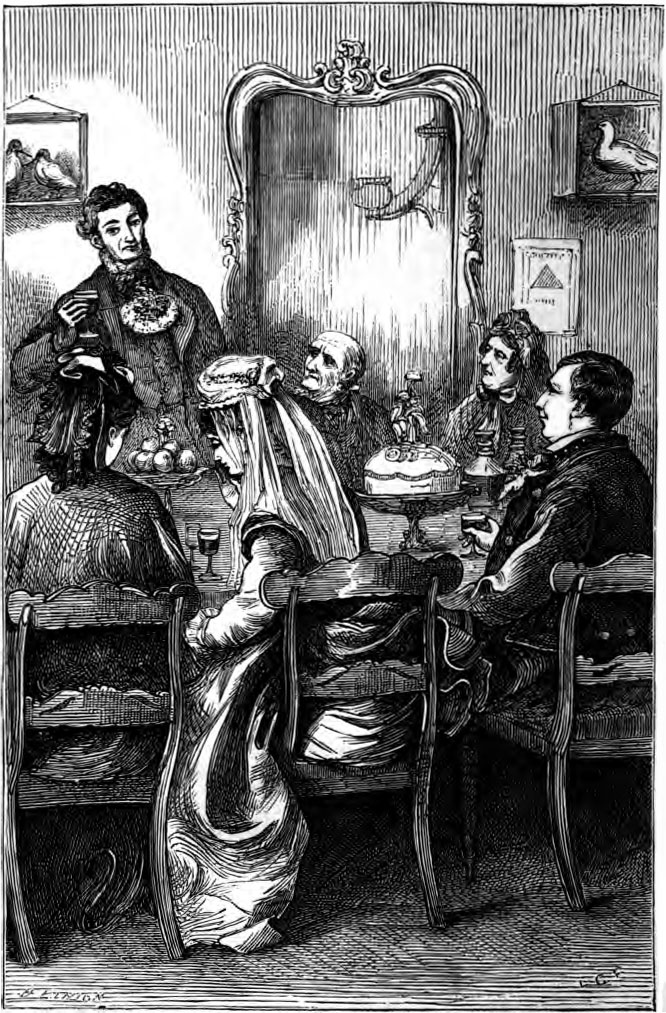
In the afternoon John took his bride to Lowestoft, and brought her
back to all the glories of his own house on the following day. His
honeymoon was short, but its influence on Ruby was beneficent. When
she was alone with the man, knowing that he was her husband, and
thinking something of all that he had done to win her to be his wife,
she did learn to respect him. "Now, Ruby, give a fellow a buss,--as
though you meant it," he said, when the first fitting occasion
presented itself.
"Oh, John,--what nonsense!"
"It ain't nonsense to me, I can tell you. I'd sooner have a kiss from
you than all the wine as ever was swallowed." Then she did kiss him,
"as though she meant it;" and when she returned with him to Bungay
the next day, she had made up her mind that she would endeavour to do
her duty by him as his wife.
CHAPTER XCV.
THE LONGESTAFFE MARRIAGES.
In another part of Suffolk, not very far from Bungay, there was a
lady whose friends had not managed her affairs as well as Ruby's
friends had done for Ruby. Miss Georgiana Longestaffe in the early
days of August was in a very miserable plight. Her sister's marriage
with Mr. George Whitstable was fixed for the first of September, a
day which in Suffolk is of all days the most sacred; and the combined
energies of the houses of Caversham and Toodlam were being devoted
to that happy event. Poor Georgey's position was in every respect
wretched, but its misery was infinitely increased by the triumph
of those hymeneals. It was but the other day that she had looked
down from a very great height on her elder sister, and had utterly
despised the squire of Toodlam. And at that time, still so recent,
this contempt from her had been accepted as being almost reasonable.
Sophia had hardly ventured to rebel against it, and Mr. Whitstable
himself had been always afraid to encounter the shafts of irony with
which his fashionable future sister-in-law attacked him. But all that
was now changed. Sophia in her pride of place had become a tyrant,
and George Whitstable, petted in the house with those sweetmeats
which are always showered on embryo bridegrooms, absolutely gave
himself airs. At this time Mr. Longestaffe was never at home. Having
assured himself that there was no longer any danger of the Brehgert
alliance he had remained in London, thinking his presence to be
necessary for the winding up of Melmotte's affairs, and leaving
poor Lady Pomona to bear her daughter's ill-humour. The family at
Caversham consisted therefore of the three ladies, and was enlivened
by daily visits from Toodlam. It will be owned that in this state of
things there was very little consolation for Georgiana.
It was not long before she quarrelled altogether with her sister,--to
the point of absolutely refusing to act as bridesmaid. The reader may
remember that there had been a watch and chain, and that two of the
ladies of the family had expressed an opinion that these trinkets
should be returned to Mr. Brehgert who had bestowed them. But
Georgiana had not sent them back when a week had elapsed since the
receipt of Mr. Brehgert's last letter. The matter had perhaps escaped
Lady Pomona's memory, but Sophia was happily alive to the honour
of her family. "Georgey," she said one morning in their mother's
presence, "don't you think Mr. Brehgert's watch ought to go back to
him without any more delay?"
"What have you got to do with anybody's watch? The watch wasn't given
to you."
"I think it ought to go back. When papa finds that it has been kept
I'm sure he'll be very angry."
"It's no business of yours whether he's angry or not."
"If it isn't sent George will tell Dolly. You know what would happen
then."
This was unbearable! That George Whitstable should interfere in her
affairs,--that he should talk about her watch and chain. "I never
will speak to George Whitstable again the longest day that ever I
live," she said, getting up from her chair.
"My dear, don't say anything so horrible as that," exclaimed the
unhappy mother.
"I do say it. What has George Whitstable to do with me? A miserably
stupid fellow! Because you've landed him, you think he's to ride over
the whole family."
"I think Mr. Brehgert ought to have his watch and chain back," said
Sophia.
"Certainly he ought," said Lady Pomona. "Georgiana, it must be sent
back. It really must,--or I shall tell your papa."
Subsequently, on the same day, Georgiana brought the watch and chain
to her mother, protesting that she had never thought of keeping them,
and explaining that she had intended to hand them over to her papa
as soon as he should have returned to Caversham. Lady Pomona was now
empowered to return them, and they were absolutely confided to the
hands of the odious George Whitstable, who about this time made a
journey to London in reference to certain garments which he required.
But Georgiana, though she was so far beaten, kept up her quarrel with
her sister. She would not be bridesmaid. She would never speak to
George Whitstable. And she would shut herself up on the day of the
marriage.
She did think herself to be very hardly used. What was there left in
the world that she could do in furtherance of her future cause? And
what did her father and mother expect would become of her? Marriage
had ever been so clearly placed before her eyes as a condition of
things to be achieved by her own efforts, that she could not endure
the idea of remaining tranquil in her father's house and waiting
till some fitting suitor might find her out. She had struggled and
struggled,--struggling still in vain,--till every effort of her mind,
every thought of her daily life, was pervaded by a conviction that
as she grew older from year to year, the struggle should be more
intense. The swimmer when first he finds himself in the water,
conscious of his skill and confident in his strength, can make his
way through the water with the full command of all his powers. But
when he begins to feel that the shore is receding from him, that his
strength is going, that the footing for which he pants is still
far beneath his feet,--that there is peril where before he had
contemplated no danger,--then he begins to beat the water with
strokes rapid but impotent, and to waste in anxious gaspings the
breath on which his very life must depend. So it was with poor
Georgey Longestaffe. Something must be done at once, or it would be
of no avail. Twelve years had been passed by her since first she
plunged into the stream,--the twelve years of her youth,--and she was
as far as ever from the bank; nay, farther, if she believed her eyes.
She too must strike out with rapid efforts, unless, indeed, she would
abandon herself and let the waters close over her head. But immersed
as she was here at Caversham, how could she strike at all? Even now
the waters were closing upon her. The sound of them was in her ears.
The ripple of the wave was already round her lips; robbing her of
breath. Ah!--might not there be some last great convulsive effort
which might dash her on shore, even if it were upon a rock!
That ultimate failure in her matrimonial projects would be the same
as drowning she never for a moment doubted. It had never occurred
to her to consider with equanimity the prospect of living as an old
maid. It was beyond the scope of her mind to contemplate the chances
of a life in which marriage might be well if it came, but in which
unmarried tranquillity might also be well should that be her lot. Nor
could she understand that others should contemplate it for her. No
doubt the battle had been carried on for many years so much under the
auspices of her father and mother as to justify her in thinking that
their theory of life was the same as her own. Lady Pomona had been
very open in her teaching, and Mr. Longestaffe had always given a
silent adherence to the idea that the house in London was to be
kept open in order that husbands might be caught. And now when
they deserted her in her real difficulty,--when they first told her
to live at Caversham all the summer, and then sent her up to the
Melmottes, and after that forbade her marriage with Mr. Brehgert,--it
seemed to her that they were unnatural parents who gave her a stone
when she wanted bread, a serpent when she asked for a fish. She had
no friend left. There was no one living who seemed to care whether
she had a husband or not. She took to walking in solitude about the
park, and thought of many things with a grim earnestness which had
not hitherto belonged to her character.
"Mamma," she said one morning when all the care of the household
was being devoted to the future comforts,--chiefly in regard to
linen,--of Mrs. George Whitstable, "I wonder whether papa has any
intention at all about me."
"In what sort of way, my dear?"
"In any way. Does he mean me to live here for ever and ever?"
"I don't think he intends to have a house in town again."
"And what am I to do?"
"I suppose we shall stay here at Caversham."
"And I'm to be buried just like a nun in a convent,--only that the
nun does it by her own consent and I don't! Mamma, I won't stand it.
I won't indeed."
"I think, my dear, that that is nonsense. You see company here, just
as other people do in the country;--and as for not standing it, I
don't know what you mean. As long as you are one of your papa's
family of course you must live where he lives."
"Oh, mamma, to hear you talk like that!--It is horrible--horrible!
As if you didn't know! As if you couldn't understand! Sometimes I
almost doubt whether papa does know, and then I think that if he did
he would not be so cruel. But you understand it all as well as I do
myself. What is to become of me? Is it not enough to drive me mad
to be going about here by myself, without any prospect of anything?
Should you have liked at my age to have felt that you had no chance
of having a house of your own to live in? Why didn't you, among you,
let me marry Mr. Brehgert?" As she said this she was almost eloquent
with passion.
"You know, my dear," said Lady Pomona, "that your papa wouldn't hear
of it."
"I know that if you would have helped me I would have done it in
spite of papa. What right has he to domineer over me in that way? Why
shouldn't I have married the man if I chose? I am old enough to know
surely. You talk now of shutting up girls in convents as being a
thing quite impossible. This is much worse. Papa won't do anything to
help me. Why shouldn't he let me do something for myself?"
"You can't regret Mr. Brehgert!"
"Why can't I regret him? I do regret him. I'd have him to-morrow if
he came. Bad as it might be, it couldn't be so bad as Caversham."
"You couldn't have loved him, Georgiana."
"Loved him! Who thinks about love nowadays? I don't know any one who
loves any one else. You won't tell me that Sophy is going to marry
that idiot because she loves him! Did Julia Triplex love that man
with the large fortune? When you wanted Dolly to marry Marie Melmotte
you never thought of his loving her. I had got the better of all that
kind of thing before I was twenty."
"I think a young woman should love her husband."
"It makes me sick, mamma, to hear you talk in that way. It does
indeed. When one has been going on for a dozen years trying to do
something,--and I have never had any secrets from you,--then that you
should turn round upon me and talk about love! Mamma, if you would
help me I think I could still manage with Mr. Brehgert." Lady Pomona
shuddered. "You have not got to marry him."
"It is too horrid."
"Who would have to put up with it? Not you, or papa, or Dolly. I
should have a house of my own at least, and I should know what I had
to expect for the rest of my life. If I stay here I shall go mad,--or
die."
"It is impossible."
"If you will stand to me, mamma, I am sure it may be done. I would
write to him, and say that you would see him."
"Georgiana, I will never see him."
"Why not?"
"He is a Jew!"
"What abominable prejudice;--what wicked prejudice! As if you didn't
know that all that is changed now! What possible difference can it
make about a man's religion? Of course I know that he is vulgar, and
old, and has a lot of children. But if I can put up with that, I
don't think that you and papa have a right to interfere. As to his
religion it cannot signify."
"Georgiana, you make me very unhappy. I am wretched to see you so
discontented. If I could do anything for you, I would. But I will not
meddle about Mr. Brehgert. I shouldn't dare to do so. I don't think
you know how angry your papa can be."
"I'm not going to let papa be a bugbear to frighten me. What can he
do? I don't suppose he'll beat me. And I'd rather he would than shut
me up here. As for you, mamma, I don't think you care for me a bit.
Because Sophy is going to be married to that oaf, you are become so
proud of her that you haven't half a thought for anybody else."
"That's very unjust, Georgiana."
"I know what's unjust,--and I know who's ill-treated. I tell you
fairly, mamma, that I shall write to Mr. Brehgert and tell him that
I am quite ready to marry him. I don't know why he should be afraid
of papa. I don't mean to be afraid of him any more, and you may tell
him just what I say."
All this made Lady Pomona very miserable. She did not communicate
her daughter's threat to Mr. Longestaffe, but she did discuss it with
Sophia. Sophia was of opinion that Georgiana did not mean it, and
gave two or three reasons for thinking so. In the first place had she
intended it she would have written her letter without saying a word
about it to Lady Pomona. And she certainly would not have declared
her purpose of writing such letter after Lady Pomona had refused her
assistance. And moreover,--Lady Pomona had received no former hint of
the information which was now conveyed to her,--Georgiana was in the
habit of meeting the curate of the next parish almost every day in
the park.
"Mr. Batherbolt!" exclaimed Lady Pomona.
"She is walking with Mr. Batherbolt almost every day."
"But he is so very strict."
"It is true, mamma."
"And he's five years younger than she! And he's got nothing but his
curacy! And he's a celibate! I heard the bishop laughing at him
because he called himself a celibate."
"It doesn't signify, mamma. I know she is with him constantly. Wilson
has seen them,--and I know it. Perhaps papa could get him a living.
Dolly has a living of his own that came to him with his property."
"Dolly would be sure to sell the presentation," said Lady Pomona.
"Perhaps the bishop would do something," said the anxious sister,
"when he found that the man wasn't a celibate. Anything, mamma,
would be better than the Jew." To this latter proposition Lady Pomona
gave a cordial assent. "Of course it is a come-down to marry a
curate,--but a clergyman is always considered to be decent."
The preparations for the Whitstable marriage went on without any
apparent attention to the intimacy which was growing up between Mr.
Batherbolt and Georgiana. There was no room to apprehend anything
wrong on that side. Mr. Batherbolt was so excellent a young man,
and so exclusively given to religion, that, even should Sophy's
suspicion be correct, he might be trusted to walk about the park with
Georgiana. Should he at any time come forward and ask to be allowed
to make the lady his wife, there would be no disgrace in the matter.
He was a clergyman and a gentleman,--and the poverty would be
Georgiana's own affair.
Mr. Longestaffe returned home only on the eve of his eldest
daughter's marriage, and with him came Dolly. Great trouble had been
taken to teach him that duty absolutely required his presence at his
sister's marriage, and he had at last consented to be there. It is
not generally considered a hardship by a young man that he should
have to go into a good partridge country on the 1st of September, and
Dolly was an acknowledged sportsman. Nevertheless, he considered that
he had made a great sacrifice to his family, and he was received by
Lady Pomona as though he were a bright example to other sons. He
found the house not in a very comfortable position, for Georgiana
still persisted in her refusal either to be a bridesmaid or to speak
to Mr. Whitstable; but still his presence, which was very rare at
Caversham, gave some assistance: and, as at this moment his money
affairs had been comfortably arranged, he was not called upon to
squabble with his father. It was a great thing that one of the girls
should be married, and Dolly had brought down an enormous china dog,
about five feet high, as a wedding present, which added materially
to the happiness of the meeting. Lady Pomona had determined that she
would tell her husband of those walks in the park, and of other signs
of growing intimacy which had reached her ears;--but this she would
postpone until after the Whitstable marriage.
But at nine o'clock on the morning set apart for that marriage, they
were all astounded by the news that Georgiana had run away with Mr.
Batherbolt. She had been up before six. He had met her at the park
gate, and had driven her over to catch the early train at Stowmarket.
Then it appeared, too, that by degrees various articles of her
property had been conveyed to Mr. Batherbolt's lodgings in the
adjacent village, so that Lady Pomona's fear that Georgiana would not
have a thing to wear, was needless. When the fact was first known
it was almost felt, in the consternation of the moment, that the
Whitstable marriage must be postponed. But Sophia had a word to say
to her mother on that head, and she said it. The marriage was not
postponed. At first Dolly talked of going after his younger sister,
and the father did dispatch various telegrams. But the fugitives
could not be brought back, and with some little delay,--which made
the marriage perhaps uncanonical but not illegal,--Mr. George
Whitstable was made a happy man.
It need only be added that in about a month's time Georgiana returned
to Caversham as Mrs. Batherbolt, and that she resided there with her
husband in much connubial bliss for the next six months. At the end
of that time they removed to a small living, for the purchase of
which Mr. Longestaffe had managed to raise the necessary money.
CHAPTER XCVI.
WHERE "THE WILD ASSES QUENCH THEIR THIRST."
We must now go back a little in our story,--about three weeks,--in
order that the reader may be told how affairs were progressing at the
Beargarden. That establishment had received a terrible blow in the
defection of Herr Vossner. It was not only that he had robbed the
club, and robbed every member of the club who had ventured to have
personal dealings with him. Although a bad feeling in regard to
him was no doubt engendered in the minds of those who had suffered
deeply, it was not that alone which cast an almost funereal gloom
over the club. The sorrow was in this,--that with Herr Vossner all
their comforts had gone. Of course Herr Vossner had been a thief.
That no doubt had been known to them from the beginning. A man does
not consent to be called out of bed at all hours in the morning to
arrange the gambling accounts of young gentlemen without being a
thief. No one concerned with Herr Vossner had supposed him to be an
honest man. But then as a thief he had been so comfortable that his
absence was regretted with a tenderness almost amounting to love even
by those who had suffered most severely from his rapacity. Dolly
Longestaffe had been robbed more outrageously than any other member
of the club, and yet Dolly Longestaffe had said since the departure
of the purveyor that London was not worth living in now that Herr
Vossner was gone. In a week the Beargarden collapsed,--as Germany
would collapse for a period if Herr Vossner's great compatriot were
suddenly to remove himself from the scene; but as Germany would
strive to live even without Bismarck, so did the club make its new
efforts. But here the parallel must cease. Germany no doubt would
at last succeed, but the Beargarden had received a blow from which
it seemed that there was no recovery. At first it was proposed that
three men should be appointed as trustees,--trustees for paying
Vossner's debts, trustees for borrowing more money, trustees for the
satisfaction of the landlord who was beginning to be anxious as to
his future rent. At a certain very triumphant general meeting of
the club it was determined that such a plan should be arranged, and
the members assembled were unanimous. It was at first thought that
there might be a little jealousy as to the trusteeship. The club was
so popular and the authority conveyed by the position would be so
great, that A, B, and C might feel aggrieved at seeing so much power
conferred on D, E, and F. When at the meeting above mentioned one
or two names were suggested, the final choice was postponed, as a
matter of detail to be arranged privately, rather from this consider-
ation than with any idea that there might be a difficulty in finding
adequate persons. But even the leading members of the Beargarden
hesitated when the proposition was submitted to them with all its
honours and all its responsibilities. Lord Nidderdale declared from
the beginning that he would have nothing to do with it,--pleading his
poverty openly. Beauchamp Beauclerk was of opinion that he himself
did not frequent the club often enough. Mr. Lupton professed his
inability as a man of business. Lord Grasslough pleaded his father.
The club from the first had been sure of Dolly Longestaffe's
services;--for were not Dolly's pecuniary affairs now in process of
satisfactory arrangement, and was it not known by all men that his
courage never failed him in regard to money? But even he declined.
"I have spoken to Squercum," he said to the Committee, "and Squer-
cum won't hear of it. Squercum has made inquiries and he thinks the
club very shaky." When one of the Committee made a remark as to
Mr. Squercum which was not complimentary,--insinuated indeed that
Squercum without injustice might be consigned to the infernal
deities,--Dolly took the matter up warmly. "That's all very well for
you, Grasslough; but if you knew the comfort of having a fellow who
could keep you straight without preaching sermons at you you wouldn't
despise Squercum. I've tried to go alone and I find that does not
answer. Squercum's my coach, and I mean to stick pretty close to
him." Then it came to pass that the triumphant project as to the
trustees fell to the ground, although Squercum himself advised
that the difficulty might be lessened if three gentlemen could be
selected who lived well before the world and yet had nothing to lose.
Whereupon Dolly suggested Miles Grendall. But the Committee shook its
heads, not thinking it possible that the club could be re-established
on a basis of three Miles Grendalls.
Then dreadful rumours were heard. The Beargarden must surely be
abandoned. "It is such a pity," said Nidderdale, "because there never
has been anything like it."
"Smoke all over the house!" said Dolly.
"No horrid nonsense about closing," said Grasslough, "and
no infernal
old fogies wearing out the carpets and paying for nothing."
"Not a vestige of propriety, or any beastly rules to be kept! That's
what I liked," said Nidderdale.
"It's an old story," said Mr. Lupton, "that if you put a man into
Paradise he'll make it too hot to hold him. That's what you've done
here."
"What we ought to do," said Dolly, who was pervaded by a sense of his
own good fortune in regard to Squercum, "is to get some fellow like
Vossner, and make him tell us how much he wants to steal above his
regular pay. Then we could subscribe that among us. I really think
that might be done. Squercum would find a fellow, no doubt." But Mr.
Lupton was of opinion that the new Vossner might perhaps not know,
when thus consulted, the extent of his own cupidity.
One day, before the Whitstable marriage, when it was understood that
the club would actually be closed on the 12th August unless some
new heaven-inspired idea might be forthcoming for its salvation,
Nidderdale, Grasslough, and Dolly were hanging about the hall and
the steps, and drinking sherry and bitters preparatory to dinner,
when Sir Felix Carbury came round the neighbouring corner and, in a
creeping, hesitating fashion, entered the hall door. He had nearly
recovered from his wounds, though he still wore a bit of court
plaster on his upper lip, and had not yet learned to look or to speak
as though he had not had two of his front teeth knocked out. He had
heard little or nothing of what had been done at the Beargarden since
Vossner's defection. It was now a month since he had been seen at
the club. His thrashing had been the wonder of perhaps half nine
days, but latterly his existence had been almost forgotten. Now, with
difficulty, he had summoned courage to go down to his old haunt, so
completely had he been cowed by the latter circumstances of his life;
but he had determined that he would pluck up his courage, and talk to
his old associates as though no evil thing had befallen him. He had
still money enough to pay for his dinner and to begin a small rubber
of whist. If fortune should go against him he might glide into I. O.
U.'s;--as others had done before, so much to his cost. "By George,
here's Carbury!" said Dolly. Lord Grasslough whistled, turned his
back, and walked up-stairs; but Nidderdale and Dolly consented to
have their hands shaken by the stranger.
"Thought you were out of town," said Nidderdale. "Haven't seen you
for the last ever so long."
"I have been out of town," said Felix,--lying; "down in Suffolk. But
I'm back now. How are things going on here?"
"They're not going at all;--they're gone," said Dolly.
"Everything is smashed," said Nidderdale. "We shall all have to pay,
I don't know how much."
"Wasn't Vossner ever caught?" asked the baronet.
"Caught!" ejaculated Dolly. "No;--but he has caught us. I don't know
that there has ever been much idea of catching Vossner. We close
altogether next Monday, and the furniture is to be gone to law for.
Flatfleece says it belongs to him under what he calls a deed of sale.
Indeed, everything that everybody has seems to belong to Flatfleece.
He's always in and out of the club, and has got the key of the
cellar."
"That don't matter," said Nidderdale, "as Vossner took care that
there shouldn't be any wine."
"He's got most of the forks and spoons, and only lets us use what we
have as a favour."
"I suppose one can get a dinner here?"
"Yes; to-day you can, and perhaps to-morrow."
"Isn't there any playing?" asked Felix with dismay.
"I haven't seen a card this fortnight," said Dolly. "There hasn't
been anybody to play. Everything has gone to the dogs. There has been
the affair of Melmotte, you know;--though, I suppose, you do know all
about that."
"Of course I know he poisoned himself."
"Of course that had effect," said Dolly, continuing his history.
"Though why fellows shouldn't play cards because another fellow like
that takes poison, I can't understand. Last year the only day I
managed to get down in February, the hounds didn't come because some
old cove had died. What harm could our hunting have done him? I call
that rot."
"Melmotte's death was rather awful," said Nidderdale.
"Not half so awful as having nothing to amuse one. And now they say
the girl is going to be married to Fisker. I don't know how you and
Nidderdale like that. I never went in for her myself. Squercum never
seemed to see it."
"Poor dear!" said Nidderdale. "She's welcome for me, and I dare say
she couldn't do better with herself. I was very fond of her;--I'll be
shot if I wasn't."
"And Carbury too, I suppose," said Dolly.
"No; I wasn't. If I'd really been fond of her I suppose it would have
come off. I should have had her safe enough to America, if I'd cared
about it." This was Sir Felix's view of the matter.
"Come into the smoking-room, Dolly," said Nidderdale. "I can stand
most things, and I try to stand everything; but, by George, that
fellow is such a cad that I cannot stand him. You and I are bad
enough,--but I don't think we're so heartless as Carbury."
"I don't think I'm heartless at all," said Dolly. "I'm good-natured
to everybody that is good-natured to me,--and to a great many people
who ain't. I'm going all the way down to Caversham next week to see
my sister married, though I hate the place and hate marriages, and
if I was to be hung for it I couldn't say a word to the fellow who
is going to be my brother-in-law. But I do agree about Carbury. It's
very hard to be good-natured to him."
But, in the teeth of these adverse opinions Sir Felix managed to get
his dinner-table close to theirs and to tell them at dinner something
of his future prospects. He was going to travel and see the world. He
had, according to his own account, completely run through London life
and found that it was all barren.
"In life I've rung all changes through,
Run every pleasure down,
'Midst each excess of folly too,
And lived with half the town."
Sir Felix did not exactly quote the old song, probably having never
heard the words. But that was the burden of his present story. It was
his determination to seek new scenes, and in search of them to travel
over the greater part of the known world.
"How jolly for you!" said Dolly.
"It will be a change, you know."
"No end of a change. Is any one going with you?"
"Well;--yes. I've got a travelling companion;--a very pleasant
fellow, who knows a lot, and will be able to coach me up in things.
There's a deal to be learned by going abroad, you know."
"A sort of a tutor," said Nidderdale.
"A parson, I suppose," said Dolly.
"Well;--he is a clergyman. Who told you?"
"It's only my inventive genius. Well;--yes; I should say that would
be nice,--travelling about Europe with a clergyman. I shouldn't get
enough advantage out of it to make it pay, but I fancy it will just
suit you."
"It's an expensive sort of thing;--isn't it?" asked Nidderdale.
"Well;--it does cost something. But I've got so sick of this kind of
life;--and then that railway Board coming to an end, and the club
smashing up, and--"
"Marie Melmotte marrying Fisker," suggested Dolly.
"That too, if you will. But I want a change, and a change I mean to
have. I've seen this side of things, and now I'll have a look at the
other."
"Didn't you have a row in the street with some one the other day?"
This question was asked very abruptly by Lord Grasslough, who, though
he was sitting near them, had not yet joined in the conversation, and
who had not before addressed a word to Sir Felix. "We heard something
about it, but we never got the right story." Nidderdale glanced
across the table at Dolly, and Dolly whistled. Grasslough looked at
the man he addressed as one does look when one expects an answer.
Mr. Lupton, with whom Grasslough was dining, also sat expectant. Dolly
and Nidderdale were both silent.
It was the fear of this that had kept Sir Felix away from the club.
Grasslough, as he had told himself, was just the fellow to ask such
a question,--ill-natured, insolent, and obtrusive. But the question
demanded an answer of some kind. "Yes," said he; "a fellow attacked
me in the street, coming behind me when I had a girl with me. He
didn't get much the best of it though."
"Oh;--didn't he?" said Grasslough. "I think, upon the whole, you
know, you're right about going abroad."
"What business is it of yours?" asked the baronet.
"Well;--as the club is being broken up, I don't know that it is very
much the business of any of us."
"I was speaking to my friends, Lord Nidderdale and Mr. Longestaffe,
and not to you."
"I quite appreciate the advantage of the distinction," said Lord
Grasslough, "and am sorry for Lord Nidderdale and Mr. Longestaffe."
"What do you mean by that?" said Sir Felix, rising from his chair.
His present opponent was not horrible to him as had been John Crumb,
as men in clubs do not now often knock each others' heads or draw
swords one upon another.
"Don't let's have a quarrel here," said Mr. Lupton. "I shall leave
the room if you do."
"If we must break up, let us break up in peace and quietness," said
Nidderdale.
"Of course, if there is to be a fight, I'm good to go out with
anybody," said Dolly. "When there's any beastly thing to be done,
I've always got to do it. But don't you think that kind of thing is
a little slow?"
"Who began it?" said Sir Felix, sitting down again. Whereupon Lord
Grasslough, who had finished his dinner, walked out of the room.
"That fellow is always wanting to quarrel."
"There's one comfort, you know," said Dolly. "It wants two men to
make a quarrel."
"Yes; it does," said Sir Felix, taking this as a friendly observation;
"and I'm not going to be fool enough to be one of them."
"Oh, yes, I meant it fast enough," said Grasslough afterwards up
in the card-room. The other men who had been together had quickly
followed him, leaving Sir Felix alone, and they had collected
themselves there not with the hope of play, but thinking that they
would be less interrupted than in the smoking-room. "I don't suppose
we shall ever any of us be here again, and as he did come in I
thought I would tell him my mind."
"What's the use of taking such a lot of trouble?" said Dolly. "Of
course he's a bad fellow. Most fellows are bad fellows in one way or
another."
"But he's bad all round," said the bitter enemy.
"And so this is to be the end of the Beargarden," said Lord
Nidderdale with a peculiar melancholy. "Dear old place! I always felt
it was too good to last. I fancy it doesn't do to make things too
easy;--one has to pay so uncommon dear for them! And then, you know,
when you've got things easy, then they get rowdy;--and, by George,
before you know where you are, you find yourself among a lot of
blackguards. If one wants to keep one's self straight, one has to
work hard at it, one way or the other. I suppose it all comes from
the fall of Adam."
"If Solomon, Solon, and the Archbishop of Canterbury were rolled into
one, they couldn't have spoken with more wisdom," said Mr. Lupton.
"Live and learn," continued the young lord. "I don't think anybody
has liked the Beargarden so much as I have, but I shall never try
this kind of thing again. I shall begin reading blue books to-morrow,
and shall dine at the Carlton. Next session I shan't miss a day in
the House, and I'll bet anybody a fiver that I make a speech before
Easter. I shall take to claret at 20_s._ a dozen, and shall go about
London on the top of an omnibus."
"How about getting married?" asked Dolly.
"Oh;--that must be as it comes. That's the governor's affair. None of
you fellows will believe me, but, upon my word, I liked that girl;
and I'd 've stuck to her at last,--only that there are some things a
fellow can't do. He was such a thundering scoundrel!"
After a while Sir Felix followed them up-stairs, and entered the room
as though nothing unpleasant had happened below. "We can make up a
rubber;--can't we?" said he.
"I should say not," said Nidderdale.
"I shall not play," said Mr. Lupton.
"There isn't a pack of cards in the house," said Dolly. Lord
Grasslough didn't condescend to say a word. Sir Felix sat down with
his cigar in his mouth, and the others continued to smoke in silence.
"I wonder what has become of Miles Grendall," asked Sir Felix. But no
one made any answer, and they smoked on in silence. "He hasn't paid
me a shilling yet of the money he owes me." Still there was not a
word. "And I don't suppose he ever will." There was another pause.
"He is the biggest scoundrel I ever met," said Sir Felix.
"I know one as big," said Lord Grasslough,--"or, at any rate, as
little."
There was another pause of a minute, and then Sir Felix left the room
muttering something as to the stupidity of having no cards;--and
so brought to an end his connection with his associates of the
Beargarden. From that time forth he was never more seen by them,--or,
if seen, was never known.
The other men remained there till well on into the night, although
there was not the excitement of any special amusement to attract
them. It was felt by them all that this was the end of the
Beargarden, and, with a melancholy seriousness befitting the
occasion, they whispered sad things in low voices, consoling
themselves simply with tobacco. "I never felt so much like crying in
my life," said Dolly, as he asked for a glass of brandy-and-water at
about midnight. "Good-night, old fellows; good-bye. I'm going down to
Caversham, and I shouldn't wonder if I didn't drown myself."
How Mr. Flatfleece went to law, and tried to sell the furniture, and
threatened everybody, and at last singled out poor Dolly Longestaffe
as his special victim; and how Dolly Longestaffe, by the aid of
Mr. Squercum, utterly confounded Mr. Flatfleece, and brought that
ingenious but unfortunate man, with his wife and small family, to
absolute ruin, the reader will hardly expect to have told to him in
detail in this chronicle.
CHAPTER XCVII.
MRS. HURTLE'S FATE.
Mrs. Hurtle had consented at the joint request of Mrs. Pipkin and
John Crumb to postpone her journey to New York and to go down to
Bungay and grace the marriage of Ruby Ruggles, not so much from any
love for the persons concerned, not so much even from any desire to
witness a phase of English life, as from an irresistible tenderness
towards Paul Montague. She not only longed to see him once again,
but she could with difficulty bring herself to leave the land in which
he was living. There was no hope for her. She was sure of that. She
had consented to relinquish him. She had condoned his treachery to
her,--and for his sake had even been kind to the rival who had taken
her place. But still she lingered near him. And then, though, in all
her very restricted intercourse with such English people as she met,
she never ceased to ridicule things English, yet she dreaded a return
to her own country. In her heart of hearts she liked the somewhat
stupid tranquillity of the life she saw, comparing it with the
rough tempests of her past days. Mrs. Pipkin, she thought, was less
intellectual than any American woman she had ever known; and she was
quite sure that no human being so heavy, so slow, and so incapable
of two concurrent ideas as John Crumb had ever been produced in the
United States;--but, nevertheless, she liked Mrs. Pipkin, and almost
loved John Crumb. How different would her life have been could she
have met a man who would have been as true to her as John Crumb was
to his Ruby!
She loved Paul Montague with all her heart, and she despised herself
for loving him. How weak he was;--how inefficient; how unable to
seize glorious opportunities; how swathed and swaddled by scruples
and prejudices;--how unlike her own countrymen in quickness of
apprehension and readiness of action! But yet she loved him for his
very faults, telling herself that there was something sweeter in his
English manners than in all the smart intelligence of her own land.
The man had been false to her,--false as hell; had sworn to her and
had broken his oath; had ruined her whole life; had made everything
blank before her by his treachery! But then she also had not been
quite true with him. She had not at first meant to deceive;--nor had
he. They had played a game against each other; and he, with all the
inferiority of his intellect to weigh him down, had won,--because he
was a man. She had much time for thinking, and she thought much about
these things. He could change his love as often as he pleased, and be
as good a lover at the end as ever;--whereas she was ruined by his
defection. He could look about for a fresh flower and boldly seek
his honey; whereas she could only sit and mourn for the sweets of
which she had been rifled. She was not quite sure that such mourning
would not be more bitter to her in California than in Mrs. Pipkin's
solitary lodgings at Islington.
"So he was Mr. Montague's partner,--was he now?" asked Mrs. Pipkin a
day or two after their return from the Crumb marriage. For Mr. Fisker
had called on Mrs. Hurtle, and Mrs. Hurtle had told Mrs. Pipkin so
much. "To my thinking now he's a nicer man than Mr. Montague." Mrs.
Pipkin perhaps thought that as her lodger had lost one partner she
might be anxious to secure the other;--perhaps felt, too, that it
might be well to praise an American at the expense of an Englishman.
"There's no accounting for tastes, Mrs. Pipkin."
"And that's true, too, Mrs. Hurtle."
"Mr. Montague is a gentleman."
"I always did say that of him, Mrs. Hurtle."
"And Mr. Fisker is--an American citizen." Mrs. Hurtle when she said
this was very far gone in tenderness.
"Indeed now!" said Mrs. Pipkin, who did not in the least understand
the meaning of her friend's last remark.
"Mr. Fisker came to me with tidings from San Francisco which I had
not heard before, and has offered to take me back with him." Mrs.
Pipkin's apron was immediately at her eyes. "I must go some day, you
know."
"I suppose you must. I couldn't hope as you'd stay here always.
I wish I could. I never shall forget the comfort it's been.
There hasn't been a week without everything settled; and most
ladylike,--most ladylike! You seem to me, Mrs. Hurtle, just as though
you had the bank in your pocket." All this the poor woman said, moved
by her sorrow to speak the absolute truth.
"Mr. Fisker isn't in any way a special friend of mine. But I hear
that he will be taking other ladies with him, and I fancy I might as
well join the party. It will be less dull for me, and I shall prefer
company just at present for many reasons. We shall start on the first
of September." As this was said about the middle of August there
was still some remnant of comfort for poor Mrs. Pipkin. A fortnight
gained was something; and as Mr. Fisker had come to England on
business, and as business is always uncertain, there might possibly
be further delay. Then Mrs. Hurtle made a further communication to
Mrs. Pipkin, which, though not spoken till the latter lady had her
hand on the door, was, perhaps, the one thing which Mrs. Hurtle had
desired to say. "By-the-bye, Mrs. Pipkin, I expect Mr. Montague to
call to-morrow at eleven. Just show him up when he comes." She had
feared that unless some such instructions were given, there might be
a little scene at the door when the gentleman came.
"Mr. Montague;--oh! Of course, Mrs. Hurtle,--of course. I'll see to
it myself." Then Mrs. Pipkin went away abashed,--feeling that she had
made a great mistake in preferring any other man to Mr. Montague, if,
after all, recent difficulties were to be adjusted.
On the following morning Mrs. Hurtle dressed herself with almost more
than her usual simplicity, but certainly with not less than her usual
care, and immediately after breakfast seated herself at her desk,
nursing an idea that she would work as steadily for the next hour as
though she expected no special visitor. Of course she did not write
a word of the task which she had prescribed to herself. Of course
she was disturbed in her mind, though she had dictated to herself
absolute quiescence.
She almost knew that she had been wrong even to desire to see him.
She had forgiven him, and what more was there to be said? She had
seen the girl, and had in some fashion approved of her. Her curiosity
had been satisfied, and her love of revenge had been sacrificed. She
had no plan arranged as to what she would now say to him, nor did she
at this moment attempt to make a plan. She could tell him that she
was about to return to San Francisco with Fisker, but she did not
know that she had anything else to say. Then came the knock at the
door. Her heart leaped within her, and she made a last great effort
to be tranquil. She heard the steps on the stairs, and then the door
was opened and Mr. Montague was announced by Mrs. Pipkin herself.
Mrs. Pipkin, however, quite conquered by a feeling of gratitude to
her lodger, did not once look in through the door, nor did she pause
a moment to listen at the keyhole. "I thought you would come and see
me once again before I went," said Mrs. Hurtle, not rising from her
sofa, but putting out her hand to greet him. "Sit there opposite, so
that we can look at one another. I hope it has not been a trouble to
you."
"Of course I came when you left word for me to do so."
"I certainly should not have expected it from any wish of your own."
"I should not have dared to come, had you not bade me. You know
that."
"I know nothing of the kind;--but as you are here we will not quarrel
as to your motives. Has Miss Carbury pardoned you as yet? Has she
forgiven your sins?"
"We are friends,--if you mean that."
"Of course you are friends. She only wanted to have somebody to tell
her that somebody had maligned you. It mattered not much who it was.
She was ready to believe any one who would say a good word for you.
Perhaps I wasn't just the person to do it, but I believe even I was
sufficient to serve the turn."
"Did you say a good word for me?"
"Well; no;" replied Mrs. Hurtle. "I will not boast that I did. I do
not want to tell you fibs at our last meeting. I said nothing good
of you. What could I say of good? But I told her what was quite as
serviceable to you as though I had sung your virtues by the hour
without ceasing. I explained to her how very badly you had behaved
to me. I let her know that from the moment you had seen her, you had
thrown me to the winds."
"It was not so, my friend."
"What did that matter? One does not scruple a lie for a friend, you
know! I could not go into all the little details of your perfidies.
I could not make her understand during one short and rather agonizing
interview how you had allowed yourself to be talked out of your
love for me by English propriety even before you had seen her
beautiful eyes. There was no reason why I should tell her all my
disgrace,--anxious as I was to be of service. Besides, as I put it,
she was sure to be better pleased. But I did tell her how unwillingly
you had spared me an hour of your company;--what a trouble I had been
to you;--how you would have shirked me if you could!"
"Winifrid, that is untrue."
"That wretched journey to Lowestoft was the great crime. Mr. Roger
Carbury, who I own is poison to me--"
"You do not know him."
"Knowing him or not I choose to have my own opinion, sir. I say that
he is poison to me, and I say that he had so stuffed her mind with
the flagrant sin of that journey, with the peculiar wickedness of our
having lived for two nights under the same roof, with the awful fact
that we had travelled together in the same carriage, till that had
become the one stumbling block on your path to happiness."
"He never said a word to her of our being there."
"Who did then? But what matters? She knew it;--and, as the only
means of whitewashing you in her eyes, I did tell her how cruel and
how heartless you had been to me. I did explain how the return of
friendship which you had begun to show me, had been frozen, harder
than Wenham ice, by the appearance of Mr. Carbury on the sands.
Perhaps I went a little farther and hinted that the meeting had been
arranged as affording you the easiest means of escape from me."
"You do not believe that."
"You see I had your welfare to look after; and the baser your conduct
had been to me, the truer you were in her eyes. Do I not deserve some
thanks for what I did? Surely you would not have had me tell her that
your conduct to me had been that of a loyal, loving gentleman. I
confessed to her my utter despair;--I abased myself in the dust, as a
woman is abased who has been treacherously ill-used, and has failed
to avenge herself. I knew that when she was sure that I was prostrate
and hopeless she would be triumphant and contented. I told her on
your behalf how I had been ground to pieces under your chariot
wheels. And now you have not a word of thanks to give me!"
"Every word you say is a dagger."
"You know where to go for salve for such skin-deep scratches as I
make. Where am I to find a surgeon who can put together my crushed
bones? Daggers, indeed! Do you not suppose that in thinking of you
I have often thought of daggers? Why have I not thrust one into
your heart, so that I might rescue you from the arms of this puny,
spiritless English girl?" All this time she was still seated, looking
at him, leaning forward towards him with her hands upon her brow.
"But, Paul, I spit out my words to you, like any common woman, not
because they will hurt you, but because I know I may take that
comfort, such as it is, without hurting you. You are uneasy for a
moment while you are here, and I have a cruel pleasure in thinking
that you cannot answer me. But you will go from me to her, and then
will you not be happy? When you are sitting with your arm round her
waist, and when she is playing with your smiles, will the memory of
my words interfere with your joy then? Ask yourself whether the prick
will last longer than the moment. But where am I to go for happiness
and joy? Can you understand what it is to have to live only on
retrospects?"
"I wish I could say a word to comfort you."
"You cannot say a word to comfort me, unless you will unsay all that
you have said since I have been in England. I never expect comfort
again. But, Paul, I will not be cruel to the end. I will tell you all
that I know of my concerns, even though my doing so should justify
your treatment of me. He is not dead."
"You mean Mr. Hurtle."
"Whom else should I mean? And he himself says that the divorce which
was declared between us was no divorce. Mr. Fisker came here to me
with tidings. Though he is not a man whom I specially love,--though I
know that he has been my enemy with you,--I shall return with him to
San Francisco."
"I am told that he is taking Madame Melmotte with him, and Melmotte's
daughter."
"So I understand. They are adventurers,--as I am, and I do not see
why we should not suit each other."
"They say also that Fisker will marry Miss Melmotte."
"Why should I object to that? I shall not be jealous of Mr. Fisker's
attentions to the young lady. But it will suit me to have some one to
whom I can speak on friendly terms when I am back in California. I
may have a job of work to do there which will require the backing of
some friends. I shall be hand-and-glove with these people before I
have travelled half across the ocean with them."
"I hope they will be kind to you," said Paul.
"No;--but I will be kind to them. I have conquered others by being
kind, but I have never had much kindness myself. Did I not conquer
you, sir, by being gentle and gracious to you? Ah, how kind I was to
that poor wretch, till he lost himself in drink! And then, Paul, I
used to think of better people, perhaps of softer people, of things
that should be clean and sweet and gentle,--of things that should
smell of lavender instead of wild garlic. I would dream of fair, fem-
inine women,--of women who would be scared by seeing what I saw,
who would die rather than do what I did. And then I met you, Paul,
and I said that my dreams should come true. I ought to have known
that it could not be so. I did not dare quite to tell you all the
truth. I know I was wrong, and now the punishment has come upon me.
Well;--I suppose you had better say good-bye to me. What is the good
of putting it off?" Then she rose from her chair and stood before him
with her arms hanging listlessly by her side.
"God bless you, Winifrid!" he said, putting out his hand to her.
"But he won't. Why should he,--if we are right in supposing that
they who do good will be blessed for their good, and those who do
evil cursed for their evil? I cannot do good. I cannot bring myself
now not to wish that you would return to me. If you would come I
should care nothing for the misery of that girl,--nothing, at least
nothing now, for the misery I should certainly bring upon you. Look
here;--will you have this back?" As she asked this she took from out
her bosom a small miniature portrait of himself which he had given
her in New York, and held it towards him.
"If you wish it I will,--of course," he said.
"I would not part with it for all the gold in California. Nothing
on earth shall ever part me from it. Should I ever marry another
man,--as I may do,--he must take me and this together. While I live
it shall be next my heart. As you know, I have but little respect for
the proprieties of life. I do not see why I am to abandon the picture
of the man I love because he becomes the husband of another wo-
man. Having once said that I love you I shall not contradict myself
because you have deserted me. Paul, I have loved you, and do love
you,--oh, with my very heart of hearts." So speaking she threw
herself into his arms and covered his face with kisses. "For one
moment you shall not banish me. For one short minute I will be here.
Oh, Paul, my love;--my love!"
All this to him was simply agony,--though as she had truly said it
was an agony he would soon forget. But to be told by a woman of her
love,--without being able even to promise love in return,--to be so
told while you are in the very act of acknowledging your love for
another woman,--carries with it but little of the joy of triumph. He
did not want to see her raging like a tigress, as he had once thought
might be his fate; but he would have preferred the continuance of
moderate resentment to this flood of tenderness. Of course he stood
with his arm round her waist, and of course he returned her caresses;
but he did it with such stiff constraint that she at once felt how
chill they were. "There," she said, smiling through her bitter
tears,--"there; you are released now, and not even my fingers shall
ever be laid upon you again. If I have annoyed you, at this our last
meeting, you must forgive me."
"No;--but you cut me to the heart."
"That we can hardly help;--can we? When two persons have made fools
of themselves as we have, there must I suppose be some punishment.
Yours will never be heavy after I am gone. I do not start till the
first of next month because that is the day fixed by our friend, Mr.
Fisker, and I shall remain here till then because my presence is
convenient to Mrs. Pipkin; but I need not trouble you to come to me
again. Indeed it will be better that you should not. Good-bye."
He took her by the hand, and stood for a moment looking at her, while
she smiled and gently nodded her head at him. Then he essayed to pull
her towards him as though he would again kiss her. But she repulsed
him, still smiling the while. "No, sir; no; not again; never again, never
,--never,--never again." By that time she had recovered her hand
and stood apart from him. "Good-bye, Paul;--and now go." Then he
turned round and left the room without uttering a word.
She stood still, without moving a limb, as she listened to his step
down the stairs and to the opening and the closing of the door. Then
hiding herself at the window with the scanty drapery of the curtain
she watched him as he went along the street. When he had turned the
corner she came back to the centre of the room, stood for a moment
with her arms stretched out towards the walls, and then fell prone
upon the floor. She had spoken the very truth when she said that she
had loved him with all her heart.
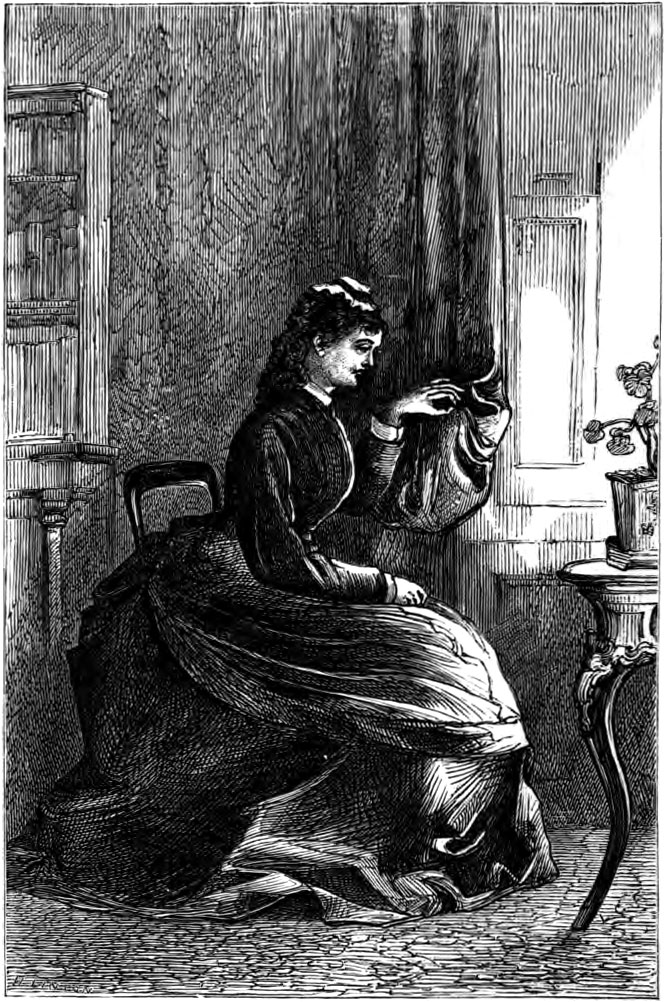
But that evening she bade Mrs. Pipkin drink tea with her and was more
gracious to the poor woman than ever. When the obsequious but still
curious landlady asked some question about Mr. Montague, Mrs. Hurtle
seemed to speak very freely on the subject of her late lover,--and to
speak without any great pain. They had put their heads together, she
said, and had found that the marriage would not be suitable. Each of
them preferred their own country, and so they had agreed to part.
On that evening Mrs. Hurtle made herself more than usually pleasant,
having the children up into her room, and giving them jam and
bread-and-butter. During the whole of the next fortnight she seemed
to take a delight in doing all in her power for Mrs. Pipkin and her
family. She gave toys to the children, and absolutely bestowed upon
Mrs. Pipkin a new carpet for the drawing-room. Then Mr. Fisker came
and took her away with him to America; and Mrs. Pipkin was left,--a
desolate but grateful woman.
"They do tell bad things about them Americans," she said to a friend
in the street, "and I don't pretend to know. But for a lodger, I only
wish Providence would send me another just like the one I have lost.
She had that good nature about her she liked to see the bairns eating
pudding just as if they was her own."
I think Mrs. Pipkin was right, and that Mrs. Hurtle, with all her
faults, was a good-natured woman.
CHAPTER XCVIII.
MARIE MELMOTTE'S FATE.
In the meantime Marie Melmotte was living with Madame Melmotte in
their lodgings up at Hampstead, and was taking quite a new look out
into the world. Fisker had become her devoted servant,--not with that
old-fashioned service which meant making love, but with perhaps a
truer devotion to her material interests. He had ascertained on her
behalf that she was the undoubted owner of the money which her fa-
ther had made over to her on his first arrival in England,--and she
also had made herself mistress of that fact with equal precision. It
would have astonished those who had known her six months since could
they now have seen how excellent a woman of business she had be-
come, and how capable she was of making the fullest use of Mr.
Fisker's services. In doing him justice it must be owned that he kept
nothing back from her of that which he learned, probably feeling
that he might best achieve success in his present project by such
honesty,--feeling also, no doubt, the girl's own strength in discov-
ering truth and falsehood. "She's her father's own daughter,"he
said one day to Croll in Abchurch Lane;--for Croll, though he had
left Melmotte's employment when he found that his name had been
forged, had now returned to the service of the daughter in some
undefined position, and had been engaged to go with her and Madame
Melmotte to New York.
"Ah; yees," said Croll, "but bigger. He vas passionate, and did lose
his 'ead; and vas blow'd up vid bigness." Whereupon Croll made an
action as though he were a frog swelling himself to the dimensions
of an ox. "'E bursted himself, Mr. Fisker. 'E vas a great man; but
the greater he grew he vas always less and less vise. 'E ate so
much that he became too fat to see to eat his vittels." It was thus
that Herr Croll analyzed the character of his late master. "But
Ma'me'selle,--ah, she is different. She vill never eat too moch, but
vill see to eat alvays." Thus too he analyzed the character of his
young mistress.
At first things did not arrange themselves pleasantly between Madame
Melmotte and Marie. The reader will perhaps remember that they were
in no way connected by blood. Madame Melmotte was not Marie's mother,
nor, in the eye of the law, could Marie claim Melmotte as her father.
She was alone in the world, absolutely without a relation, not know-
ing even what had been her mother's name,--not even knowing what
was her father's true name, as in the various biographies of the
great man which were, as a matter of course, published within a
fortnight of his death, various accounts were given as to his birth,
parentage, and early history. The general opinion seemed to be that
his father had been a noted coiner in New York,--an Irishman of the
name of Melmody,--and, in one memoir, the probability of the descent
was argued from Melmotte's skill in forgery. But Marie, though she
was thus isolated, and now altogether separated from the lords and
duchesses who a few weeks since had been interested in her career,
was the undoubted owner of the money,--a fact which was beyond the
comprehension of Madame Melmotte. She could understand,--and was
delighted to understand,--that a very large sum of money had been
saved from the wreck, and that she might therefore look forward to
prosperous tranquillity for the rest of her life. Though she never
acknowledged so much to herself, she soon learned to regard the
removal of her husband as the end of her troubles. But she could
not comprehend why Marie should claim all the money as her own.
She declared herself to be quite willing to divide the spoil,--and
suggested such an arrangement both to Marie and to Croll. Of Fisker
she was afraid, thinking that the iniquity of giving all the money
to Marie originated with him, in order that he might obtain it
by marrying the girl. Croll, who understood it all perfectly,
told her the story a dozen times,--but quite in vain. She made a
timid suggestion of employing a lawyer on her own behalf, and was
only deterred from doing so by Marie's ready assent to such an
arrangement. Marie's equally ready surrender of any right she might
have to a portion of the jewels which had been saved had perhaps
some effect in softening the elder lady's heart. She thus was in
possession of a treasure of her own,--though a treasure small in
comparison with that of the younger woman; and the younger woman
had promised that in the event of her marriage she would be liberal.
It was distinctly understood that they were both to go to New York
under Mr. Fisker's guidance as soon as things should be sufficiently
settled to allow of their departure; and Madame Melmotte was told,
about the middle of August, that their places had been taken for the
3rd of September. But nothing more was told her. She did not as yet
know whether Marie was to go out free or as the affianced bride of
Hamilton Fisker. And she felt herself injured by being left so much
in the dark. She herself was inimical to Fisker, regarding him as a
dark, designing man, who would ultimately swallow up all that her
husband had left behind him,--and trusted herself entirely to Croll,
who was personally attentive to her. Fisker was, of course, going
on to San Francisco. Marie also had talked of crossing the American
continent. But Madame Melmotte was disposed to think that for her,
with her jewels, and such share of the money as Marie might be
induced to give her, New York would be the most fitting residence.
Why should she drag herself across the continent to California? Herr
Croll had declared his purpose of remaining in New York. Then it
occurred to the lady that as Melmotte was a name which might be too
well known in New York, and which it therefore might be wise to
change, Croll would do as well as any other. She and Herr Croll had
known each other for a great many years, and were, she thought, of
about the same age. Croll had some money saved. She had, at any rate,
her jewels,--and Croll would probably be able to get some portion of
all that money, which ought to be hers, if his affairs were made to
be identical with her own. So she smiled upon Croll, and whispered
to him; and when she had given Croll two glasses of Curaçoa,--which
comforter she kept in her own hands, as safe-guarded almost as the
jewels,--then Croll understood her.
But it was essential that she should know what Marie intended to do.
Marie was anything but communicative, and certainly was not in any
way submissive. "My dear," she said one day, asking the question in
French, without any preface or apology, "are you going to be married
to Mr. Fisker?"
"What makes you ask that?"
"It is so important I should know. Where am I to live? What am I to
do? What money shall I have? Who will be a friend to me? A woman
ought to know. You will marry Fisker if you like him. Why cannot you
tell me?"
"Because I do not know. When I know I will tell you. If you go on
asking me till to-morrow morning I can say no more."
And this was true. She did not know. It certainly was not Fisker's
fault that she should still be in the dark as to her own destiny, for
he had asked her often enough, and had pressed his suit with all his
eloquence. But Marie had now been wooed so often that she felt the
importance of the step which was suggested to her. The romance of
the thing was with her a good deal worn, and the material view of
matrimony had also been damaged in her sight. She had fallen in love
with Sir Felix Carbury, and had assured herself over and over again
that she worshipped the very ground on which he stood. But she had
taught herself this business of falling in love as a lesson, rather
than felt it. After her father's first attempts to marry her to this
and that suitor because of her wealth,--attempts which she had hardly
opposed amidst the consternation and glitter of the world to which
she was suddenly introduced,--she had learned from novels that it
would be right that she should be in love, and she had chosen Sir
Felix as her idol. The reader knows what had been the end of that
episode in her life. She certainly was not now in love with Sir Felix
Carbury. Then she had as it were relapsed into the hands of Lord
Nidderdale,--one of her early suitors,--and had felt that as love was
not to prevail, and as it would be well that she should marry some
one, he might probably be as good as any other, and certainly better
than many others. She had almost learned to like Lord Nidderdale and
to believe that he liked her, when the tragedy came. Lord Nidderdale
had been very good-natured,--but he had deserted her at last. She
had never allowed herself to be angry with him for a moment. It had
been a matter of course that he should do so. Her fortune was still
large, but not so large as the sum named in the bargain made. And it
was moreover weighted with her father's blood. From the moment of
her father's death she had never dreamed that he would marry her.
Why should he? Her thoughts in reference to Sir Felix were bitter
enough;--but as against Nidderdale they were not at all bitter.
Should she ever meet him again she would shake hands with him and
smile,--if not pleasantly as she thought of the things which were
past,--at any rate with good humour. But all this had not made
her much in love with matrimony generally. She had over a hundred
thousand pounds of her own, and, feeling conscious of her own power
in regard to her own money, knowing that she could do as she pleased
with her wealth, she began to look out into life seriously.
What could she do with her money, and in what way would she shape
her life, should she determine to remain her own mistress? Were she to
refuse Fisker how should she begin? He would then be banished, and
her only remaining friends, the only persons whose names she would
even know in her own country, would be her father's widow and
Herr Croll. She already began to see Madame Melmotte's purport in
reference to Croll, and could not reconcile herself to the idea of
opening an establishment with them on a scale commensurate with her
fortune. Nor could she settle in her own mind any pleasant position
for herself as a single woman, living alone in perfect independence.
She had opinions of women's rights,--especially in regard to money;
and she entertained also a vague notion that in America a young woman
would not need support so essentially as in England. Nevertheless,
the idea of a fine house for herself in Boston, or Philadelphia,--for
in that case she would have to avoid New York as the chosen residence
of Madame Melmotte,--did not recommend itself to her. As to Fisker
himself,--she certainly liked him. He was not beautiful like Felix
Carbury, nor had he the easy good-humour of Lord Nidderdale. She had
seen enough of English gentlemen to know that Fisker was very unlike
them. But she had not seen enough of English gentlemen to make
Fisker distasteful to her. He told her that he had a big house at San
Francisco, and she certainly desired to live in a big house. He
represented himself to be a thriving man, and she calculated that
he certainly would not be here, in London, arranging her father's
affairs, were he not possessed of commercial importance. She had
contrived to learn that, in the United States, a married woman
has greater power over her own money than in England, and this
information acted strongly in Fisker's favour. On consideration of
the whole subject she was inclined to think that she would do better
in the world as Mrs. Fisker than as Marie Melmotte,--if she could see
her way clearly in the matter of her own money.
"I have got excellent berths," Fisker said to her one morning at
Hampstead. At these interviews, which were devoted first to business
and then to love, Madame Melmotte was never allowed to be present.
"I am to be alone?"
"Oh, yes. There is a cabin for Madame Melmotte and the maid, and a
cabin for you. Everything will be comfortable. And there is another
lady going,--Mrs. Hurtle,--whom I think you will like."
"Has she a husband?"
"Not going with us," said Mr. Fisker evasively.
"But she has one?"
"Well, yes;--but you had better not mention him. He is not exactly
all that a husband should be."
"Did she not come over here to marry some one else?"--For Marie in
the days of her sweet intimacy with Sir Felix Carbury had heard
something of Mrs. Hurtle's story.
"There is a story, and I dare say I shall tell you all about it some
day. But you may be sure I should not ask you to associate with any
one you ought not to know."
"Oh,--I can take care of myself."
"No doubt, Miss Melmotte,--no doubt. I feel that quite strongly.
But what I meant to observe was this,--that I certainly should not
introduce a lady whom I aspire to make my own lady to any lady whom
a lady oughtn't to know. I hope I make myself understood, Miss
Melmotte."
"Oh, quite."
"And perhaps I may go on to say that if I could go on board that
ship as your accepted lover, I could do a deal more to make you
comfortable, particularly when you land, than just as a mere friend,
Miss Melmotte. You can't doubt my heart."
"I don't see why I shouldn't. Gentlemen's hearts are things very much
to be doubted as far as I've seen 'em. I don't think many of 'em have
'em at all."
"Miss Melmotte, you do not know the glorious west. Your past
experiences have been drawn from this effete and stone-cold country
in which passion is no longer allowed to sway. On those golden shores
which the Pacific washes man is still true,--and woman is still
tender."
"Perhaps I'd better wait and see, Mr. Fisker."
But this was not Mr. Fisker's view of the case. There might be other
men desirous of being true on those golden shores. "And then," said
he, pleading his cause not without skill, "the laws regulating
woman's property there are just the reverse of those which the
greediness of man has established here. The wife there can claim
her share of her husband's property, but hers is exclusively her
own. America is certainly the country for women,--and especially
California."
"Ah;--I shall find out all about it, I suppose, when I've been there
a few months."
"But you would enter San Francisco, Miss Melmotte, under such much
better auspices,--if I may be allowed to say so,--as a married lady
or as a lady just going to be married."
"Ain't single ladies much thought of in California?"
"It isn't that. Come, Miss Melmotte, you know what I mean."
"Yes, I do."
"Let us go in for life together. We've both done uncommon well. I'm
spending 30,000 dollars a year,--at that rate,--in my own house.
You'll see it all. If we put them both together,--what's yours and
what's mine,--we can put our foot out as far as about any one there,
I guess."
"I don't know that I care about putting my foot out. I've seen
something of that already, Mr. Fisker. You shouldn't put your foot
out farther than you can draw it in again."
"You needn't fear me as to that, Miss Melmotte. I shouldn't be able
to touch a dollar of your money. It would be such a triumph to go
into Francisco as man and wife."
"I shouldn't think of being married till I had been there a while and
looked about me."
"And seen the house! Well;--there's something in that. The house is
all there, I can tell you. I'm not a bit afraid but what you'll like
the house. But if we were engaged, I could do every thing for you.
Where would you be, going into San Francisco all alone? Oh, Miss
Melmotte, I do admire you so much!"
I doubt whether this last assurance had much efficacy. But the
arguments with which it was introduced did prevail to a certain
extent. "I'll tell you how it must be then," she said.
"How shall it be?" and as he asked the question he jumped up and put
his arm round her waist.
"Not like that, Mr. Fisker," she said, withdrawing herself. "It shall
be in this way. You may consider yourself engaged to me."
"I'm the happiest man on this continent," he said, forgetting in his
ecstasy that he was not in the United States.
"But if I find when I get to Francisco anything to induce me to
change my mind, I shall change it. I like you very well, but I'm not
going to take a leap in the dark, and I'm not going to marry a pig in
a poke."
"There you're quite right," he said,--"quite right."
"You may give it out on board the ship that we're engaged, and I'll
tell Madame Melmotte the same. She and Croll don't mean going any
farther than New York."
"We needn't break our hearts about that;--need we?"
"It don't much signify. Well;--I'll go on with Mrs. Hurtle, if she'll
have me."
"Too much delighted she'll be."
"And she shall be told we're engaged."
"My darling!"
"But if I don't like it when I get to Frisco, as you call it, all the
ropes in California shan't make me do it. Well;--yes; you may give
me a kiss I suppose now if you care about it." And so,--or rather so
far,--Mr. Fisker and Marie Melmotte became engaged to each other as
man and wife.
After that Mr. Fisker's remaining business in England went very
smoothly with him. It was understood up at Hampstead that he was
engaged to Marie Melmotte,--and it soon came to be understood also
that Madame Melmotte was to be married to Herr Croll. No doubt the
father of the one lady and the husband of the other had died so
recently as to make these arrangements subject to certain censorious
objections. But there was a feeling that Melmotte had been so unlike
other men, both in his life and in his death, that they who had been
concerned with him were not to be weighed by ordinary scales. Nor did
it much matter, for the persons concerned took their departure soon
after the arrangement was made, and Hampstead knew them no more.
On the 3rd of September Madame Melmotte, Marie, Mrs. Hurtle, Hamilton
K. Fisker, and Herr Croll left Liverpool for New York; and the three
ladies were determined that they never would revisit a country of
which their reminiscences certainly were not happy. The writer of the
present chronicle may so far look forward,--carrying his reader with
him,--as to declare that Marie Melmotte did become Mrs. Fisker very
soon after her arrival at San Francisco.
CHAPTER XCIX.
LADY CARBURY AND MR. BROUNE.
When Sir Felix Carbury declared to his friends at the Beargarden that
he intended to devote the next few months of his life to foreign
travel, and that it was his purpose to take with him a Protestant
divine,--as was much the habit with young men of rank and fortune
some years since,--he was not altogether lying. There was indeed
a sounder basis of truth than was usually to be found attached to
his statements. That he should have intended to produce a false
impression was a matter of course,--and nearly equally so that he
should have made his attempt by asserting things which he must have
known that no one would believe. He was going to Germany, and he was
going in company with a clergyman, and it had been decided that he
should remain there for the next twelve months. A representation had
lately been made to the Bishop of London that the English Protestants
settled in a certain commercial town in the north-eastern district of
Prussia were without pastoral aid, and the bishop had stirred himself
in the matter. A clergyman was found willing to expatriate himself,
but the income suggested was very small. The Protestant English
population of the commercial town in question, though pious, was not
liberal. It had come to pass that the "Morning Breakfast Table" had
interested itself in the matter, having appealed for subscriptions
after a manner not unusual with that paper. The bishop and all those
concerned in the matter had fully understood that if the "Morning
Breakfast Table" could be got to take the matter up heartily, the
thing would be done. The heartiness had been so complete that it had
at last devolved upon Mr. Broune to appoint the clergyman; and, as
with all the aid that could be found, the income was still small, the
Rev. Septimus Blake,--a brand snatched from the burning of Rome,--
had been induced to undertake the maintenance and total charge of Sir
Felix Carbury for a consideration. Mr. Broune imparted to Mr. Blake
all that there was to know about the baronet, giving much counsel
as to the management of the young man, and specially enjoining
on the clergyman that he should on no account give Sir Felix the
means of returning home. It was evidently Mr. Broune's anxious wish
that Sir Felix should see as much as possible of German life, at a
comparatively moderate expenditure, and under circumstances that
should be externally respectable if not absolutely those which a
young gentleman might choose for his own comfort or profit;--but
especially that those circumstances should not admit of the speedy
return to England of the young gentleman himself.
Lady Carbury had at first opposed the scheme. Terribly difficult
as was to her the burden of maintaining her son, she could not
endure the idea of driving him into exile. But Mr. Broune was very
obstinate, very reasonable, and, as she thought, somewhat hard of
heart. "What is to be the end of it then?" he said to her, almost in
anger. For in those days the great editor, when in presence of Lady
Carbury, differed very much from that Mr. Broune who used to squeeze
her hand and look into her eyes. His manner with her had become so
different that she regarded him as quite another person. She hardly
dared to contradict him, and found herself almost compelled to tell
him what she really felt and thought. "Do you mean to let him eat
up everything you have to your last shilling, and then go to the
workhouse with him?"
"Oh, my friend, you know how I am struggling! Do not say such horrid
things."
"It is because I know how you are struggling that I find myself
compelled to say anything on the subject. What hardship will there be
in his living for twelve months with a clergyman in Prussia? What can
he do better? What better chance can he have of being weaned from the
life he is leading?"
"If he could only be married!"
"Married! Who is to marry him? Why should any girl with money throw
herself away upon him?"
"He is so handsome."
"What has his beauty brought him to? Lady Carbury, you must let me
tell you that all that is not only foolish but wrong. If you keep him
here you will help to ruin him, and will certainly ruin yourself. He
has agreed to go;--let him go."
She was forced to yield. Indeed, as Sir Felix had himself assented,
it was almost impossible that she should not do so. Perhaps Mr.
Broune's greatest triumph was due to the talent and firmness with
which he persuaded Sir Felix to start upon his travels. "Your
mother," said Mr. Broune, "has made up her mind that she will
not absolutely beggar your sister and herself in order that your
indulgence may be prolonged for a few months. She cannot make you
go to Germany of course. But she can turn you out of her house, and,
unless you go, she will do so."
"I don't think she ever said that, Mr. Broune."
"No;--she has not said so. But I have said it for her in her
presence; and she has acknowledged that it must necessarily be so.
You may take my word as a gentleman that it will be so. If you take
her advice £175 a year will be paid for your maintenance;--but if you
remain in England not a shilling further will be paid." He had no
money. His last sovereign was all but gone. Not a tradesman would
give him credit for a coat or a pair of boots. The key of the
door had been taken away from him. The very page treated him with
contumely. His clothes were becoming rusty. There was no prospect
of amusement for him during the coming autumn or winter. He did not
anticipate much excitement in Eastern Prussia, but he thought that
any change must be a change for the better. He assented, therefore,
to the proposition made by Mr. Broune, was duly introduced to the
Rev. Septimus Blake, and, as he spent his last sovereign on a last
dinner at the Beargarden, explained his intentions for the immediate
future to those friends at his club who would no doubt mourn his
departure.
Mr. Blake and Mr. Broune between them did not allow the grass to
grow under their feet. Before the end of August Sir Felix, with
Mr. and Mrs. Blake and the young Blakes, had embarked from Hull
for Hamburgh,--having extracted at the very hour of parting a last
five-pound note from his foolish mother. "It will be just enough to
bring him home," said Mr. Broune with angry energy when he was told
of this. But Lady Carbury, who knew her son well, assured him that
Felix would be restrained in his expenditure by no such prudence as
such a purpose would indicate. "It will be gone," she said, "long
before they reach their destination."
"Then why the deuce should you give it him?" said Mr. Broune.
Mr. Broune's anxiety had been so intense that he had paid half a
year's allowance in advance to Mr. Blake out of his own pocket.
Indeed, he had paid various sums for Lady Carbury,--so that that
unfortunate woman would often tell herself that she was becoming
subject to the great editor, almost like a slave. He came to her,
three or four times a week, at about nine o'clock in the evening, and
gave her instructions as to all that she should do. "I wouldn't write
another novel if I were you," he said. This was hard, as the writing
of novels was her great ambition, and she had flattered herself that
the one novel which she had written was good. Mr. Broune's own critic
had declared it to be very good in glowing language. The "Evening
Pulpit" had of course abused it,--because it is the nature of the
"Evening Pulpit" to abuse. So she had argued with herself, telling
herself that the praise was all true, whereas the censure had come
from malice. After that article in the "Breakfast Table," it did seem
hard that Mr. Broune should tell her to write no more novels. She
looked up at him piteously but said nothing. "I don't think you'd
find it answer. Of course you can do it as well as a great many
others. But then that is saying so little!"
"I thought I could make some money."
"I don't think Mr. Leadham would hold out to you very high hopes;--I
don't, indeed. I think I would turn to something else."
"It is so very hard to get paid for what one does."
To this Mr. Broune made no immediate answer; but, after sitting for
a while, almost in silence, he took his leave. On that very morning
Lady Carbury had parted from her son. She was soon about to part from
her daughter, and she was very sad. She felt that she could hardly
keep up that house in Welbeck Street for herself, even if her means
permitted it. What should she do with herself? Whither should she
take herself? Perhaps the bitterest drop in her cup had come from
those words of Mr. Broune forbidding her to write more novels. After
all, then, she was not a clever woman,--not more clever than other
women around her! That very morning she had prided herself on her
coming success as a novelist, basing all her hopes on that review in
the "Breakfast Table." Now, with that reaction of spirits which is so
common to all of us, she was more than equally despondent. He would
not thus have crushed her without a reason. Though he was hard to her
now,--he who used to be so soft,--he was very good. It did not occur
to her to rebel against him. After what he had said, of course there
would be no more praise in the "Breakfast Table,"--and, equally of
course, no novel of hers could succeed without that. The more she
thought of him, the more omnipotent he seemed to be. The more she
thought of herself, the more absolutely prostrate she seemed to have
fallen from those high hopes with which she had begun her literary
career not much more than twelve months ago.
On the next day he did not come to her at all, and she sat idle,
wretched, and alone. She could not interest herself in Hetta's coming
marriage, as that marriage was in direct opposition to one of her
broken schemes. She had not ventured to confess so much to Mr.
Broune, but she had in truth written the first pages of the first
chapter of a second novel. It was impossible now that she should even
look at what she had written. All this made her very sad. She spent
the evening quite alone; for Hetta was staying down in Suffolk, with
her cousin's friend, Mrs. Yeld, the bishop's wife; and as she thought
of her life past and her life to come, she did, perhaps, with a
broken light, see something of the error of her ways, and did, after
a fashion, repent. It was all "leather or prunello," as she said to
herself;--it was all vanity,--and vanity,--and vanity! What real
enjoyment had she found in anything? She had only taught herself to
believe that some day something would come which she would like;--
but she had never as yet in truth found anything to like. It had all been
in anticipation,--but now even her anticipations were at an end. Mr.
Broune had sent her son away, had forbidden her to write any more
novels,--and had been refused when he had asked her to marry him!
The next day he came to her as usual, and found her still very
wretched. "I shall give up this house," she said. "I can't afford to
keep it; and in truth I shall not want it. I don't in the least know
where to go, but I don't think that it much signifies. Any place will
be the same to me now."
"I don't see why you should say that."
"What does it matter?"
"You wouldn't think of going out of London."
"Why not? I suppose I had better go wherever I can live cheapest."
"I should be sorry that you should be settled where I could not see
you," said Mr. Broune plaintively.
"So shall I,--very. You have been more kind to me than anybody.
But what am I to do? If I stay in London I can live only in some
miserable lodgings. I know you will laugh at me, and tell me that I
am wrong; but my idea is that I shall follow Felix wherever he goes,
so that I may be near him and help him when he needs help. Hetta
doesn't want me. There is nobody else that I can do any good to."
"I want you," said Mr. Broune, very quietly.
"Ah,--that is so kind of you. There is nothing makes one so good
as goodness;--nothing binds your friend to you so firmly as the
acceptance from him of friendly actions. You say you want me, because
I have so sadly wanted you. When I go you will simply miss an almost
daily trouble, but where shall I find a friend?"
"When I said I wanted you, I meant more than that, Lady Carbury. Two
or three months ago I asked you to be my wife. You declined, chiefly,
if I understood you rightly, because of your son's position. That has
been altered, and therefore I ask you again. I have quite convinced
myself,--not without some doubts, for you shall know all; but, still,
I have quite convinced myself,--that such a marriage will best
contribute to my own happiness. I do not think, dearest, that it
would mar yours."
This was said with so quiet a voice and so placid a demeanour, that
the words, though they were too plain to be misunderstood, hardly at
first brought themselves home to her. Of course he had renewed his
offer of marriage, but he had done so in a tone which almost made her
feel that the proposition could not be an earnest one. It was not
that she believed that he was joking with her or paying her a poor
insipid compliment. When she thought about it at all, she knew that
it could not be so. But the thing was so improbable! Her opinion of
herself was so poor, she had become so sick of her own vanities and
littlenesses and pretences, that she could not understand that such
a man as this should in truth want to make her his wife. At this mo-
ment she thought less of herself and more of Mr. Broune than either
perhaps deserved. She sat silent, quite unable to look him in the
face, while he kept his place in his arm-chair, lounging back, with
his eyes intent on her countenance. "Well," he said; "what do you
think of it? I never loved you better than I did for refusing me
before, because I thought that you did so because it was not right
that I should be embarrassed by your son."
"That was the reason," she said, almost in a whisper.
"But I shall love you better still for accepting me now,--if you will
accept me."
The long vista of her past life appeared before her eyes. The
ambition of her youth which had been taught to look only to a
handsome maintenance, the cruelty of her husband which had driven
her to run from him, the further cruelty of his forgiveness when she
returned to him; the calumny which had made her miserable, though she
had never confessed her misery; then her attempts at life in London,
her literary successes and failures, and the wretchedness of her
son's career;--there had never been happiness, or even comfort, in
any of it. Even when her smiles had been sweetest her heart had been
heaviest. Could it be that now at last real peace should be within
her reach, and that tranquillity which comes from an anchor holding
to a firm bottom? Then she remembered that first kiss,--or attempted
kiss,--when, with a sort of pride in her own superiority, she had
told herself that the man was a susceptible old goose. She certainly
had not thought then that his susceptibility was of this nature.
Nor could she quite understand now whether she had been right then,
and that the man's feelings, and almost his nature, had since
changed,--or whether he had really loved her from first to last. As
he remained silent it was necessary that she should answer him. "You
can hardly have thought of it enough," she said.
"I have thought of it a good deal too. I have been thinking of it for
six months at least."
"There is so much against me."
"What is there against you?"
"They say bad things of me in India."
"I know all about that," replied Mr. Broune.
"And Felix!"
"I think I may say that I know all about that also."
"And then I have become so poor!"
"I am not proposing to myself to marry you for your money. Luckily
for me,--I hope luckily for both of us,--it is not necessary that I
should do so."
"And then I seem so to have fallen through in everything. I don't
know what I've got to give to a man in return for all that you offer
to give to me."
"Yourself," he said, stretching out his right hand to her. And there
he sat with it stretched out,--so that she found herself compelled
to put her own into it, or to refuse to do so with very absolute
words. Very slowly she put out her own, and gave it to him without
looking at him. Then he drew her towards him, and in a moment she was
kneeling at his feet, with her face buried on his knees. Considering
their ages perhaps we must say that their attitude was awkward. They
would certainly have thought so themselves had they imagined that
any one could have seen them. But how many absurdities of the kind
are not only held to be pleasant, but almost holy,--as long as they
remain mysteries inspected by no profane eyes! It is not that Age
is ashamed of feeling passion and acknowledging it,--but that the
display of it is, without the graces of which Youth is proud, and
which Age regrets.
On that occasion there was very little more said between them. He had
certainly been in earnest, and she had now accepted him. As he went
down to his office he told himself now that he had done the best, not
only for her but for himself also. And yet I think that she had won
him more thoroughly by her former refusal than by any other virtue.
She, as she sat alone, late into the night, became subject to a
thorough reaction of spirit. That morning the world had been a
perfect blank to her. There was no single object of interest before
her. Now everything was rose-coloured. This man who had thus bound
her to him, who had given her such assured proofs of his affection
and truth, was one of the considerable ones of the world; a man than
whom few,--so she now told herself,--were greater or more powerful.
Was it not a career enough for any woman to be the wife of such a
man, to receive his friends, and to shine with his reflected glory?
Whether her hopes were realised, or,--as human hopes never are
realised,--how far her content was assured, these pages cannot tell;
but they must tell that, before the coming winter was over, Lady
Carbury became the wife of Mr. Broune, and, in furtherance of her own
resolve, took her husband's name. The house in Welbeck Street was
kept, and Mrs. Broune's Tuesday evenings were much more regarded by
the literary world than had been those of Lady Carbury.
CHAPTER C.
DOWN IN SUFFOLK.
It need hardly be said that Paul Montague was not long in adjusting
his affairs with Hetta after the visit which he received from Roger
Carbury. Early on the following morning he was once more in Welbeck
Street, taking the brooch with him; and though at first Lady Carbury
kept up her opposition, she did it after so weak a fashion as to
throw in fact very little difficulty in his way. Hetta understood
perfectly that she was in this matter stronger than her mother
and that she need fear nothing, now that Roger Carbury was on
her side. "I don't know what you mean to live on," Lady Carbury
said, threatening future evils in a plaintive tone. Hetta repeated,
though in other language, the assurance which the young lady made
who declared that if her future husband would consent to live on
potatoes, she would be quite satisfied with the potato-peelings;
while Paul made some vague allusion to the satisfactory nature of his
final arrangements with the house of Fisker, Montague, and Montague.
"I don't see anything like an income," said Lady Carbury; "but I
suppose Roger will make it right. He takes everything upon himself
now it seems." But this was before the halcyon day of Mr. Broune's
second offer.
It was at any rate decided that they were to be married, and the time
fixed for the marriage was to be the following spring. When this was
finally arranged Roger Carbury, who had returned to his own home,
conceived the idea that it would be well that Hetta should pass the
autumn and if possible the winter also down in Suffolk, so that she
might get used to him in the capacity which he now aspired to fill;
and with that object he induced Mrs. Yeld, the Bishop's wife, to
invite her down to the palace. Hetta accepted the invitation and left
London before she could hear the tidings of her mother's engagement
with Mr. Broune.
Roger Carbury had not yielded in this matter,--had not brought
himself to determine that he would recognise Paul and Hetta
as acknowledged lovers,--without a fierce inward contest. Two
convictions had been strong in his mind, both of which were opposed
to this recognition,--the first telling him that he would be a fitter
husband for the girl than Paul Montague, and the second assuring him
that Paul had ill-treated him in such a fashion that forgiveness
would be both foolish and unmanly. For Roger, though he was
a religious man, and one anxious to conform to the spirit of
Christianity, would not allow himself to think that an injury should
be forgiven unless the man who did the injury repented of his own
injustice. As to giving his coat to the thief who had taken his
cloak,--he told himself that were he and others to be guided by
that precept honest industry would go naked in order that vice and
idleness might be comfortably clothed. If any one stole his cloak he
would certainly put that man in prison as soon as possible and not
commence his lenience till the thief should at any rate affect to be
sorry for his fault. Now, to his thinking, Paul Montague had stolen
his cloak, and were he, Roger, to give way in this matter of his
love, he would be giving Paul his coat also. No! He was bound after
some fashion to have Paul put into prison; to bring him before a
jury, and to get a verdict against him, so that some sentence of
punishment might be at least pronounced. How then could he yield?
And Paul Montague had shown himself to be very weak in regard to
women. It might be,--no doubt it was true,--that Mrs. Hurtle's
appearance in England had been distressing to him. But still he
had gone down with her to Lowestoft as her lover, and, to Roger's
thinking, a man who could do that was quite unfit to be the husband
of Hetta Carbury. He would himself tell no tales against Montague
on that head. Even when pressed to do so he had told no tale. But
not the less was his conviction strong that Hetta ought to know the
truth, and to be induced by that knowledge to reject her younger
lover.
But then over these convictions there came a third,--equally
strong,--which told him that the girl loved the younger man and did
not love him, and that if he loved the girl it was his duty as a
man to prove his love by doing what he could to make her happy. As
he walked up and down the walk by the moat, with his hands clasped
behind his back, stopping every now and again to sit on the terrace
wall,--walking there, mile after mile, with his mind intent on the
one idea,--he schooled himself to feel that that, and that only,
could be his duty. What did love mean if not that? What could be the
devotion which men so often affect to feel if it did not tend to
self-sacrifice on behalf of the beloved one? A man would incur any
danger for a woman, would subject himself to any toil,--would even
die for her! But if this were done simply with the object of winning
her, where was that real love of which sacrifice of self on behalf
of another is the truest proof? So, by degrees, he resolved that the
thing must be done. The man, though he had been bad to his friend,
was not all bad. He was one who might become good in good hands.
He, Roger, was too firm of purpose and too honest of heart to buoy
himself up into new hopes by assurances of the man's unfitness.
What right had he to think that he could judge of that better than
the girl herself? And so, when many many miles had been walked, he
succeeded in conquering his own heart,--though in conquering it he
crushed it,--and in bringing himself to the resolve that the energies
of his life should be devoted to the task of making Mrs. Paul Mont-
ague a happy woman. We have seen how he acted up to this resolve
when last in London, withdrawing at any rate all signs of anger from
Paul Montague and behaving with the utmost tenderness to Hetta.
When he had accomplished that task of conquering his own heart and
of assuring himself thoroughly that Hetta was to become his rival's
wife, he was, I think, more at ease and less troubled in his spirit
than he had been during those months in which there had still been
doubt. The sort of happiness which he had once pictured to himself
could certainly never be his. That he would never marry he was quite
sure. Indeed he was prepared to settle Carbury on Hetta's eldest boy
on condition that such boy should take the old name. He would never
have a child whom he could in truth call his own. But if he could
induce these people to live at Carbury, or to live there for at least
a part of the year, so that there should be some life in the place,
he thought that he could awaken himself again, and again take an
interest in the property. But as a first step to this he must learn
to regard himself as an old man,--as one who had let life pass by too
far for the purposes of his own home, and who must therefore devote
himself to make happy the homes of others.
So thinking of himself and so resolving, he had told much of his
story to his friend the Bishop, and as a consequence of those
revelations Mrs. Yeld had invited Hetta down to the palace. Roger
felt that he had still much to say to his cousin before her marriage
which could be said in the country much better than in town, and he
wished to teach her to regard Suffolk as the county to which she
should be attached and in which she was to find her home. The day
before she came he was over at the palace with the pretence of asking
permission to come and see his cousin soon after her arrival, but
in truth with the idea of talking about Hetta to the only friend to
whom he had looked for sympathy in his trouble. "As to settling your
property on her or her children," said the Bishop, "it is quite out
of the question. Your lawyer would not allow you to do it. Where
would you be if after all you were to marry?"
"I shall never marry."
"Very likely not,--but yet you may. How is a man of your age to
speak with certainty of what he will do or what he will not do in
that respect? You can make your will, doing as you please with your
property;--and the will, when made, can be revoked."
"I think you hardly understand just what I feel," said Roger, "and
I know very well that I am unable to explain it. But I wish to act
exactly as I would do if she were my daughter, and as if her son, if
she had a son, would be my natural heir."
"But, if she were your daughter, her son wouldn't be your natural
heir as long as there was a probability or even a chance that you
might have a son of your own. A man should never put the power,
which properly belongs to him, out of his own hands. If it does properly
belong to you it must be better with you than elsewhere. I think very
highly of your cousin, and I have no reason to think otherwise than
well of the gentleman whom she intends to marry. But it is only human
nature to suppose that the fact that your property is still at your
own disposal should have some effect in producing a more complete
observance of your wishes."
"I do not believe it in the least, my lord," said Roger somewhat
angrily.
"That is because you are so carried away by enthusiasm at the
present moment as to ignore the ordinary rules of life. There are
not, perhaps, many fathers who have Regans and Gonerils for their
daughters;--but there are very many who may take a lesson from the
folly of the old king. 'Thou hadst little wit in thy bald crown,' the
fool said to him, 'when thou gav'st thy golden one away.' The world,
I take it, thinks that the fool was right."
The Bishop did so far succeed that Roger abandoned the idea of
settling his property on Paul Montague's children. But he was not on
that account the less resolute in his determination to make himself
and his own interests subordinate to those of his cousin. When he
came over, two days afterwards, to see her he found her in the
garden, and walked there with her for a couple of hours. "I hope all
our troubles are over now," he said smiling.
"You mean about Felix," said Hetta,--"and mamma?"
"No, indeed. As to Felix I think that Lady Carbury has done the best
thing in her power. No doubt she has been advised by Mr. Broune, and
Mr. Broune seems to be a prudent man. And about your mother herself,
I hope that she may now be comfortable. But I was not alluding to
Felix and your mother. I was thinking of you--and of myself."
"I hope that you will never have any troubles."
"I have had troubles. I mean to speak very freely to you now, dear.
I was nearly upset,--what I suppose people call broken-hearted,--when
I was assured that you certainly would never become my wife. I ought
not to have allowed myself to get into such a frame of mind. I should
have known that I was too old to have a chance."
"Oh, Roger,--it was not that."
"Well,--that and other things. I should have known it sooner, and
have got over my misery quicker. I should have been more manly and
stronger. After all, though love is a wonderful incident in a man's
life, it is not that only that he is here for. I have duties plainly
marked out for me; and as I should never allow myself to be withdrawn
from them by pleasure, so neither should I by sorrow. But it is done
now. I have conquered my regrets, and I can say with safety that I
look forward to your presence and Paul's presence at Carbury as the
source of all my future happiness. I will make him welcome as though
he were my brother, and you as though you were my daughter. All I ask
of you is that you will not be chary of your presence there." She
only answered him by a close pressure on his arm. "That is what I
wanted to say to you. You will teach yourself to regard me as your
best and closest friend,--as he on whom you have the strongest right
to depend, of all,--except your husband."
"There is no teaching necessary for that," she said.
"As a daughter leans on a father I would have you lean on me, Hetta.
You will soon come to find that I am very old. I grow old quickly,
and already feel myself to be removed from everything that is young
and foolish."
"You never were foolish."
"Nor young either, I sometimes think. But now you must promise me
this. You will do all that you can to induce him to make Carbury his
residence."
"We have no plans as yet at all, Roger."
"Then it will be certainly so much the easier for you to fall into my
plan. Of course you will be married at Carbury?"
"What will mamma say?"
"She will come here, and I am sure will enjoy it. That I regard as
settled. Then, after that, let this be your home,--so that you should
learn really to care about and to love the place. It will be your
home really, you know, some of these days. You will have to be Squire
of Carbury yourself when I am gone, till you have a son old enough
to fill that exalted position." With all his love to her and his
good-will to them both, he could not bring himself to say that Paul
Montague should be Squire of Carbury.
"Oh, Roger, please do not talk like that."
"But it is necessary, my dear. I want you to know what my wishes
are, and, if it be possible, I would learn what are yours. My mind
is quite made up as to my future life. Of course, I do not wish to
dictate to you,--and if I did, I could not dictate to Mr. Montague."
"Pray,--pray do not call him Mr. Montague."
"Well, I will not;--to Paul then. There goes the last of my anger."
He threw his hands up as though he were scattering his indignation
to the air. "I would not dictate either to you or to him, but it
is right that you should know that I hold my property as steward
for those who are to come after me, and that the satisfaction of my
stewardship will be infinitely increased if I find that those for
whom I act share the interest which I shall take in the matter. It is
the only payment which you and he can make me for my trouble."
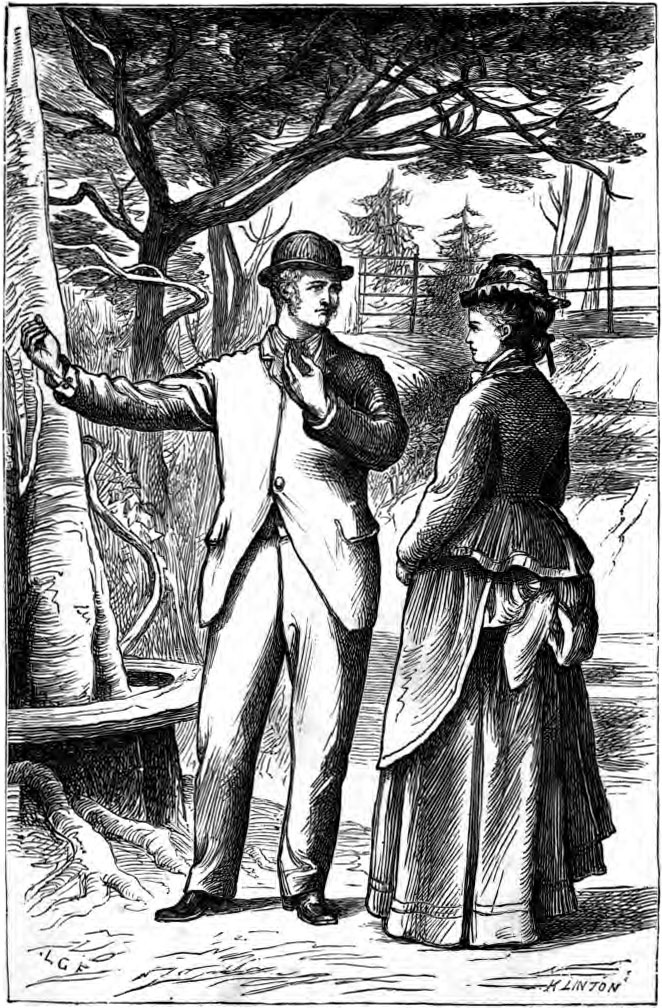
"But Felix, Roger!"
His brow became a little black as he answered her. "To a sister,"
he said very solemnly, "I will not say a word against her brother;
but on that subject I claim a right to come to a decision on my
own judgment. It is a matter in which I have thought much, and, I
may say, suffered much. I have ideas, old-fashioned ideas, on the
matter, which I need not pause to explain to you now. If we are as
much together as I hope we shall be, you will, no doubt, come to
understand them. The disposition of a family property, even though
it be one so small as mine, is, to my thinking, a matter which a man
should not make in accordance with his own caprices,--or even with
his own affections. He owes a duty to those who live on his land, and
he owes a duty to his country. And, though it may seem fantastic to
say so, I think he owes a duty to those who have been before him, and
who have manifestly wished that the property should be continued in
the hands of their descendants. These things are to me very holy. In
what I am doing I am in some respects departing from the theory of
my life,--but I do so under a perfect conviction that by the course
I am taking I shall best perform the duties to which I have alluded.
I do not think, Hetta, that we need say any more about that." He
had spoken so seriously, that, though she did not quite understand
all that he had said, she did not venture to dispute his will any
further. He did not endeavour to exact from her any promise, but
having explained his purposes, kissed her as he would have kissed
a daughter, and then left her and rode home without going into the
house.
Soon after that, Paul Montague came down to Carbury, and the same
thing was said to him, though in a much less solemn manner. Paul was
received quite in the old way. Having declared that he would throw
all anger behind him, and that Paul should be again Paul, he rigidly
kept his promise, whatever might be the cost to his own feelings.
As to his love for Hetta, and his old hopes, and the disappointment
which had so nearly unmanned him, he said not another word to his
fortunate rival. Montague knew it all, but there was now no necessity
that any allusion should be made to past misfortunes. Roger indeed
made a solemn resolution that to Paul he would never again speak of
Hetta as the girl whom he himself had loved, though he looked forward
to a time, probably many years hence, when he might perhaps remind
her of his fidelity. But he spoke much of the land and of the tenants
and the labourers, of his own farm, of the amount of the income, and
of the necessity of so living that the income might always be more
than sufficient for the wants of the household.
When the spring came round, Hetta and Paul were married by the Bishop
at the parish church of Carbury, and Roger Carbury gave away the
bride. All those who saw the ceremony declared that the squire had
not seemed to be so happy for many a long year. John Crumb, who was
there with his wife,--himself now one of Roger's tenants, having
occupied the land which had become vacant by the death of old Daniel
Ruggles,--declared that the wedding was almost as good fun as his
own. "John, what a fool you are!" Ruby said to her spouse, when this
opinion was expressed with rather a loud voice. "Yes, I be," said
John,--"but not such a fool as to a' missed a having o' you." "No,
John; it was I was the fool then," said Ruby. "We'll see about that
when the bairn's born," said John,--equally aloud. Then Ruby held
her tongue. Mrs. Broune, and Mr. Broune, were also at Carbury,--thus
doing great honour to Mr. and Mrs. Paul Montague, and showing by
their presence that all family feuds were at an end. Sir Felix was
not there. Happily up to this time Mr. Septimus Blake had continued
to keep that gentleman as one of his Protestant population in the
German town,--no doubt not without considerable trouble to himself.