Part One
Chapter 1
"I Am the Sire de Coucy”: The Dynasty
By virtue of its location in the center of Picardy, the domain of Coucy, as the crown
acknowledged, was "one of the keys of the kingdom.” Reaching almost to Flanders in the
north and to the Channel and borders of Normandy on the west, Picardy was the main
avenue of northern France. Its rivers led both southward to the Seine and westward to the
Channel. Its fertile soil made it the primary agricultural region of France, with
pasture
and fields of grain, clumps of forest, and a comfortable sprinkling of villages. Clearing,
the first act of civilization, had started with the Romans. At the opening of the 14th
century Picardy supported about 250,000 households or a population of more than a
million, making it the only province of France, other than Toulouse in
the south, to have
been more populous in medieval rimes than in modern. Its temper was vigorous and
independent, its towns the earliest to win charters as communes.
In the shadowed region between legend and history, the domain of Coucy was originally
a fief of the Church supposedly bestowed on St. Remi, first Bishop of Reims, by Clovis,
first Christian King of the Franks, in about the year 500. After his conversion to
Christianity by St. Remi, King Clovis gave the territory of Coucy to the new bishopric of
Reims, grounding the Church in the things of Caesar, as the Emperor Constantine had
traditionally grounded the Church of Rome. By Constantine’s gift, Christianity was both
officially established and fatally compromised. As William Langland wrote,
When the kindness of Constantine gave Holy Church endowments
In lands and leases, lordships and servants,
The Romans heard an angel cry on high above them,
"This day dos ecclesiae has drunk venom
And all who have Peter’s power are poisoned forever.”
That conflict between the reach for the divine and the lure of earthly things was to be the
central problem of the Middle Ages. The claim of the Church to spiritual leadership could
never be made wholly credible to all its communicants when it was founded in material
wealth. The more riches the Church amassed, the more visible and disturbing became
the
flaw; nor could it ever be resolved, but continued to renew doubt and dissent in every
century.
In the earliest Latin documents, Coucy was called Codiciacum or Codiacum, supposedly
derived from Codex, codicis, meaning a tree trunk stripped of its branches such as those
the Gauls used to build their palisades. For four centuries through the Dark Ages the
place remained in shadow. In 910-20 Herve, Archbishop of Reims, built the first
primitive castle and chapel on the hill, surrounded by a wall as defense against Norsemen
invading the valley of the Oise. Settlers from the village below, taking refuge within the
Bishop’s walls, founded the upper town, which came to be known as Coucy-le-Chateau,
as distinguished from Coucy-la-Ville below. In those fierce times the territory was a
constant bone of conflict among barons, archbishops, and kings, all equally bellicose.
Defense against invaders--Moors in the south, Norsemen in the north--had
bred a class
of hard-bitten warriors who fought among themselves as willingly and savagely as
against outsiders. In 975 Oderic, Archbishop of Reims, ceded the fief to a personage
called the Comte d’Eudes, who became the first lord of Coucy. Nothing is known of this
individual except his name, but once established on the hilltop, he produced in his
descendants a strain of extraordinary strength and fury.
Enguerrand I, was a man of many scandals, obsessed by lust for women, according to
Abbot Guibert (himself a victim of repressed sexuality, as revealed in
his Confessions).
Seized by a passion for Sybil, wife of a lord of Lorraine, Enguerrand succeeded, with
the aid of a compliant Bishop of Laon who was his first cousin, in divorcing
his first wife,
Adele de Marie, on charges of adultery. Afterward he married Sybil with
the sanction
of the Church while her husband was absent at war and while the lady herself
was preg-
nant as the result of still a third liaison. She was said to be of dissolute
morals.
Out of this vicious family situation came that "raging wolf” (in the
words of another
famous abbot, Suger of St. Denis), the most notorious and savage of the Coucys, Thomas
de Marie, son of the repudiated Adele. Bitterly hating the father who had cast his
paternity in doubt, Thomas grew up to take part in the ceaseless war originally launched
against Enguerrand I by the discarded husband of Sybil.
These private wars were fought by the knights with furious gusto and a single strategy,
which consisted in trying to ruin the enemy by killing or maiming as many of his
peasants and destroying as many crops, vineyards, tools, barns, and other possessions as
possible, thereby reducing his sources of revenue. As a result, the chief victim of the
belligerents was their respective peasantry. Abbot Guibert claimed that
in the "mad war”
of Enguerrand against the Lorrainer, captured men had their eyes put out and feet cut off
with results that could still be seen in the district in his time. The private wars were the
curse of Europe which the crusades, it has been thought, were subconsciously invented to
relieve by providing a vent for aggression.
While political power centralized during the 12th and 13th centuries, the energies and
talents of Europe were gathering in one of civilization’s great bursts of development.
Stimulated by commerce, a surge took place in art, technology, building, learning,
exploration by land and sea, universities, cities, banking and credit, and every sphere that
enriched life and widened horizons. Those 200 years were the High Middle Ages, a
period that brought into use the compass and mechanical clock, the spinning wheel and
treadle loom, the windmill and watermill; a period when Marco Polo traveled to China
and Thomas Aquinas set himself to organize knowledge, when universities were
established at Paris, Bologna, Padua, and Naples, Oxford and Cambridge, Salamanca and
Valladolid, Montpellier and Toulouse; when Giotto painted human feeling, Roger Bacon
delved into experimental science, Dante framed his great design of human fate and wrote
it in the vernacular; a period when religion was expressed both in the gentle preaching of
St. Francis and in the cruelty of the Inquisition, when the Albigensian Crusade in the
name of faith drenched southern France in blood and massacre while the soaring
cathedrals rose arch upon arch, triumphs of creativity, technology, and faith.
They were not built by slave labor. Though limited serfdom existed, the rights and duties
of serfs were fixed by custom and legal memory, and the work of medieval society,
unlike that of the ancient world, was done by its own members.
The grand seigneur’s authority extended to "high justice,” meaning
the power of life or
death, while the lesser knight’s was limited to prison, flogging, and other punishments of
"low justice.” Its basis and justification remained the duty to protect,
as embodied in the
lord’s oath to his vassals, which was as binding in theory as theirs to
him--and theirs was
binding "only so long as the lord keeps his oath.” Medieval political
structure was ideally a
contract exchanging service and loyalty in return for protection, justice,
and order. As the
peasant owed produce and labor, the lord in turn owed ministerial service
to his overlord or
sovereign, and counsel in peace as well as military service in war. Land in all cases was the
consideration, and the oath of homage, made and accepted, was the seal
binding both sides,
including kings.
Not all nobles were grands seigneurs like the Coucys. A bachelor knight, possessor of
one manor and a bony nag, shared the same cult but not the interests of
a territorial lord.
The total ranks of the nobility in France numbered about 200,000 persons in 40,000 to
50,000 families who represented something over one percent of the population. They
ranged from the great dukedoms with revenues of more than 10,000 livres,
down through
the lord of a minor castle with one or two knights as vassals and an income under 500
livres, to the poor knight at the bottom of the scale who was lord of no one except those
of servile birth and whose only fief was a house and a few fields equivalent to a peasant’s
holding. He might have an income from a few rents of 25 livres or less, which had to
support family and servants and the knight’s equipment that was his livelihood.
He lived
by horse and arms, dependent for maintenance on his overlord or whoever needed his
services.
A squire belonged to the nobility by birth whether or not he obtained the belt and spurs
of a knight, but legal process was often required to determine what other
functions a
gentleman might undertake without losing noble status. Could he sell wine from his
vineyard, for instance?--a delicate question because the kings regularly
sold theirs. In a
case brought in 1393 to determine this question, a royal ordinance stated rather
ambiguously, "It is not proper for a noble to be an innkeeper.” According
to another
judgment, a noble could acquire license to trade without losing his status. Sons of noble
fathers were known "who live and have long lived as merchants selling
cloth, grain, wine
and all other things of merchandise, or as tradesmen, furriers, shoemakers or tailors,” but
such activities would doubtless have lost them the privileges of a noble.
The rationale of the problem was made plain by Honore Bonet, a 14th century cleric who
made the brave attempt in his Tree of Battles to set forth existing codes of military
conduct. The reason for the prohibition of commercial activity, he wrote, was to ensure
that the knight 'shall have no cause to leave the practice of arms for the desire of
acquiring worldly riches.”
Definition increasingly concerned the born nobles in proportion as their status was
diluted by the ennoblement of outsiders. Like the grant of charters to towns, the grant of
fiefs to commoners, who paid handsomely for the honor, was found by the crown to be a
lucrative source of funds. The ennobled were men of fortune who procured the king’s
needs, or they were lawyers and notaries who had started by assisting the king at various
levels in the administration of finance and justice and gradually, as the business of
government grew more complex, created a group of professional civil servants and
ministers of the crown. Called noblesse de la robe when elevated, as distinguished from
nobility of the sword, they were scorned as parvenus by the ancestral nobles, who
resented the usurping of their right of counsel, lost more or less by default.
In consequence, the heraldic coat-of-arms--outward sign of ancestry signifying
the right
to bear arms, which, once granted to a family, could be worn by no other--came
to be an
object almost of cult worship. At tournaments its display was required as evidence of
noble ancestry; at some tournaments four were required. As penetration by outsiders
increased, so did snobbery until a day in the mid-15th century when a knight rode into the
lists followed by a parade of pennants bearing no less than 32 coats-of-arms.
Through disappearance by failure to produce a male heir or by sinking over the edge into
the lower classes, and through inflow of the ennobled, the personnel of the nobility was
in flux, even though the status was fixed as an order of society. The disappearance rate of
noble families has been estimated at 50 percent a century, and the average duration of a
dynasty at three to six generations over a period from 100 to 200 years.
An example of
the sinking process occurred in a family called Clusel with a small fief in the Loire
valley. In 1276 it was headed by a knight evidently of too small resources to maintain
himself in arms, who was reduced to the non-noble necessity of tilling his fields and
operating his mill with his own hands. Of three grandsons appearing in local records, one
was still a squire, one had become a parish priest, and the third a rent-collector for the
lord of the county. After a passage of 85 years no member of the lineage was any longer
referred to as a noble. In the case of another squire named Guichard Vert, who died as a
young man in 1287, the family hovered on the edge. Guichard left two beds, three
blankets, four bedsheets, two small rugs, one table, three benches, five coffers, two hams
and a haunch of bacon in the larder, five empty barrels in the cellar, a chessboard, and a
helmet and lance but no sword. Though without cash, he willed 200 livres to his wife to
be paid in ten installments from his revenues of about 60 livres a year, and other income
to found a chantry for his soul. He bequeathed gifts of cloth to friends and to the poor,
and remitted two years’ tax to his tenants, most of whom were already in arrears. Such a
family, in physical conditions hardly distinguishable from a commoner’s, would strain to
keep its ties to the nobility, sending sons to take service as squires so that they might have
access to gifts and pensions, or to enter the clergy in the hope of taking one of its many
paths to riches.
A knight on the way down might pass an enterprising peasant on his way up. Having
bought or inherited his freedom, a rent-paying peasant who prospered would add fields
and tenants of his own, gradually leave manual labor to servants, acquire a fief from lord
or Church, learn the practice of arms, marry the daughter of a needy squire, and slowly
assimilate upward until he appeared in the records as domicellus, or squire, himself. The
bailiff in the lord’s service had greater opportunities to make himself rich and, if he had
also made himself useful, was often rewarded by a fief with vassals and rents, perhaps
also a fortified manor. He would begin to dress like a noble, wear a sword, keep hunting
dogs and falcons, and ride a war-horse carrying shield and lance. Nothing was more
resented by the hereditary nobles than the imitation of their clothes and manners by the
upstarts, thus obscuring the lines between the eternal orders of society. Magnificence in
clothes was considered a prerogative of the nobles, who should be identifiable by modes
of dress forbidden to others. In the effort to establish this principle as law and prevent
"outrageous and excessive apparel of divers people against their estate
and degree,”
sumptuary laws were repeatedly announced, attempting to fix what kinds of clothes
people might wear and how much they might spend.
Proclaimed by criers in the county courts and public assemblies, exact gradations of
fabric, color, fur trimming, ornaments, and jewels were laid down for every rank and
income level. Bourgeois might be forbidden to own a carriage or wear ermine, and
peasants to wear any color but black or brown. Florence allowed doctors and magistrates
to share the nobles’ privilege of ermine, but ruled out for merchants’ wives multicolored,
striped, and checked gowns, brocades, figured velvets, and fabrics embroidered in silver
and gold. In France territorial lords and their ladies with incomes of 6,000 livres or more
could order four costumes a year; knights and bannerets with incomes of 3,000 could
have three a year, one of which had to be for summer. Boys could have only one a year,
and no demoiselle who was not the chatelaine of a castle or did not have an income of
2,000 livres could order more than one costume a year. In England, according to a law of
1363, a merchant worth Ј1,000 was entitled to the same dress and meals as a knight
worth Ј500, and a merchant worth Ј200 the same as a knight worth Ј100. Double wealth
in this case equaled nobility. Efforts were also made to regulate how many dishes could
be served at meals, what garments and linens could be accumulated for a trousseau, how
many minstrels at a wedding party. In the passion for fixing and stabilizing identity,
prostitutes were required to wear stripes, or garments turned inside out.
Servants who imitated the long pointed shoes and hanging sleeves of their betters were
severely disapproved, more because of their pretensions than because their sleeves
slopped into the broth when they waited on table and their fur-trimmed hems trailed in
the dirt. "There was so much pride amongst the common people,” wrote the English
chronicler Henry Knighton, "in vying with one another in dress and
ornaments that it was
scarce possible to distinguish the poor from the rich, the servant from the master, or a
priest from other men.”
Expenditure of money by commoners pained the nobles not least because they saw it
benefiting the merchant class rather than themselves. The clergy considered that this
expenditure drained money from the Church, and so condemned it on the moral ground
that extravagance and luxury were in themselves wicked and harmful to virtue. In
general, the sumptuary laws were favored as a means of curbing extravagance and
promoting thrift, in the belief that if people could be made to save money, the King could
obtain it when necessary. Economic thinking did not embrace the idea of spending as a
stimulus to the economy.
The sumptuary laws proved unenforceable; the prerogative of adornment, like the
drinking of liquor in a later century, defied prohibition. When Florentine city officials
pursued women in the streets to examine their gowns, and entered houses to search their
wardrobes, their findings were often spectacular: cloth of white marbled silk embroidered
with vine leaves and red grapes, a coat with white and red roses on a pale yellow ground,
another coat of "blue cloth with white lilies and white and red stars
and compasses and
white and yellow stripes across it, lined with red striped cloth,” which almost seemed as
if the owner were trying to see how far defiance could go.
To the grands seigneurs of multiple fiefs and castles, identity was no problem. In their
gold-embossed surcoats and velvet mantles lined in ermine, their slashed and particolored
tunics embroidered with family crest or verses or a lady-love’s initials, their hanging
scalloped sleeves with colored linings, their long pointed shoes of red leather from
Cordova, their rings and chamois gloves and belts hung with bells and trinkets, their
infinity of hats--puffed tam-o’shanters and furred caps, hoods and brims,
chaplets of
flowers, coiled turbans, coverings of every shape, puffed, pleated, scalloped,
or curled
into a long tailed pocket called a liripipe--they were beyond imitation.
When the 14th century opened, France was supreme. Her superiority in chivalry,
learning, and Christian devotion was taken for granted, and as traditional champion of the
Church, her monarch was accorded the formula of "Most Christian King." The people of
his realm considered themselves the chosen objects of divine favor through whom God
expressed his will on earth. The classic French account of the First Crusade was entitled
Gesta Dei per Francos (God’s Deeds Done by the French). Divine favor was confirmed
in 1297 when, a bare quarter-century after his death, France’s twice-crusading King,
Louis IX, was canonized as a saint.
"The fame of French knights," acknowledged Giraldus Cambrensis in the 12th century,
"dominates the world." France was the land of "well-conducted chivalry" where uncouth
German nobles came to learn good manners and taste at the courts of French princes, and
knights and sovereigns from all over Europe assembled at the royal court to enjoy jousts
and festivals and amorous gallantries. Residence there, according to blind King John of
Bohemia, who preferred the French court to his own, offered "the most chivalrous
sojourn in the world." The French, as described by the renowned Spanish knight Don
Pero Nino, "are generous and great givers of presents." They know how to treat strangers
honorably, they praise fair deeds, they are courteous and gracious in speech and "very
gay, giving themselves up to pleasure and seeking it. They are very amorous, women as
well as men, and proud of it."
As a result of Norman conquests and the crusades, French was spoken as a second mother
tongue by the noble estate in England, Flanders, and the Kingdom of Naples and Sicily. It
was used as the language of business by Flemish magnates, by law courts in the remnants
of the Kingdom of Jerusalem, by scholars and poets of other lands. Marco Polo dictated
his Travels in French, St. Francis sang French songs, foreign troubadours modeled their
tales of adventure on the French chansons de geste. When a Venetian scholar translated a
Latin chronicle of his city into French rather than Italian, he explained his choice on the
ground that "the French language is current throughout the world and more delightful to
hear and read than any other."
The architecture of Gothic cathedrals was called the "French style"; a French architect
was invited to design London Bridge; Venice imported dolls from France dressed in the
latest mode in order to keep up with French fashions; exquisitely carved French ivories,
easily transportable, penetrated to the limits of the Christian world. Above all, the
University of Paris elevated the name of the French capital, surpassing all others in the
fame of its masters and the prestige of its studies in theology and philosophy, though
these were already petrifying in the rigid doctrines of Scholasticism. Its faculty at the
opening of the 14th century numbered over 500, its students, attracted from all countries,
were too numerous to count. It was a magnet for the greatest minds: Thomas Aquinas of
Italy taught there in the 13th century, as did his own teacher Albertus Magnus of
Germany, his philosophical opponent Duns Scotus of Scotland, and in the next century,
the two great political thinkers, Marsilius of Padua and the English Franciscan William of
Ockham. By virtue of the university, Paris was the "Athens of Europe"; the Goddess of
Wisdom, it was said, after leaving Greece and then Rome, had made it her home.
The University’s charter of privileges, dating from 1200, was its greatest pride. Exempted
from civil control, the University was equally haughty in regard to ecclesiastical
authority, and always in conflict with Bishop and Pope. "You Paris masters at your desks
seem to think the world should be ruled by your reasonings," stormed the papal legate
Benedict Caetani, soon to be Pope Boniface VIII. "It is to us," he reminded them, "that
the world is entrusted, not to you." Unconvinced, the University considered itself as
authoritative in theology as the Pope, although conceding to Christ’s Vicar equal status
with itself as "the two lights of the world."
In this favored land of the Western world, the Coucy inheritance in 1335 was as rich as it
was ancient. Watered by the Ailette, the Coucys’ land was called the vallee d’or (golden
valley) because of its resources in timber, vineyards, grain crops, and a profusion of fish
in the streams. The magnificent forest of St. Gobain covered more than 7,000 acres of
primeval oak and beech, ash and birch, willow, alder and quivering aspen, wild cherry
and pine. The home of deer, wolves, wild boar, heron, and every other bird, it was a
paradise for the hunt. From taxes and land rents and feudal dues of various kinds
increasingly converted to money, from tolls on bridges and fees for use of the lord’s flour
mill, wine press, and bread ovens, the annual revenue of an estate the size of Coucy
would have been in the range of 5,000 to 6,000 livres.
Everything that had formed the fief since the tree trunks at Codiciacum was symbolized
in the great lion platform of stone in front of the castle gate where vassals came to present
rents and homage. The platform rested on three lions, couchant, on devouring a child, one
a dog, and in between them, a third, quiescent. On top was a fourth lion seated in all the
majesty the sculptor could evoke. Three times a year-at Easter, Pentecost, and
Christmas-the Abbot of Nogent or his agent came to pay homage for the land originally
granted to the monks by Aubry de Coucy. The rituals of the ceremony were as elaborate
and abstruse as any in the royal crowning at Reims.
Mounted on a bay horse (or, according to some accounts, a palomino) with clipped tail
and ears and a plow-horse’s harness, the abbot’s representative carried a whip, a seed bag
of wheat, and a basket filled with 120 rissoles. These were crescent-shaped pastries made
of rye flour, stuffed with minced veal cooked in oil. A dog followed, also with clipped
ears and tail, and with a rissole tied around his neck. The agent circled a stone cross at the
entrance to the court three times, cracking his whip on each tour, dismounted and knelt at
the lion platform, and, if each detail of equipment and performance was exactly right so
far, was allowed to proceed. He then mounted the platform, kissed the lion, and deposited
the rissoles plus twelve loaves of bread and three portions of wine as his homage. The
Sire de Coucy took a third of the offerings, distributed the rest amoung the assembled
bailiffs and town magistrates, and stamped the document of homage with a seal representing
a mitered abbot with the feet of a goat.
Pagan, barbarian, feudal, Christian, accumulated out of the shrouded past, here was
medieval society-and the many-layered elements of Western man.
Chapter 2
Born to Woe: The Century
Thereafter under six French popes in succession, Avignon became a virtual temporal
state of sumptuous pomp, of great cultural attraction, and of unlimited simony-- that is,
the selling of offices. Diminished by its removal from the Holy See of Rome and by
being generally regarded as a tool of France, the papacy sought to make up prestige and
power in temporal terms. It concentrated on finance and the organization and
centralization of every process of papal government that could bring in
revenue. Besides
its regular revenue from tithes and annates on ecclesiastical income and from dues from
papal fiefs, every office, every nomination, every appointment or preferment, every
dispensation of the rules, every judgment of the Rota or adjudication of a claim, every
pardon, indulgence, and absolution, everything the Church had or was, from cardinal’s
hat to pilgrim’s relic, was for sale. In addition, the papacy took a cut of all voluntary gifts
and bequests and offerings on the altar. It received Peter’s Pence from England and other
kingdoms. It sold extra indulgences in jubilee years and took a special tax for crusades
which continued to be proclaimed but rarely left home. The once great impulse had
faded, and fervor for holy war had become largely verbal.
Benefices, of which there were 700 bishops’ sees and hundreds of thousands of lower
offices, were the most lucrative source of papal income. Increasingly, the popes reserved
more and more benefices to their power of appointment, destroying the elective principle.
Since the appointees were often strangers to the diocese, or some cardinal’s favorite, the
practice aroused resentment within the clergy. If an episcopal election was still held, the
papacy charged a fee for confirming it. To obtain a conferred benefice, a bishop or abbot
greased the palms of the Curia for his nomination, paid anywhere from a third to the
whole of his first year’s revenue as the fee for his appointment, and knew that when he
died his personal property would revert to the Pope and any outstanding dues would have
to be paid by his successor.
Excommunication and anathema, the most extreme measures the Church could
command, supposedly reserved for heresy and horrible crimes-- "for
by these penalties a
man is separated from the faithful and turned over to Satan"-- were
now used to wring
money from recalcitrant payers. In one case a bishop was denied Christian burial
until his
heirs agreed to be responsible for his debts, to the scandal of the diocese, which saw its
bishop lying unshriven and cut off from hope of salvation. Abuse of the spiritual power
for such purposes brought excommunication into contempt and lowered respect for
clerical leaders.
Money could buy any kind of dispensation: to legitimize children, of which the majority
were those of priests and prelates;* to divide a corpse for the favorite custom of burial in
two or more places; to permit nuns to keep two maids; to permit a converted Jew to visit
his unconverted parents; to marry within the prohibited degree of consanguinity (with a
sliding scale of fees for the second, third, and fourth degrees); to trade with the infidel
Moslem (with a fee required for each ship on a scale according to cargo); to receive
stolen goods up to a specific value. The collection and accounting of all these sums,
largely handled through Italian bankers, made the physical counting of cash a common
sight in the papal palace. Whenever he entered there, reported Alvar Pelayo, a Spanish
official of the Curia, "I found brokers and clergy engaged in reckoning the money which
lay in heaps before them."
[* Out of 614 grants of legitimacy in the year 1342-43, 484 were to members of the
clergy.]
The dispensation with most serious results was the one permitting appointment to a
benefice of a candidate below the canonical age of 25 or one who had never been
consecrated or never taken the required examination for literacy. Appointment of unfit or
absentee clergy became an abuse in itself. In Bohemia on one occasion in the early 14th
century, a boy of seven was appointed to a parish worth an annual income of 25 gulden;
another was raised through three offices of the hierarchy, paying at each stage for a
dispensation for non-residence and postponed consecration. Younger sons
of noble
families were repeatedly appointed to archbishoprics at 18, 20, or 22. Tenures were short
because each preferment brought in another payment.
Priests who could not read or who, from ignorance, stumbled stupidly through the ritual
of the Eucharist were another scandal. A Bishop of Durham in 1318 could not understand
or pronounce Latin and after struggling helplessly with the word Metropolitan at his own
consecration, muttered in the vernacular, "Let us take that word as read." Later when
ordaining candidates for holy orders, he met the word aenigmate (through a glass darkly)
and this time swore in honest outrage, "By St. Louis, that was no courteous man who
wrote this word!" The unfit clergy spread dismay, for these were the men supposed to
have the souls of the laity in their charge and be the intermediaries between man and
God. Writing of "incapable and ignorant men" who could buy any office
they wanted
from the Curia, the chronicler Henry of Hereford went to the heart of the dismay when he
wrote, "Look ... at the dangerous situation of those in their charge, and tremble!"
When Church practices were calculated at a money value, their religious content seeped
away. Theoretically, pardon for sin could only be won through penitence, but the penance
of a pilgrimage to Rome or Jerusalem had little meaning when the culprit could estimate
the cost of the journey and buy an indulgence for an equivalent sum.
The popes--successors, as Petrarch pointed out, of "the poor fishermen
of Galilee"--
were now "loaded with gold and clad in purple." John XXII, a Pope with the touch of
Midas who ruled from 1316 to 1334, bought for his own use forty pieces of gold cloth
from Damascus for 1,276 gold florins and spent even more on furs, including an ermine
trimmed pillow. The clothing of his retinue cost 7,000 to 8,000 florins a year.
His successors Benedict XII and Clement VI built in stages the great papal palace at
Avignon on a rock overlooking the Rhone, a huge and inharmonious mass of roofs and
towers without coherent design. Constructed in castle style around interior courts, with
battlements and twelve-foot-thick walls for defense, it had odd pyramidal chimneys rising
from the kitchens, banqueting halls and gardens, money chambers and offices, rose
windowed chapels, a steam room for the Pope heated by a boiler, and a gate opening on
the public square where the faithful gathered to watch the Holy Father ride out on his
white mule. Here moved the majestic cardinals in their wide red hats, "rich, insolent and
rapacious" in Petrarch’s words, vying with each other in the magnificence of their suites.
One required ten stables for his horses, and another rented parts of 51 houses to lodge all
his retainers.
Corridors of the palace bustled with notaries and officers of the Curia and legates
departing on or returning from their missions. Petitioners and their lawyers waited
anxiously in anterooms, pilgrims crowded in the courtyards to receive the pontifical
blessing, while through the halls passed the parade of the Pope’s relatives of both sexes in
brocades and furs with their attending knights and squires and retainers. The household of
sergeants-at-arms, ushers, chamberlains, chaplains, stewards, and servants numbered
about 400, all supplied with board, lodging, clothing, and wages.
Tiled floors were ornamented in designs of flowers, fantastic beasts, and elaborate
heraldry. Clement VI, a lover of luxury and beauty who used 1,080 ermine skins in his
personal wardrobe, imported Matteo Giovanetti and artists from the school of Simone
Martini to paint the walls with scenes from the Bible. The four walls of Clement’s own
study, however, were entirely covered by scenes of a noble’s secular pleasures: a stag
hunt, falconry, orchards, gardens, fishponds, and a group of ambiguous nude bathers who
could be either women or children depending on the eye of the beholder. No religious
themes intruded.
At banquets the Pope’s guests dined off gold and silver plate, seated beneath Flemish
tapestries and hangings of silk. Receptions for visiting princes and envoys rivaled the
splendors of any secular court. Papal entertainments, fetes, even tournaments and balls,
reproduced the secular.
"I am living in the Babylon of the West," wrote Petrarch in the 1340s, where prelates
feast at "licentious banquets" and ride on snow-white horses "decked in gold, fed on
gold, soon to be shod in gold if the Lord does not check this slavish luxury." Though
himself something of a lapsed cleric, Petrarch shared the clerical habit of denouncing at
double strength whatever was disapproved. Avignon became for him "that disgusting
city," though whether because of worldly corruption or the physical filth and smells of its
narrow, overcrowded streets is uncertain. The town, crammed with merchants, artisans,
ambassadors, adventurers, astrologers, thieves, prostitutes, and no less than 43 branches
of Italian banking houses (in 1327), was not so well equipped as the papal palace for the
disposal of sewage. The palace had a tower whose two lower stories contained
exclusively latrines. Fitted with stone seats, these were emptied into a pit below ground
level that was flushed by water from the kitchen drains and by an underground stream
diverted for the purpose. In the town, however, the stench caused the ambassador from
Aragon to swoon, and Petrarch to move out to nearby Vaucluse "to prolong my life."
More accessible than Rome, Avignon attracted visitors from all over Europe, and its flow
of money helped to support artists, writers and scholars, masters of law and medicine,
minstrels and poets. If corrupt, it was also Maecenas. Everybody scolded Avignon and
everybody came there. St. Brigitta, a widowed Swedish noblewoman who lived in Rome
and eloquently deplored the sins of the times, called the papal city "a field full of pride,
avarice, self-indulgence, and corruption." But corruption takes two, and if the papacy
sinned, it was not without partners. In the real world of shifting political balances and
every ruler’s constant need of money, popes and kings needed each other and made the
necessary adjustments. They dealt in territories and sovereignties, men-at-arms, alliances,
and loans. A regular method was the levy for a crusade, which allowed ecclesiastical
income within each country to be taxed by its king, who soon came to regard it as a right.
The clergy were partners too. When prelates were gorgeously clad, the lower ranks would
not long remain somber. Many were the complaints, like that of the Archbishop of
Canterbury in 1342, that the clergy were dressing like laymen, in checkerboard squares of
red and green, short coats, "notably scant," with excessively wide sleeves to show linings
of fur or silk, hoods and tippets of "wonderful length," pointed and slashed shoes,
jeweled girdles hung with gilt purses. Worse, ignoring the tonsure, they wore beards and
long hair to the shoulders contrary to canonical rule, to the "abominable scandal among
the people." Some kept jesters, dogs, and falcons,
As an integral part of life, religion was both subjected to burlesque and unharmed by it.
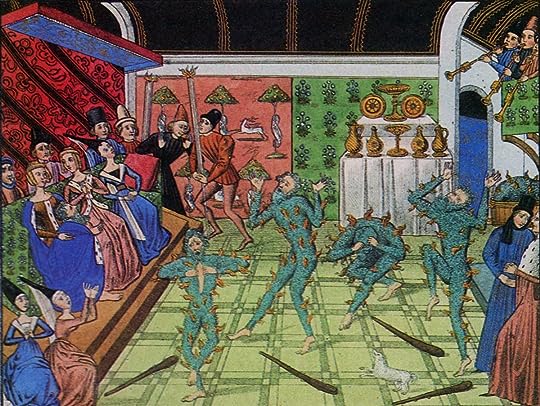
In the annual Feast of Fools at Christmastime, every rite and article of the Church no
matter how sacred was celebrated in mockery. A dominus festi, or lord of the revels, was
elected from the inferior clergy--the cures, subdeacons, vicars, and choir clerks, mostly
ill-educated, ill-paid, and ill-disciplined--whose day it was to turn everything
topsy
turvy. They installed their lord as Pope or Bishop or Abbot of Fools in a ceremony of
head-shaving accompanied by bawdy talk and lewd acts; dressed him in vestments turned
inside out; played dice on the altar and ate black puddings and sausages while mass was
celebrated in nonsensical gibberish; swung censers made of old shoes emitting 'stinking
smoke"; officiated in the various offices of the priest wearing beast masks and
dressed as
women or minstrels; sang obscene songs in the choir; howled and hooted and jangled
bells while the "Pope" recited a doggerel benediction. At his call to follow him on pain of
having their breeches split, all rush violently from the church to parade through the town,
drawing the dominus in a cart from which he issues mock indulgences while
his
followers hiss, cackle, jeer, and gesticulate. They rouse the bystanders to laughter with
"infamous performances" and parody preachers in scurrilous sermons. Naked men haul
carts of manure which they throw at the populace. Drinking bouts and dances accompany
the procession. The whole was a burlesque of the too-familiar, tedious, annd often
meaningless rituals; a release of “the natural lout beneath the cassock."
In daily life the Church was comforter, protector, physician. The Virgin and patron saints
gave succor in trouble and protection against the evils and enemies that lurked along
every man’s path. Craft guilds, towns, and functions had patron saints, as did individuals.
Archers and crossbowmen had St. Sebastian, martyr of the arrows; bakers had St.
Honore, whose banner bore an oven shovel argent and three loaves gules; sailors had St.
Nicholas with the three children he saved from the sea; travelers had St. Christopher
carrying the infant Jesus on his shoulder; charitable brotherhoods usually chose St.
Martin, who gave half his cloak to the poor man; unmarried girls had St. Catherine,
supposed to have been very beautiful. The patron saint was an extra companion through
life who healed hurts, soothed distress, and in extremity could make miracles. His image
was carried on banners in processions, sculpted over the entrance to town halls and
chapels, and worn as a medallion on an individual’s hat.
Above all, the Virgin was the ever-merciful, ever-dependable source of comfort, full
of
compassion for human frailty, caring nothing for laws and judges, ready to respond to
anyone in trouble; amid all the inequities, injuries, and senseless harms, the one never
failing figure. She frees the prisoner from his dungeon, revives the starving with milk
from her own breasts. When a peasant mother takes her son, blinded by a thorn in his eye,
to the Church of St. Denis, kneels before Our Lady, recites an Ave Maria,
and makes the
sign of the cross over the child with a sacred relic, the nail of the Saviour, "at once,"
reports the chronicler, "the thorn falls out, the inflammation disappears, and the mother in
joy returns home with her son no longer blind."
A hardened murderer has no less access. No matter what crime a person has committed,
though every man’s hand be against him, he is still not cut off from the
Virgin. In the
Miracles of Notre Dame, a cycle of popular plays performed in the towns, the Virgin
redeems every kind of malefactor who reaches out to her through the act of repentance. A
woman accused of incest with her son-in-law has procured his assassination by two hired
men and is about to be burned at the stake. She prays to Notre Dame, who promptly
appears and orders the fire not to burn. Convinced of a miracle, the magistrates free the
condemned woman, who, after distributing her goods and money to the poor, enters a
convent. The act of faith through prayer was what counted. It was not justice one
received from the Church but forgiveness.
More than comfort, the Church gave answers. For nearly a thousand years it had been the
central institution that gave meaning and purpose to life in a capricious world. It affirmed
that man’s life on earth was but a passage in exile on the way to God and to the New
Jerusalem, "our other home." Life was nothing, wrote Petrarch to his brother, but "a hard
and weary journey toward the eternal home for which we look; or, if we neglect our
salvation, an equally pleasureless way to eternal death." What the Church offered was
salvation, which could be reached only through the rituals of the established Church and
by the permission and aid of its ordained priests. "Extra ecclesiam nulla salus" (No
salvation outside the Church) was the rule.
Salvation’s alternative was Hell and eternal torture, very realistically pictured in the art
of the time. In Hell the damned hung by their tongues from trees of fire, the impenitent
burned in furnaces, unbelievers smothered in foul-smelling smoke. The wicked fell into
the black waters of an abyss and sank to a depth proportionate to their sins: fornicators up
to the nostrils, persecutors of their fellow man up to the eyebrows. Some were swallowed
by monstrous fish, some gnawed by demons, tormented by serpents, by fire or ice or
fruits hanging forever out of reach of the starving. In Hell men were naked, nameless, and
forgotten. No wonder salvation was important and the Day of Judgment present in every
mind. Over the doorway of every cathedral it was carved in vivid reminder, showing the
numerous sinners roped and led off by devils toward a flaming cauldron while angels led
the fewer elect to bliss in the opposite direction.
No one doubted in the Middle Ages that the vast majority would be eternally damned.
Salvandorum paucitas, damnandorum multitude (Few saved, many damned) was the stern
principle maintained from Augustine to Aquinas. Noah and his family were taken to
indicate the proportion of the saved, usually estimated at one in a thousand or even one in
ten thousand. No matter how few were to be chosen, the Church offered hope to all.
Salvation was permanently closed to non-believers in Christ, but not to sinners, for sin
was an inherent condition of life which could be canceled as often as necessary by
penitence and absolution. "Turn thee again, turn thee again, thou sinful soul," spoke
a
Lollard preacher, "for God knoweth thy misgovernance and will not forsake thee. Turn
thou to me saith the Lord and I shall receive thee and take thee to grace."
The Church gave ceremony and dignity to lives that had little of either. It was the source
of beauty and art to which all had some access and which many helped to
create. To
carve the stone folds of an apostle’s gown, to paste with infinite patience the bright
mosaic chips into a picture of winged angels in a heavenly chorus, to stand in the
towering space of a cathedral nave amid pillars rising and rising to an almost invisible
vault and know this to be man’s work in honor of God, gave pride to the lowest and could
make the least man an artist.
The Church, not the government, sponsored the care of society’s helpless--the
indigent
and sick, orphan and cripple, the leper, the blind, the idiot--by indoctrinating
the laity in
the belief that alms bought them merit and a foothold in Heaven. Based on this principle,
the impulse of Christian charity was self-serving but effective. Nobles gave alms daily at
the castle gate to all comers, in coin and in leftover food from the hall. Donations from all
sources poured into the hospitals, favorite recipients of Christian charity.
Merchants
bought themselves peace of mind for the non-Christian business of making
profit by
allocating a regular percentage to charity. This was entered in the ledger under the name
of God as the poor’s representative. A Christian duty of particular merit was the donation
of dowries to enable poor girls to marry, as in the case of a Gascon seigneur of the 14th
century who left 100 livres to "those whom I deflowered, if they can be found."
Corporate bodies accepted the obligation to help the poor as a religious duty. The statutes
of craft guilds set aside a penny for charity, called "God’s penny," from each contract of
sale or purchase. Parish councils of laymen superintended maintenance of the "Table of
the Poor" and of a bank for alms. On feast days it was a common practice to invite twelve
poor to the banquet table, and on Holy Thursday, in memory of Christ, the mayor of a
town or other notable would wash the feet of a beggar. When St. Louis conducted the
ceremony, his companion and biographer, the Sire de Joinville, refused to participate,
saying it would make him sick to touch the feet of such villeins. It was not always easy to
love the poor.
The clergy on the whole were probably no more lecherous or greedy or untrustworthy
than other men, but because they were supposed to be better or nearer to God than other
men, their failings attracted more attention. If Clement VI was luxury-loving, he was also
generous and warm-hearted. The Parson among the Canterbury pilgrams is as benign and
admirable as the Pardoner is repulsive, always ready to visit on foot the farthest and
poorest house of his parish, undeterred by thunder and rain.
To drawen folk to heaven with fairnesse.
By good ensample was his businesse.
Nevertheless, a wind of discontent was rising. Papal tax-collectors were attacked and
beaten, and even bishops were not safe. In 1326, in a burst of anti-clericalism, a London
mob beheaded the Bishop and left his body naked in the street. In 1338 two "rectors of
churches" joined two knights and a "great crowd of country folk" in attacking the Bishop
of Constance, severely wounding several of his retinue, and holding him in prison.
Among the religious themselves, the discontent took serious form. In Italy arose the
Fraticelli, a sect of the Franciscan Order, in another of the poverty-embracing movements
that periodically tormented the Church by wanting to disendow it. The Fraticelli or
Spiritual Franciscans insisted that Christ had lived without possessions, and they
preached a return to that condition as the only true "imitation of
Christ."
The poverty movements grew out of the essence of Christian doctrine: renunciation of the
material world--the idea that made the great break with the classical age.
It maintained
that God was positive and life on earth negative, that the world was incurably bad and
holiness achieved only through renunciation of earthly pleasures, goods, and honors. To
gain victory over the flesh was the purpose of fasting and celibacy, which denied the
pleasures of this world for the sake of reward in the next. Money was evil, beauty vain,
and both were transitory. Ambition was pride, desire for gain was avarice, desire of the
flesh was lust, desire for honor, even for knowledge and beauty, was vainglory. Insofar as
these diverted man from seeking the life of the spirit, they were sinful. The Christian
ideal was ascetic: the denial of sensual man. The result was that, under the sway of the
Church, life became a continual struggle against the senses and a continual engagement
in sin, accounting for the persistent need for absolution.
Repeatedly, mystical sects arose in an effort to sweep away the whole detritus
of the
material world, to become nearer to God by cutting the earth-binding chains of property.
Embedded in its lands and buildings, the Church could only react by denouncing the sects
as heretical. The Fraticelli’s stubborn insistence on the absolute poverty of Christ
and his
twelve Apostles was acutely inconvenient for the Avignon papacy, which condemned
their doctrine as "false and pernicious" heresy in 1315 and, when they refused to desist,
excommunicated them and other associated sects at various times during the next decade.
Twenty-seven members of a particularly stubborn group of Spiritual Franciscans of
Provence were tried by the Inquisition and four of them burned at the stake at Marseille
in 1318.
The wind of temporal challenge to papal supremacy was rising too, focusing on the
Pope’s right to crown the Emperor, and setting the claims of the state against those of the
Church. The Pope tried to excommunicate this temporal spirit in the person of its boldest
exponent, Marsilius of Padua, whose Defensor Pads in 1324 was a forthright assertion of
the supremacy of the state. Two years later the logic of the struggle led John XXII to
excommunicate William of Ockham, the English Franciscan, known for his forceful
reasoning as "the invincible doctor. " In expounding a philosophy called "nominalism,"
Ockham opened a dangerous door to direct intuitive knowledge of the physical world. He
was in a sense a spokesman for intellectual freedom, and the Pope recognized the
implications by his ban.
In economic man, the lay spirit did not challenge the Church, yet functioned in essential
contradiction. Capitalist enterprise, although it held by now a commanding place,
violated by its very nature the Christian attitude toward commerce, which was one of
active antagonism. It held that money was evil, that according to St. Augustine “Business
is in itself an evil,” that profit beyond a minimum necessary to support the dealer was
avarice, that to make money out of money by charging interest on a loan was the sin of
usury, that buying goods wholesale and selling them unchanged at a higher retail
price
was immoral and condemned by canon law, that, in short, St. Jerome’s dictum was final:
“A man who is a merchant can seldom if ever please God” (Homo mercator vix aut
numquam potest Deo placere).
It followed that banker, merchant, and businessman lived in daily commission of sin and
daily contradiction of the moral code centering upon the “just price.” This was based on
the principle that a craft should supply each man a livelihood and a fair return to all, but
no more. Prices should be set at a “just” level, meaning the value of the labor added to the
value of the raw material. To ensure that no one gained an advantage over anyone else,
commercial law prohibited innovation in tools or techniques, underselling below a fixed
price, working late by artificial light, employing extra apprentices or wife and under-age
children, and advertising of wares or praising them to the detriment of others. As restraint
of initiative, this was the direct opposite of capitalist enterprise. It was the denial of
economic man, and consequently even more routinely violated than the denial of sensual
man.
No economic activity was more irrepressible than the investment and lending at interest
of money; it was the basis for the rise of Western capitalist economy and the building of
private fortunes--and it was based on the sin of usury. Nothing so vexed
medieval
thinking, nothing so baffled and eluded settlement, nothing was so great a tangle of
irreconcilables as the theory of usury. Society needed money lending while Christian
doctrine forbade it. That was the basic dichotomy, but the doctrine was so elastic that
“even wise men” were unsure of its provisions. For practical purposes, usury was
considered to be not the charging of interest per se, but charging at a higher rate than was
decent. This was left to the Jews as the necessary dirty work of society, and if they had
not been available they would have had to be invented. While theologians and canonists
argued endlessly and tried vainly to decide whether 10, 12.5, 15, or 20 percent was
decent, the bankers went on lending and investing at whatever rates the situation
would
bear.
Merchants regularly paid fines for breaking every law that concerned their business, and
went on as before. The wealth of Venice and Genoa was made in trade with the infidels
of Syria and Egypt despite papal prohibition. Prior to the 14th century, it has been said,
men “could hardly imagine the merchant’s strongbox without picturing the devil
squatting on the lid.” Whether the merchant too saw the devil as he counted coins,
whether he lived with a sense of guilt, is hard to assess. Francisco Datini, the merchant of
Prato, judging by his letters, was a deeply troubled man, but his agonies were caused
more by fear of loss than by fear of God. He was evidently able to reconcile Christianity
and business, for the motto on his ledger was “In the name of God and of profit.”
Division of rich and poor became increasingly sharp. With control of the raw materials
and tools of production, the owners were able to reduce wages in classic exploitation. The
poor saw them now as enemies, no longer as protectors but as exploiters, as Dives, the
rich man consigned to hellfire, as wolves, and themselves as lambs. They felt a sense of
injustice that finding no remedy grew into a spirit of revolt.
Medieval theory intended that the lord or ruler should respond to charges of oppression
by investigating and ordering the necessary reform to ensure that taxes fell equally on
rich and poor. But this theory corresponded to reality no more than other medieval ideals,
and because of this, wrote Philippe de Beaumanoir in 1280-83, “there have been acts of
violence because the poor will not suffer this but know not how to obtain their right
except by rising and seizing it themselves.” They formed associations, he reported, to
refuse to work for “so low a price as formerly but they will raise the price by their own
authority” and take “certain pains and punishments” against those who do not join them.
This seemed to Beaumanoir a terrible act against the common good, “for the common
interest cannot suffer that work should stop.” He advocated that such persons should be
arrested and kept long in prison and afterward fined 60 sous each, the traditional fine for
rupture of the “public peace.”
The most persistent ferment was among the weavers and cloth-workers of Flanders,
where economic expansion had been most intense. The textile industry was the
automobile industry of the Middle Ages, and Flanders was a hothouse of the tensions and
antagonisms brewed in urban society by capitalist development.
Once united by a common craft, the guild of masters, journeymen, and apprentices had
spread apart into entrepreneurs and hired hands divided by class hatred. The guild was
now a corporation run by the employers in which the workers had no voice. The
magnates, who married into the nobility and bought country estates in addition to their
city real estate, developed into a patrician class that controlled the government of the
towns and managed it in their own interest. They founded churches and hospitals, built
the great Cloth Halls, paved the streets, and created the canal system. But they made up
the greater part of municipal expenses from sales taxes on wine, beer, peat, and grain,
which fell most heavily on the poor. They favored each other in governing groups like the
Thirty-nine of Ghent, named for life and serving in annual rotation of three parties of
thirteen, or the twelve magistrates of Arras, who rotated among themselves every four
months, or the oligarchy of the Hundred Peers of Rouen, which appointed the mayor and
town councilors each year. The lower bourgeois who made fortunes and pressed upward
could frequently penetrate the monopoly, but the artisans, despised as “blue nails” and
vulnerable to unemployment, had no political rights.
Chapter 3
Youth and Chivalry
What was the mental furniture of Enguerrand's class, the upper level of
lay society? Long
before Columbus, they knew the world was a globe, a knowledge proceeding from
familiarity with the movement of the stars, which could be made comprehensible only in
terms of a spherical earth. In a vivid image, it was said by the cleric Gautier de Metz in
his Image du Monde, the most widely read encyclopedia of the time, that a man could go
around the world as a fly makes the tour of an apple. So far was the earth from the stars,
according to him, that if a stone were dropped from there it would take more than 100
years to reach our globe, while a man traveling 25 leagues a day without stopping would
take 7,157Ѕ years to reach the stars.
Visually, people pictured the universe held in God's arms with man at its center. It was
understood that the moon was the nearest planet, with no light of its own; that an eclipse
was the passage of the moon between the earth and the sun; that rain was moisture drawn
by the sun from the earth which condensed into clouds and fell back as
rain; that the
shorter the time between thunder and lightning, the nearer the source.
Faraway lands, however—India, Persia, and beyond—were seen through a gauze of
fabulous fairy tales revealing an occasional nugget of reality: forests so high they touch
the clouds, horned pygmies who move in herds and grow old in seven years, brahmins
who kill themselves on funeral pyres, men with dogs' heads and six toes, "cyclopeans"
with only one eye and one foot who move as fast as the wind, the "monoceros" which can
be caught only when it sleeps in the lap of a virgin, Amazons whose tears are of silver,
panthers who practice the caesarean operation with their own claws, trees whose leaves
supply wool, snakes 300 feet long, snakes with precious stones for eyes, snakes who so
love music that for prudence they stop up one ear with their tail.
The Garden of Eden too had an earthly existence which often appeared on maps, located
far to the east, where it was believed cut off from the rest of the world by a great
mountain or ocean barrier or fiery wall. In the earthly Paradise grow every kind of
tree and flowers of surpassing colors and a thousand scents which never fade and have
healing qualities. Birds' songs harmonize with the rustling of forest leaves and the
rippling of streams flowing over jeweled rocks or over sands brighter than silver. A
palace with columns of crystal and jasper sheds marvelous light. No wind or rain, heat or
cold mars Paradise; no sickness, decay, death, or sorrow enters there. The mountain peak
on which it is situated is so high it touches the sphere of the moon—but here the
scientific mind intervened: that would be impossible, pronounced the 14th century author
of Polychronicon, because it would cause an eclipse.
For all the explanations, the earth and its phenomena were full of mysteries: What
happens to fire when it goes out? Why are there different colors of skin among men?
Why do the sun's rays darken a man's skin but bleach white linen? How can the earth,
which is weighty, be suspended in air? How do souls make their way to the next world?
Where lies the soul? What causes madness? Medieval people felt surrounded by puzzles,
yet because God was there they were willing to acknowledge that causes are hidden, that
man cannot know why all things are as they are; "they are as God pleases."
That did not silence the one unending question: Why does God allow evil, illness, and
poverty? Why did He not make man incapable of sin? Why did He not assure him of
Paradise? The answer, never wholly satisfying, was that God owed the Devil his scope.
According to St. Augustine, the fount of authority, all men were under the Devil's power
by virtue of original sin; hence the necessity of the Church and salvation.
Questions of human behavior found answers in the book of Sidrach, supposedly a
descendant of Noah to whom God gave the gift of universal knowledge, eventually
compiled into a book by several masters of Toledo. What language does a deaf-mute hear
in his heart? Answer: that of Adam, namely Hebrew. Which is worst: murder, robbery, or
assault? None of these; sodomy is the worst. Will wars ever end? Never, until the earth
becomes Paradise. The origin of war, according to its 14th century codifier Honore
Bonet, lay in Lucifer's war against God, "hence it is no great marvel if in this world
there arise wars and battles since these existed first in heaven."
Education, so far as it would have reached Enguerrand, was based on the seven "liberal
arts": Grammar, the foundation of science; Logic, which differentiates the true from the
false; Rhetoric, the source of law; Arithmetic, the foundation of order because "without
numbers there is nothing"; Geometry, the science of measurement; Astronomy, the most
noble of the sciences because it is connected with Divinity and Theology; and lastly
Music. Medicine, though not one of the liberal arts, was analogous to Music because
its
object was the harmony of the human body.
History was finite and contained within comprehensible limits. It began with the Creation
and was scheduled to end in a not indefinitely remote future with the Second Coming,
which was the hope of afflicted mankind, followed by the Day of Judgment. Within that
span, man was not subject to social or moral progress because his goal was the
next
world, not betterment in this. In this world he was assigned to ceaseless struggle against
himself in which he might attain individual progress and even victory, but collective
betterment would only come in the final union with God.
The average layman acquired knowledge mainly by ear, through public sermons, mystery
plays, and the recital of narrative poems, ballads, and tales, but during Enguerrand's
lifetime, reading by educated nobles and upper bourgeois increased with the increased
availability of manuscripts. Books of universal knowledge, mostly dating from the 13th
century and written in (or translated from the Latin into) French and other vernaculars for
the use of the layman, were literary staples familiar in every country over several
centuries. A 14th century man drew also on the Bible, romances, bestiaries, satires,
books, of astronomy, geography, universal history, church history, rhetoric, law,
medicine, alchemy, falconry, hunting, fighting, music, and any number of special
subjects. Allegory was the guiding concept. Every incident in the Old Testament was
considered to pre-figure in allegory what was to come in the New. Everything in nature
concealed an allegorical meaning relating to some aspect of Christian doctrine.
Allegorical figures— Greed, Reason, Courtesy, Love, False Seeming, Do Well, Fair
Welcome, Evil Rumor— peopled the tales and political treatises.
Epics of great heroes, of Brutus and King Arthur, of the 'strong stryfe" of Greece and
Troy, of Alexander and Julius Caesar, of how Charlemagne and Roland fought the
Saracens and how Tristan and Iseult loved and sinned, were the favorites of noble
households, though not to the exclusion of coarser stuff. The fabliaux or tales of common
life, bawdy and scatological, were told in noble halls as well as taverns. The Menagier of
Paris, a wealthy bourgeois contemporary of Enguerrand VII, who at the age of sixty in
1392 wrote a book of domestic and moral instruction for his young wife, had read or
possessed the Bible, The Golden Legend, St. Jerome's Lives of the Fathers, the works of
St. Augustine, St. Gregory, Livy, Cicero, the Roman de la Rose, Petrarch's Tale of
Griselda, and other less familiar titles. The Chevalier Geoffroy de La Tour Landry, a
slightly older contemporary of Enguerrand, who in 1371 wrote a book of cautionary tales
for his daughters, was as well acquainted with Sarah, Bathsheba, and Delilah as with
Helen of Troy, Hippolyta, and Dido. If the Menagier was too respectable to read Ovid,
the Roman poet was well known to others. Aristotle was the basis of political philosophy,
Ptolemy of "natural" philosophy, Hippocrates and Galen of medicine.
Contemporary writers rapidly found an audience. In Dante's lifetime his verse was
chanted by blacksmiths and mule-drivers; fifty years later in 1373 the growth of reading
caused the Signoria of Florence, at the petition of citizens, to offer a year's course of
public lectures on Dante's work for which the sum of 100 gold florins was raised to pay
the lecturer, who was to speak every day except holy days. The person appointed was
Boccaccio, who had written the first biography of Dante and copied out the entire Divine
Comedy himself as a gift for Petrarch.
In an Italian biographical dictionary at the end of the century, the longest articles were
given to Julius Caesar and Hannibal, two pages to Dante, one page each to Archimedes,
Aristotle, King Arthur, and Attila the Hun, two and a half columns to Petrarch, one
column to Boccaccio, shorter mentions to Cimabue and Giotto, and three lines to Marco
Polo.
Chapter 4
War
Edward III's first campaign in France, halted by the truce of 1342, had
been inconclusive
and without strategic result except for the naval battle fought off Sluys, the port of
Bruges, in 1340. Here where the mouth of the Scheldt widens among protecting isles to
form a great natural harbor, the French had assembled 200 ships from as far away as
Genoa and the Levant for a projected invasion of England. The outcome of the battle was
an English victory that destroyed the French fleet and for the time being gave England
command of the Channel. It was won by virtue of a military innovation that was to
become the nemesis of France.
This was the longbow, derived from the Welsh and developed under Edward I for use
against the Scots in the highlands. With a range reaching 300 yards and a rapidity, in
skilled hands, of ten to twelve arrows a minute in comparison to the crossbow's two, the
longbow represented a revolutionary delivery of military force. Its arrow was three feet
long, about half the length of the formidable six-foot bow, and at a range of 200 yards it
was not supposed to miss its target. While at extreme range its penetrating power was less
than that of the crossbow, the longbow's fearful hail shattered and demoralized the
enemy. Preparing for the challenge to France, Edward had to make up for the disparity in
numbers by some superiority in weaponry or tactics. In 1337 he had prohibited on pain of
death all sport except archery and canceled the debts of all workmen who manufactured
the bows of yew and their arrows.
Another new weapon, the gun, entered history at this time, but meekly and tentatively
and much less effectively than the longbow. Invented about 1325, the first riband or pot
de fer, as the French called it, was a small iron cannon shaped like a bottle which fired an
iron bolt with a triangular head. When a French raiding force at the opening of the war
sacked and burned Southampton in 1338, it brought along one riband furnished with three
pounds of gunpowder and 48 bolts. In the next year the French manufactured more in the
form of several tubes bound to a wheeled platform, with their touchholes aligned so that
all could be fired at once. But they proved too small to fire a projectile with enough force
to do serious damage. The English reportedly used some small cannon at Crecy without
noticeable effect and definitely had them at the siege of Calais, where they proved
powerless against the city's stone walls. Later, when cast in brass or copper and enlarged
in size, they were useful against bridges and city or castle gates or in defense of these, but
stone walls withstood them for another hundred years. Difficulties in re-loading,
ramming the powder, inserting the projectile, and containing the gas until it built up
enough explosive force, frustrated effective firing throughout the 14th century.
In the sea fight at Sluys, with Edward in personal command, the longbowmen dominated
the English armament, with one ship of men-at-arms placed between every two ships of
archers, plus extra ships of archers for reinforcements if need arose.
Not naval power but
the strength of soldiers and archers on board ship determined sea battle in this era. They
operated from high-decked cogs of 100 to 300 tons fitted with fighting platforms or
"castles" for the archers. The battle was "fierce and terrible," reports Froissart, "for
battles on sea are more dangerous and fiercer than battles by land, for on the sea there is
no recoiling or fleeing." Under the archers" attack the French were driven from their
decks and, pursued by ill-luck and error, were engulfed in defeat."
No one dared tell the outcome of the battle to Philip VI until his jester was thrust forward
and said, "Oh, the cowardly English, the cowardly English!" and on being asked why,
replied, "They did not jump overboard like our brave Frenchmen." The King evidently
got the point. The fish drank so much French blood, it was said afterward, that if God
had
given them the power of speech they would have spoken in French.
The English victory led nowhere at the moment because Edward could not deliver
sufficient force on land. His various allies from the Low Countries, acquired at great
expense in subsidies, were slipping away, having no basic interest in his goal. Even his
father-in-law, Count William of Hainault, returned to a more natural attachment to
France. With his own forces inadequate and his finances bankrupt, Edward was forced to
accept the Pope's offer to arrange a truce. He withdrew, but only pour mieux sauter.
What was he really fighting for? What was the real cause of a war that was to stretch
beyond imagining halfway into the next century? As in most wars, the cause was a
mixture of the political, economic, and psychological. Edward wanted to obtain the
ultimate sovereignty of Guienne and Gascony, that lower western corner of France
remaining from the Duchy of Aquitaine which the marriage of Eleanor of Aquitaine had
brought to his ancestor Henry II five generations before. The King of France still retained
superior sovereignty under the formula of superioritas et resortum, which gave the
inhabitants the right of appeal to the ultimate sovereign. Since his decisions were more
than likely to go in their favor against their English overlord, and since the citizens,
knowing this, exercised the right frequently, the situation was an endless source of
conflict. To the English superioritas et resortum was politically and psychologically
intolerable.
The situation was the more galling because of Guienne's importance to the English
economy. With its fertile valleys, long coast, and network of navigable rivers all leading
to the main port of Bordeaux, it was the greatest wine exporting region in the world.
England imported the wine and other products and sent back wool and cloth, taking on
every transaction a handsome revenue from export taxes at Bordeaux and import taxes at
English ports. Between Bordeaux and Flanders the same flourishing commerce was
exchanged, arousing the envy of central France. To the French monarchy the English
foothold within the realm was unacceptable. Every French king for 200 years had tried by
war, confiscation, or treaty to regain Aquitaine. The quarrel was old and deep and bound
for war as the sparks fly upward.
When Edward launched his claim to be the rightful King of France, it is uncertain how
seriously he took it, but as a device it was of incomparable value in giving him the
appearance of a righteous cause. While desirable in any epoch, a "just war" in the 14th
century was virtually a legal necessity as the basis for requisitioning feudal aids in men
and money. It was equally essential for securing God on one's side, for
war was
considered fundamentally an appeal to the arbitrament of God. A "just war" had to be one
of public policy declared by the sovereign, and it had to be in a "just" cause—that is,
directed against some "injustice" in the form of crime or fault on the part of the enemy.
As formulated by the inescapable Thomas Aquinas, it required a third criterion: right
intention on the part of the participants, but how this could be tested, the great expounder
did not say. Even more convenient than the help of God was the "right of spoil"—in
practice, pillage—that accompanied a just war. It rested on the theory that the enemy,
being "unjust," had no right to property, and that booty was the due reward for risk of life
in a just cause.
The claim to the French crown gave an excuse of legality to any vassal of France whom
Edward could recruit as an ally. If he, not Philip, were the rightful King of France, a
vassal could transfer his homage on the grounds that it had simply been misplaced.
Allegiance in the 14th century was still given to a person, not a nation, and the great
territorial lords of duchies and counties felt themselves free to make alliances as if almost
autonomous. The Harcourts of Normandy and the Duke and other lords of Brittany, for
various reasons, did just that. Edward's claim through his mother gave him the one thing
that made his venture feasible—support within France and a friendly beachhead. He
never had to fight his way in. In either Normandy or Brittany this situation was to last
forty years, and at Calais, captured after the Battle of Crecy, it was to outlast the Middle
Ages.
In Brittany the war centered upon the relentless feud between two rival claimants to the
dukedom and two parties of the population, one supported by France and the other by
England. As a result, France was perpetually endangered by the access given to the
enemy. The Breton seacoast was open to English ships, English garrisons were on
Breton
soil, Breton nobles were openly allied to Edward. Brittany was France's Scotland,
choleric, Celtic, stony, bred to opposition and resistance, and ready to use the English in
its struggles against its overlord as the Scots used the French in theirs. Along its
rockbound coast, in Michelet's words, "two enemies, earth and sea, man and nature, meet
in eternal conflict." Storms throw up monstrous waves, fifty, sixty, eighty feet, whose
foam flies as high as the church steeple. "Nature is atrocious here; so is man; they seem
to understand each other."